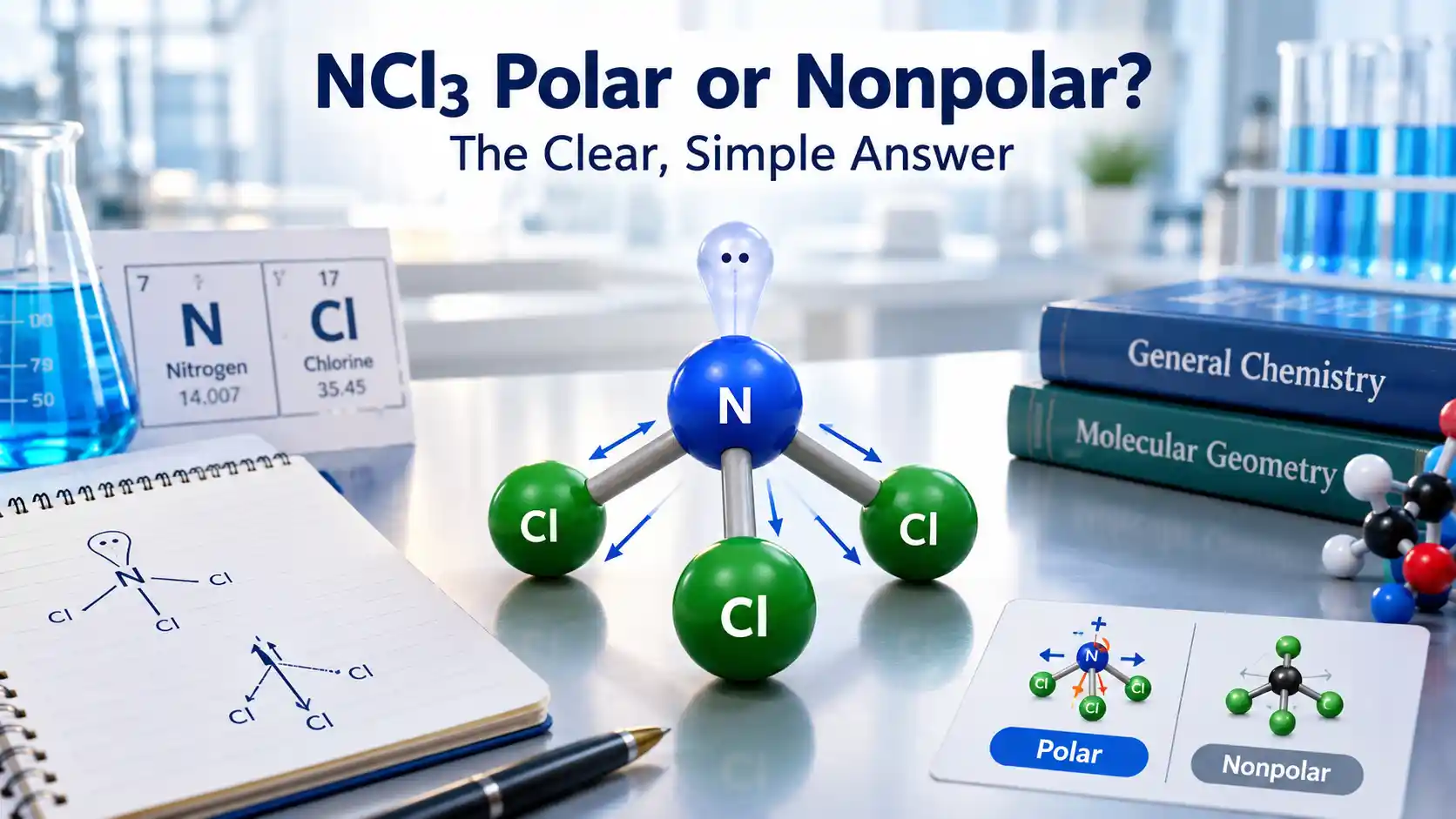
You saw “NCl3” in a chemistry problem. Now you need to know: is it polar or nonpolar? This question trips up a lot of students. NCl3, or nitrogen trichloride, looks simple. But its shape and its atoms confuse people.
Here is why people search this term. Some mix up NCl3 with NH3. Others assume all “N-something-3” molecules act the same way. Many just want a fast, correct answer before a test or homework deadline.
The confusion usually comes from one fact: chlorine is very electronegative. People assume that makes every N-Cl molecule strongly polar, like NH3. That assumption is wrong. NCl3 is polar, but only weakly. The reason is subtle, and this article explains it step by step.
By the end, you will know the answer, the reason behind it, how NCl3 compares to similar molecules, and where you might see this molecule mentioned in real life. No jargon walls. Just clear, simple chemistry.
NCl3 Polar or Nonpolar – Quick Answer
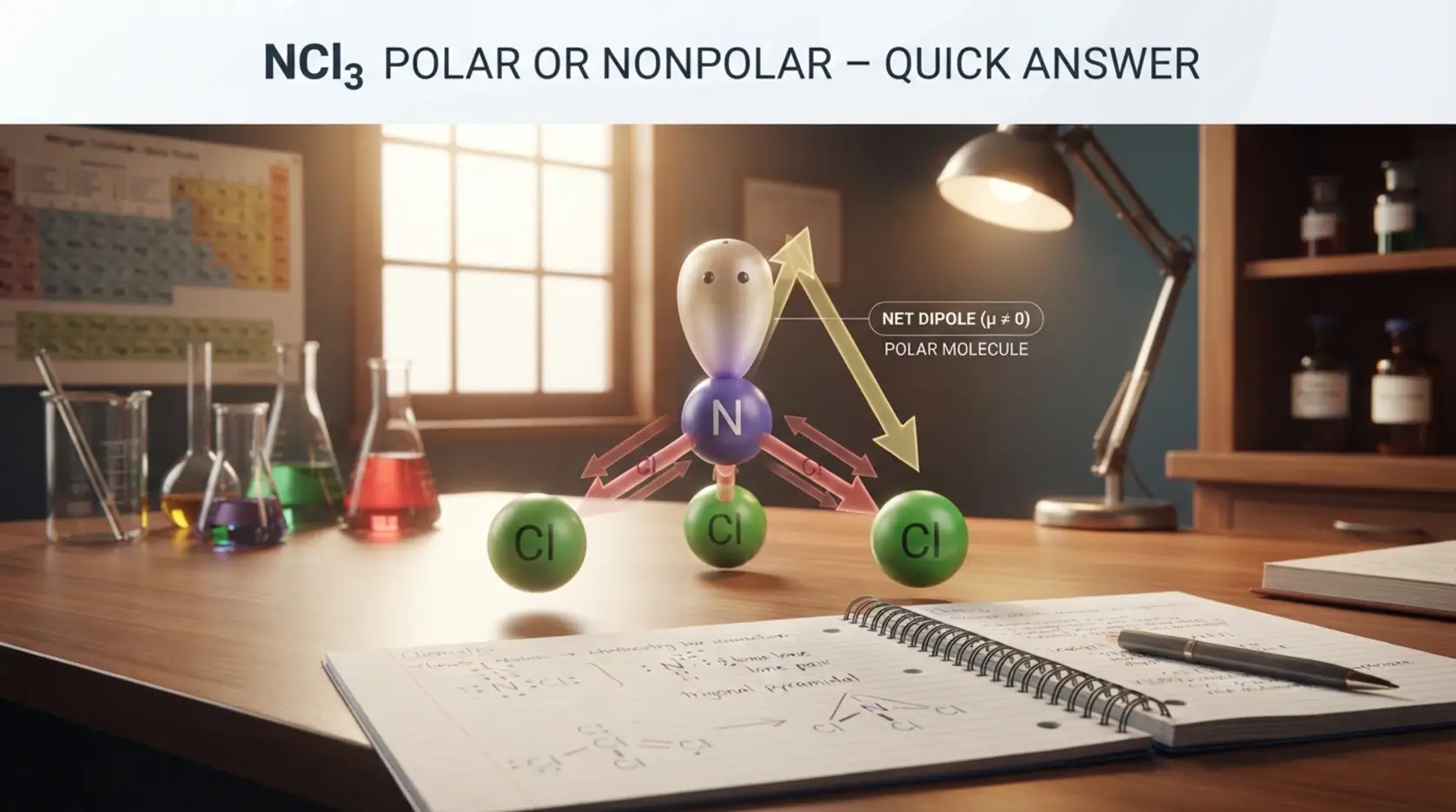
NCl3 is polar, but weakly polar.
Here is why in three short points:
- Nitrogen sits at the center. Three chlorine atoms bond to it. One lone pair of electrons sits on nitrogen too.
- This gives NCl3 a trigonal pyramidal shape. The shape is not symmetric.
- Because the shape is not symmetric, the small pulls between atoms do not cancel out. A small net dipole remains.
Compare this to CCl4 (carbon tetrachloride). CCl4 is symmetric. Its bond pulls cancel completely. CCl4 is nonpolar. NCl3 does not have that symmetry, so it stays polar.
Molecular Structure: Why NCl3 Has Its Shape
Nitrogen has five outer electrons. Three of them bond with three chlorine atoms. The fifth pair stays on nitrogen as a lone pair.
This setup matches NH3 (ammonia). Both molecules have one central atom, three bonds, and one lone pair. Both take a pyramid shape, not a flat triangle.
The lone pair matters. It pushes the three N-Cl bonds slightly closer together. It also breaks any chance of symmetry. A molecule needs symmetry to cancel out its internal pulls. NCl3 does not have it.
This shape explains why NCl3 cannot be nonpolar, no matter what the atoms are made of.
Electronegativity: The Real Reason NCl3 Is Only Weakly Polar
This part surprises most students.
Nitrogen’s electronegativity: 3.04 Chlorine’s electronegativity: 3.16
Chlorine pulls slightly harder on the shared electrons than nitrogen does. So each N-Cl bond has a small dipole, pointing from nitrogen toward chlorine.
Now compare this to NH3. Hydrogen’s electronegativity is 2.20, far lower than nitrogen’s. In NH3, the bond dipoles point away from hydrogen, toward nitrogen. That direction matches the lone pair’s direction. The two effects add together. This gives NH3 a strong dipole moment (about 1.47 D).
In NCl3, the bond dipoles point toward chlorine, away from nitrogen. That direction is opposite to the lone pair. The two effects partly cancel each other. The result is a small net dipole moment, about 0.6 D.
So NCl3 is polar, but weakly. The lone pair and the bond dipoles pull in almost opposite directions, and most of the pull cancels out.
| Feature | NCl3 | NH3 |
| Shape | Trigonal pyramidal | Trigonal pyramidal |
| Central atom electronegativity | 3.04 (N) | 3.04 (N) |
| Outer atom electronegativity | 3.16 (Cl) | 2.20 (H) |
| Bond dipole direction | Toward Cl | Toward N |
| Lone pair vs bond dipole | Opposing, partial cancel | Same direction, add up |
| Net dipole moment | ~0.6 D (weak) | ~1.47 D (strong) |
| Polar or nonpolar | Polar (weak) | Polar (strong) |
How to Determine If NCl3 Is Polar: A Simple Method
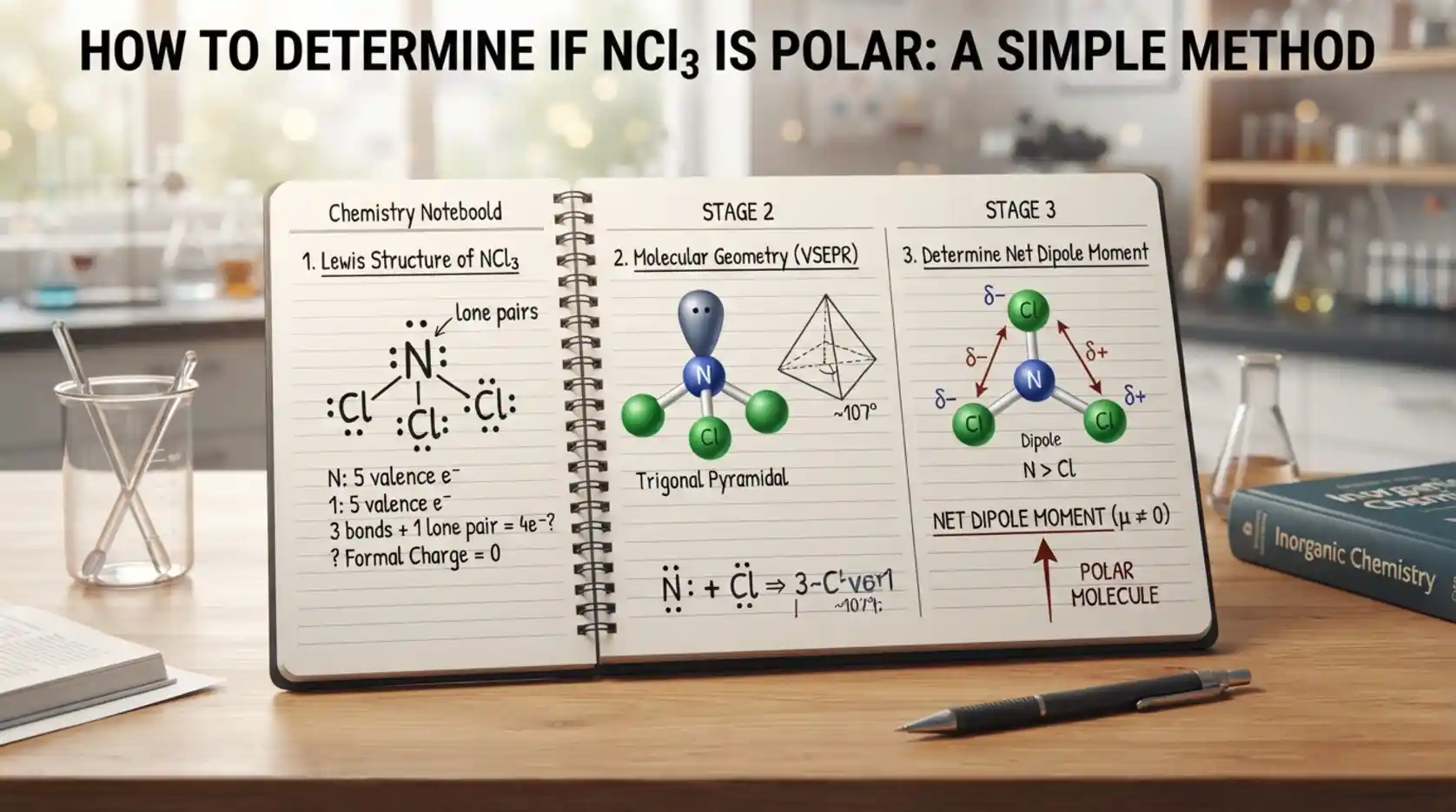
Use this three-step check for any molecule, not just NCl3.
- Draw the Lewis structure. Count bonds and lone pairs on the central atom.
- Find the shape. Use VSEPR rules. A central atom with three bonds and one lone pair gives a trigonal pyramidal shape.
- Check for symmetry. If the shape is symmetric and all outer atoms are identical, the dipoles cancel, and the molecule is nonpolar. If the shape is not symmetric, or a lone pair breaks the balance, the molecule is polar.
For NCl3: three bonds, one lone pair, pyramidal shape, no symmetry. Result: polar.
Common Mistakes with NCl3 Polarity
Mistake 1: Assuming all N-Cl bonds make a molecule strongly polar. Correction: Bond polarity and molecule polarity are different things. You must also check the shape.
Mistake 2: Confusing NCl3 with NH3 and assuming equal dipole strength. Correction: NCl3’s dipole moment is far smaller than NH3’s, because chlorine’s electronegativity direction opposes the lone pair.
Mistake 3: Ignoring the lone pair. Correction: The lone pair on nitrogen breaks the symmetry. Skipping this step leads to the wrong answer.
Mistake 4: Assuming a flat, triangular shape. Correction: NCl3 is trigonal pyramidal, not trigonal planar. The lone pair pushes it into 3D.
Mistake 5: Thinking a small dipole moment means “nonpolar.” Correction: Any nonzero dipole moment makes a molecule polar. Small does not mean zero.
NCl3 in Everyday Contexts
You will not find NCl3 in daily conversation, but it shows up in specific settings:
- Chemistry classrooms and textbooks: NCl3 is a standard example for teaching molecular geometry and dipole moments, often paired with NH3 for comparison.
- Industrial and safety documents: NCl3 is unstable and explosive. Safety data sheets and chemical handling guides mention it as a hazard, notably in water treatment plants where it can form as a byproduct of chlorination.
- Academic papers and lab reports: Researchers reference NCl3 when discussing nitrogen halide chemistry or disinfection byproducts in water.
- Online forums and study platforms: Students post this exact question — “is NCl3 polar or nonpolar” — on homework help sites and chemistry forums, almost always comparing it to NH3 or CCl4.
NCl3 Polar or Nonpolar – Search Trends & Usage Data

This question sees steady search interest tied to school terms. Searches spike during fall and spring semesters, when general chemistry courses cover molecular polarity and VSEPR theory.
Most searches come from students in the US, India, and the Philippines, regions with large numbers of chemistry students using English-language study resources. The phrasing “polar or nonpolar” is far more common in search data than formal terms like “dipole moment of nitrogen trichloride,” showing that most searchers want a quick, plain-language answer rather than a technical deep dive.
Related searches often include “NH3 polar or nonpolar,” “CCl4 polar or nonpolar,” and “BCl3 polar or nonpolar” — a sign that students commonly study these molecules together for comparison.
Comparison Table: NCl3 vs Similar Molecules
| Molecule | Shape | Polar or Nonpolar | Reason |
| NCl3 | Trigonal pyramidal | Polar (weak) | Lone pair opposes bond dipoles; small net dipole |
| NH3 | Trigonal pyramidal | Polar (strong) | Lone pair adds to bond dipoles |
| BCl3 | Trigonal planar | Nonpolar | Symmetric shape, dipoles cancel |
| CCl4 | Tetrahedral | Nonpolar | Symmetric shape, dipoles cancel |
| PCl3 | Trigonal pyramidal | Polar | Similar to NCl3; lone pair breaks symmetry |
| CO2 | Linear | Nonpolar | Symmetric shape, dipoles cancel |
Frequently Asked Questions
Is NCl3 polar or nonpolar? NCl3 is polar. Its trigonal pyramidal shape and lone pair prevent the bond dipoles from canceling out.
Why is NCl3 only weakly polar compared to NH3? Because chlorine is more electronegative than nitrogen, the bond dipoles point away from nitrogen, opposing the lone pair’s dipole. In NH3, the bond dipoles and lone pair point the same way, giving a stronger net dipole.
What is the dipole moment of NCl3? About 0.6 Debye (D), much lower than NH3’s 1.47 D.
What shape does NCl3 have? Trigonal pyramidal, the same general shape as NH3 and PCl3.
Is NCl3 symmetric? No. Its lone pair and pyramidal shape make it asymmetric, which is why it stays polar.
Is NCl3 dangerous? Yes. NCl3 is unstable and can explode under heat, light, or shock. It is handled with caution in industrial and lab settings.
How is NCl3 different from CCl4 in terms of polarity? CCl4 has a symmetric tetrahedral shape with four identical bonds, so its dipoles cancel completely, making it nonpolar. NCl3 has a lone pair and an asymmetric shape, so it stays polar.
Conclusion
NCl3 is polar, though only weakly. The molecule takes a trigonal pyramidal shape because nitrogen holds three bonds and one lone pair. That shape breaks any chance of symmetry, so the small pulls between nitrogen and chlorine do not fully cancel.
The key detail people miss is the electronegativity direction. Chlorine pulls slightly harder than nitrogen, so the bond dipoles point toward chlorine, in the opposite direction of the lone pair. This partial cancellation is why NCl3’s dipole moment (about 0.6 D) is far weaker than NH3’s (about 1.47 D), even though both molecules share the same shape.
To check polarity for any molecule: draw the structure, identify the shape, then check for symmetry. If bonds and lone pairs are unevenly arranged, the molecule is polar, even if the effect is small.
For students, the takeaway is simple: don’t judge polarity by atoms alone. Shape and lone pairs decide the final answer.