You just finished college. Now you need to add it to your résumé. Do you write “bachelor’s degree” or “bachelors degree”? You stop and stare at the screen. You are not alone.
Every year, many people search for “bachelor’s or bachelors” to get this right. The two words look almost the same. But one tiny mark changes everything.
People search for this because spelling mistakes look bad. A wrong spelling on a job application, a LinkedIn profile, or a school essay can hurt your image. Many people also wonder if the US and the UK spell it differently.
This guide clears up the confusion. First, you get a quick answer. Then you learn where the word came from and how to use it. You will also see common mistakes, real examples, a simple table, and answers to common questions.
By the end, you will never doubt this spelling again. Let’s begin.
Bachelor’s or Bachelors – Quick Answer
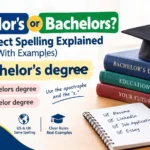
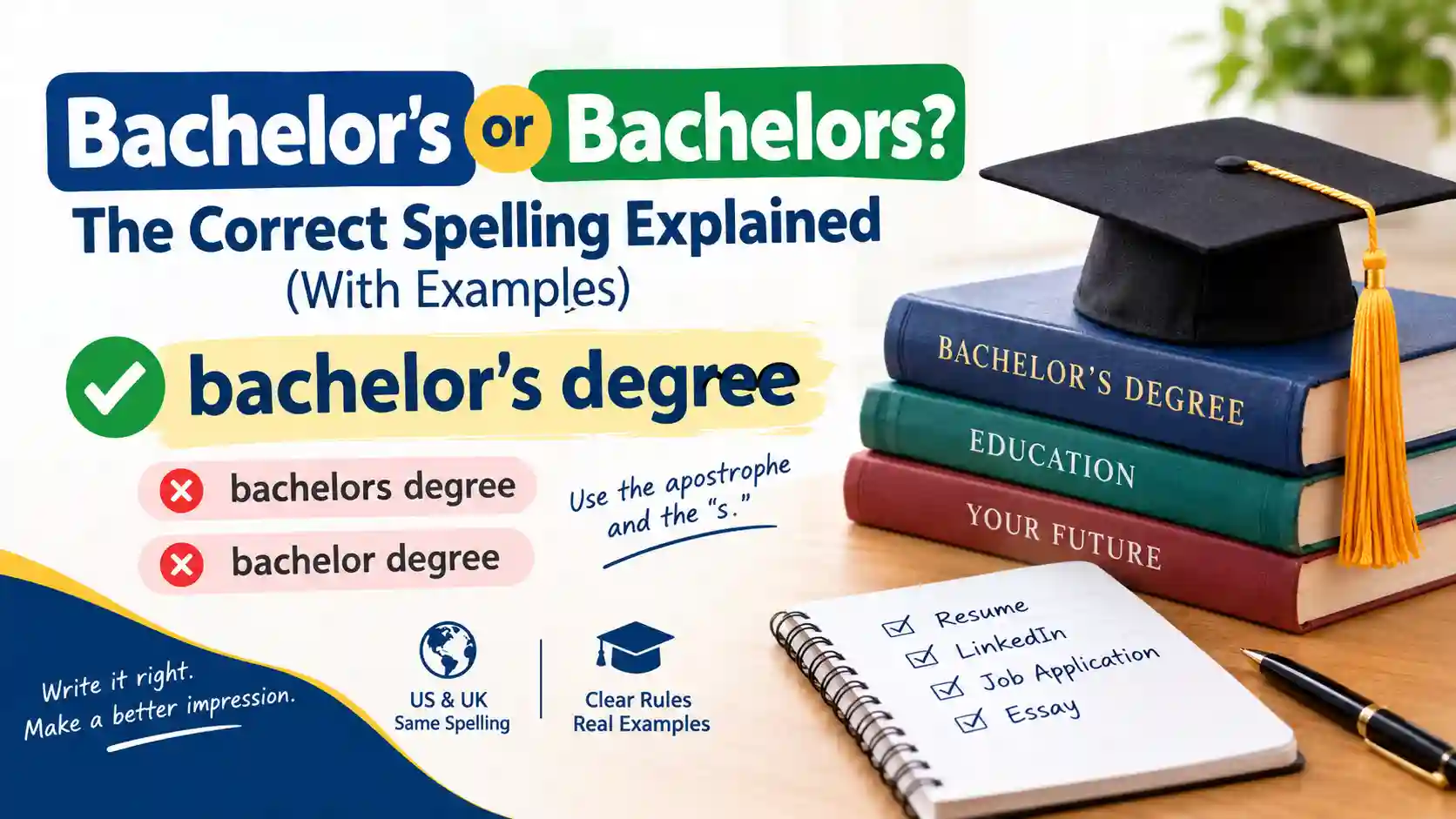
Write “bachelor’s degree.” Use an apostrophe and an “s.”
The apostrophe shows ownership. It means “a degree of a bachelor.” That is the standard form in both American and British English.
Here are some quick examples:
- She earned a bachelor’s degree in nursing.
- He is studying for a bachelor’s degree in law.
- Many jobs require a bachelor’s degree.
When do you write “bachelors” with no apostrophe? Only when you mean more than one unmarried man.
- The three bachelors shared an apartment.
Writing more than one degree? Use “bachelor’s degrees.”
- Both sisters hold bachelor’s degrees.
One more rule. If you write the full name, drop the apostrophe: Bachelor of Arts, Bachelor of Science.
The Origin of Bachelor’s
The word “bachelor” is very old. It comes from Old French bacheler, which meant a young knight or a young man in training. That word came from Medieval Latin baccalarius, which referred to a farm worker or tenant.
Over time, the meaning grew. By the 1300s, “bachelor” also described a young man who was not yet married. At about the same time, it was used for a student who had finished the first stage of university study.
The degree name has its own story. The Latin term baccalaureus was linked, partly by folk belief, to bacca lauri, meaning “laurel berry.” Laurel was a sign of honor.
So why do people mix up the spelling? There are three reasons:
- Sound. “Bachelor’s” and “bachelors” sound the same when spoken.
- Plural habit. Many people add “s” to make a word plural, so “bachelors” feels natural.
- Possessive confusion. Many people are unsure how an apostrophe works with a degree name.
The apostrophe is the key. The degree belongs to a “bachelor,” which is the old name for a person who finished the first level of study.
British English vs American English Spelling
Here is the surprise: there is no big spelling split. Both American and British writers use “bachelor’s degree.” The apostrophe rule is the same on both sides of the Atlantic.
What does change is the style and the words around it. In the UK, people often name the degree directly, like “BA” or “BSc.” They may also say “undergraduate degree” or “first degree.” In the US, “bachelor’s degree” is the everyday phrase.
| Feature | American English | British English |
| Standard spelling | bachelor’s degree | bachelor’s degree |
| Common short form | bachelor’s | degree, first degree |
| Full title | Bachelor of Science | Bachelor of Science |
| Abbreviation | B.S., B.A. | BSc, BA |
| Honours style | Not common | BA (Hons), BSc (Hons) |
| Typical length | Four years | Three years in England; four in Scotland |
| Everyday phrase | “I have a bachelor’s.” | “I have a degree.” |
So when someone asks about British vs American spelling here, the answer is simple. The spelling is the same. The habits are different.
Which Spelling Should You Use?
Use “bachelor’s degree” in almost every case. Here is how to think about your reader.
If your audience is in the US:
Write “bachelor’s degree.” Major style guides, such as AP, APA, and Chicago, all use this form. Keep it lowercase unless it starts a sentence.
If your audience is in the UK or the Commonwealth:
“Bachelor’s degree” is correct. You can also use “BA,” “BSc,” or “undergraduate degree.” These sound natural to UK readers. Use the full title, such as “Bachelor of Arts,” in formal documents.
If your audience is global:
Choose “bachelor’s degree.” It is the most widely understood form. Readers in many countries know it. It also works well in search engines.
A simple rule for every case:
- Talking about the level? Use bachelor’s degree.
- Writing the exact title? Use Bachelor of Arts (no apostrophe).
- Talking about unmarried men? Use bachelors.
Common Mistakes with Bachelor’s
Many people make the same few errors. Here they are, with fixes.
| Mistake | Why it is wrong | Correct form |
| bachelors degree | Missing the apostrophe | bachelor’s degree |
| bachelor degree | Missing the “‘s” | bachelor’s degree |
| bachelors’ degree | Apostrophe in the wrong place | bachelor’s degree |
| Bachelor’s of Science | Apostrophe not needed in full title | Bachelor of Science |
| Bachelor’s Degree (capitalized) | Needless capital letters | bachelor’s degree |
| bachelor’s’s | Double possessive | bachelor’s |
Tip: Say the phrase out loud as “degree of a bachelor.” If it fits, use the apostrophe.
Another common error is mixing the forms in one document. Pick one and stay with it. Do a quick search before you hit send.
Bachelor’s in Everyday Examples
Here is how the correct spelling looks in real life.
In an email:
Hi Sarah, I have a bachelor’s degree in marketing and three years of experience. I would love to join your team.
In a news headline:
More Employers Drop Bachelor’s Degree Requirement for Entry-Level Jobs
On social media:
Just got my bachelor’s degree! Four years of hard work. So proud. 🎓
On a résumé:
Education: Bachelor of Science in Biology, State University, 2024
In formal writing:
Applicants must hold a bachelor’s degree from an accredited institution.
In a school essay:
A bachelor’s degree can open doors to many careers.
Notice the pattern. In casual text and in formal text, the spelling stays the same. Only the full title drops the apostrophe.
Bachelor’s – Google Trends & Usage Data
I can’t pull live Google Trends numbers here, so treat this section as a general guide. For exact figures, check Google Trends yourself.
In general, people see the following patterns:
- Strong interest in English-speaking countries. The US, UK, Canada, and Australia are typical leaders.
- Strong interest in countries with many English learners and students. India, Pakistan, Nigeria, and the Philippines often show high search interest too.
- Seasonal spikes. Searches tend to rise around graduation season (May and June) and application season (late summer and winter).
- Context matters. People search for the spelling when they write résumés, college applications, scholarship forms, and LinkedIn profiles.
The form with the apostrophe, “bachelor’s degree,” is the most common in published writing. The form without it, “bachelors degree,” still appears in many searches. That is because people type quickly and search engines forgive small errors.
A tip for writers: If you run a website, use the correct spelling in your headings. You can still mention the common misspelling once in the text to catch those searches.
Keyword Variations Side by Side
| Variation | Correct? | Use it when |
| bachelor’s degree | ✅ Yes | Talking about the degree level |
| bachelor’s degrees | ✅ Yes | Talking about more than one degree |
| Bachelor of Arts / Science | ✅ Yes | Writing the full official title |
| bachelors (no apostrophe) | ✅ Yes, but different meaning | Plural of “bachelor,” an unmarried man |
| bachelors degree | ❌ No | Avoid in formal writing |
| bachelor degree | ❌ No | Avoid in formal writing |
| bachelors’ degree | ❌ No | Avoid |
FAQs
1. Is it “bachelor’s degree” or “bachelors degree”?
It is “bachelor’s degree.” The apostrophe shows the degree belongs to a bachelor.
2. Is “bachelors degree” ever correct?
Not in standard English. You may see it online, but formal writing needs the apostrophe.
3. Do the UK and the US spell it differently?
No. Both use “bachelor’s degree.” The UK often uses “BA,” “BSc,” or “first degree” in daily speech.
4. Should I capitalize “bachelor’s degree”?
No, not in the middle of a sentence. Capitalize the full title only, such as “Bachelor of Arts.”
5. Do I use an apostrophe in “Bachelor of Science”?
No. The full title has no apostrophe.
6. How do I write the plural?
Write “bachelor’s degrees.” The “s” goes on “degrees.”
7. Is “bachelor degree” acceptable?
Not in formal writing. Use “bachelor’s degree” on résumés, applications, and articles.
8. How should I write it on a résumé?
Use the full title: “Bachelor of Science in Biology.” Or write “bachelor’s degree in biology” in a sentence.
Conclusion
Let’s sum it up. The correct spelling is “bachelor’s degree.” The apostrophe and the “s” show that the degree belongs to a bachelor. This is true in both American and British English.
Remember these simple rules:
- Use bachelor’s degree in sentences.
- Use bachelor’s degrees for more than one.
- Use Bachelor of Arts or Bachelor of Science for the full title, with no apostrophe.
- Use bachelors only for unmarried men.
- Skip the capital letters unless you write the full title.
Avoid the common errors: “bachelors degree,” “bachelor degree,” and “bachelors’ degree.” They are easy to make but also easy to fix.
The word has a long history. It started as a name for a young knight and grew into the name of a college degree. That history explains why the spelling feels tricky today.
If you write for a US reader, a UK reader, or a global reader, the answer is the same. Choose “bachelor’s degree.” It looks professional. It is clear. And it keeps your writing free of small mistakes.
Now you can write your résumé, your email, or your essay with confidence.