You are about to send an email. You type “presenter.” Then you stop. Does it look right? Or should it be “presentor”?
The two words sound the same. Many English words end in -or, like actor, doctor, and sponsor. So your brain thinks “presentor” might be fine. It is not.
People search “presenter or presentor” for one reason. They want a fast, safe answer before they hit send. A wrong spelling can look sloppy in a resume, a slide deck, or a news post.
Here is the good news. The answer is simple. There is one correct spelling, and it works in the US, the UK, Canada, and Australia. There is no British or American split.
In this guide, you get the quick answer first. Then you learn why the mix-up happens, see real examples, and get tips you can use today. Let’s clear this up for good.
Presenter or Presentor – Quick Answer
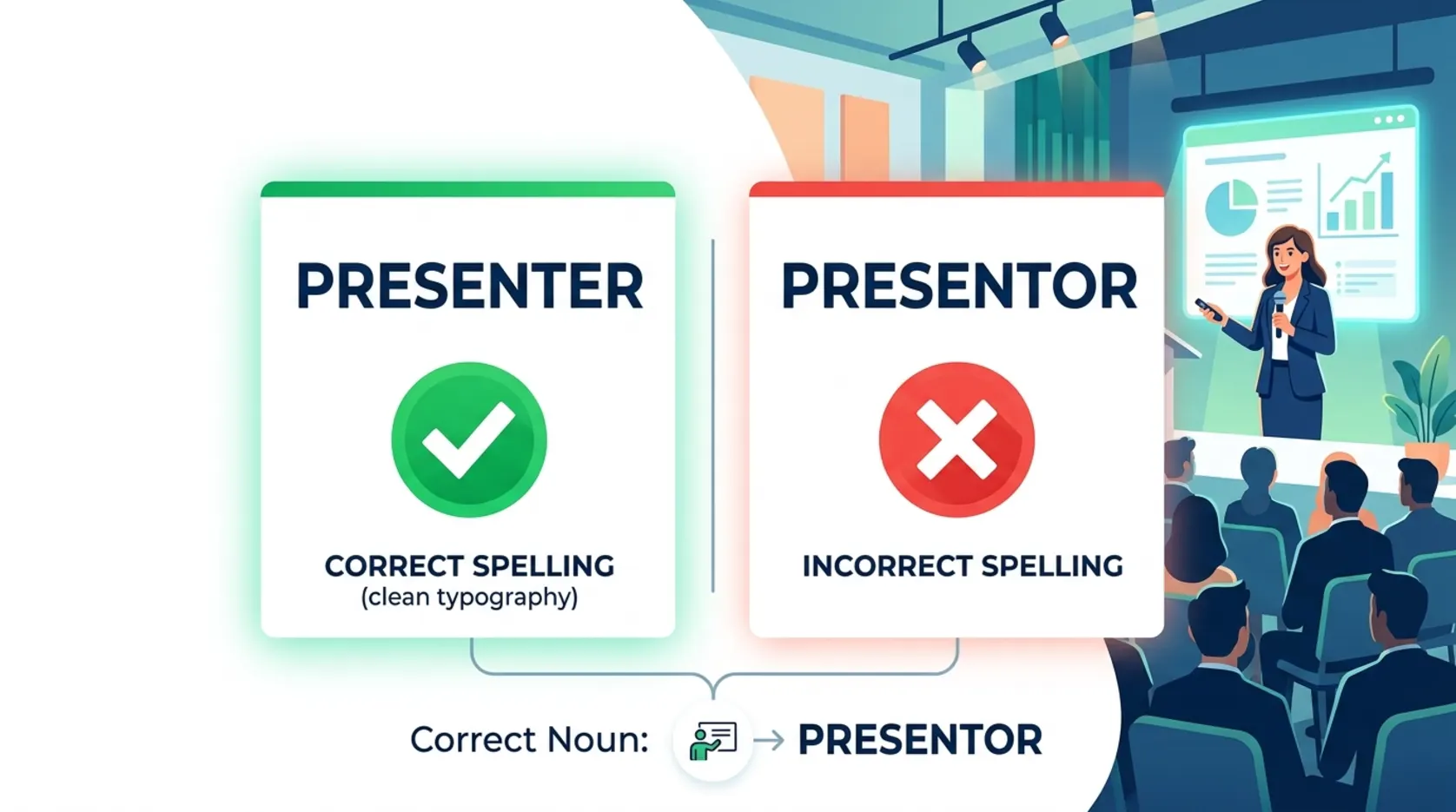
“Presenter” is correct. “Presentor” is a misspelling.
A presenter is a person who presents something. That could be a talk, a show, a report, or an award.
Examples:
- The presenter shared her slides with the team.
- The TV presenter welcomed the guests.
- Each presenter has ten minutes.
- She is the main presenter at the conference.
Do not write “presentor” in any of these. Standard dictionaries list only “presenter.”
The Origin of “Presenter”
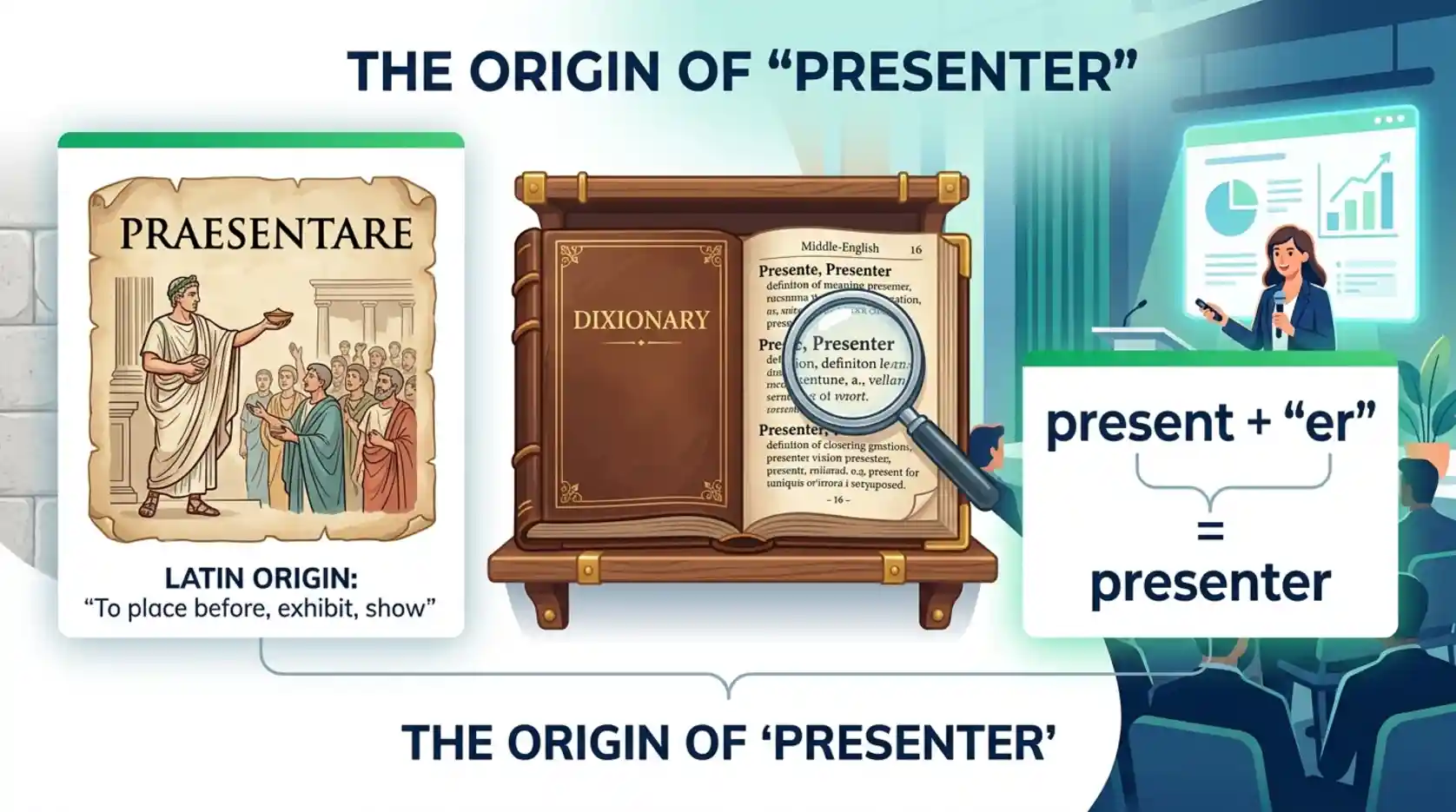
The word starts with Latin. The Latin word praesentare means “to show” or “to place before.” Old French turned it into presenter. English borrowed it and added -er to name the person who does the action.
English has a simple habit here. When we turn a verb into a “person who does it” word, we often add -er.
- teach → teacher
- write → writer
- present → presenter
Why do people write “presentor”? There are three main reasons.
- Look-alike words. Words like sponsor, mentor, donor, and investor end in -or. They come from Latin forms that kept the -or ending.
- Sound. In speech, the ending sounds like “ur” either way. Your ears cannot tell you which to pick.
- Mix-ups with precentor. A precentor is a real word. It means a person who leads a choir or church singing. It looks close to “presentor,” which adds to the confusion.
So the spelling differences do not come from two real traditions. They come from a common mistake.
British English vs American English Spelling
Many spelling pairs do split between the US and the UK. “Presenter” is not one of them.
Here are some words that do differ:
- color (US) / colour (UK)
- organize (US) / organise (UK)
- center (US) / centre (UK)
Now compare that with our word. Both countries use the same spelling.
| Word | American English | British English | Notes |
| Presenter | presenter | presenter | Same everywhere |
| Presentor | not used | not used | Misspelling |
| Color | color | colour | Real US/UK split |
| Organize | organize | organise | Real US/UK split |
| Sponsor | sponsor | sponsor | Ends in -or in both |
| Teacher | teacher | teacher | Ends in -er in both |
Simple rule: if a word is a verb plus -er, use -er. Present plus -er gives presenter.
Which Spelling Should You Use?
Use presenter. Always. Here is the advice by audience.
- US readers: Use “presenter.”
- UK and Commonwealth readers (Canada, Australia, India, and more): Use “presenter.”
- Global readers: Use “presenter.”
The only choice you may face is about style. In the UK, “presenter” is very common for TV and radio hosts. In the US, people often say “host” or “anchor” for TV and “speaker” for events. The spelling stays the same.
If you work in business, school, or media, check your spelling before you publish. One small error can hurt trust.
Common Mistakes with “Presenter”
Here are the errors people make most often, with fixes.
| Mistake | Correct form | Why |
| presentor | presenter | Use -er after a verb |
| presentors | presenters | Plural of presenter |
| presentor’s | presenter’s | Possessive of presenter |
| presentater | presenter | Extra letters added |
| precentor (for a speaker) | presenter | Precentor is a choir leader |
| presentator | presenter | Not an English word |
Other tips:
- Do not trust your ear. The sound is the same, so check the letters.
- Do not trust autocorrect only. It may miss a mistake if it looks like another word.
- Watch the plural. It is “presenters,” not “presentors.”
“Presenter” in Everyday Examples
Seeing the word in real use helps it stick.
In emails
- “Please welcome our next presenter, Maria Lopez.”
- “Each presenter should send slides by Friday.”
In news
- “The presenter thanked viewers at the end of the show.”
- “The award presenter opened the envelope.”
On social media
- “Our webinar presenter shared three great tips!”
- “Who was your favorite presenter at the event?”
In formal writing
- “The presenter will outline the findings of the study.”
- “Presenters must register before the conference begins.”
In tech tools
- “Switch to presenter view to see your notes.”
Notice that every example uses -er. It never changes.
“Presenter” – Google Trends and Usage Data
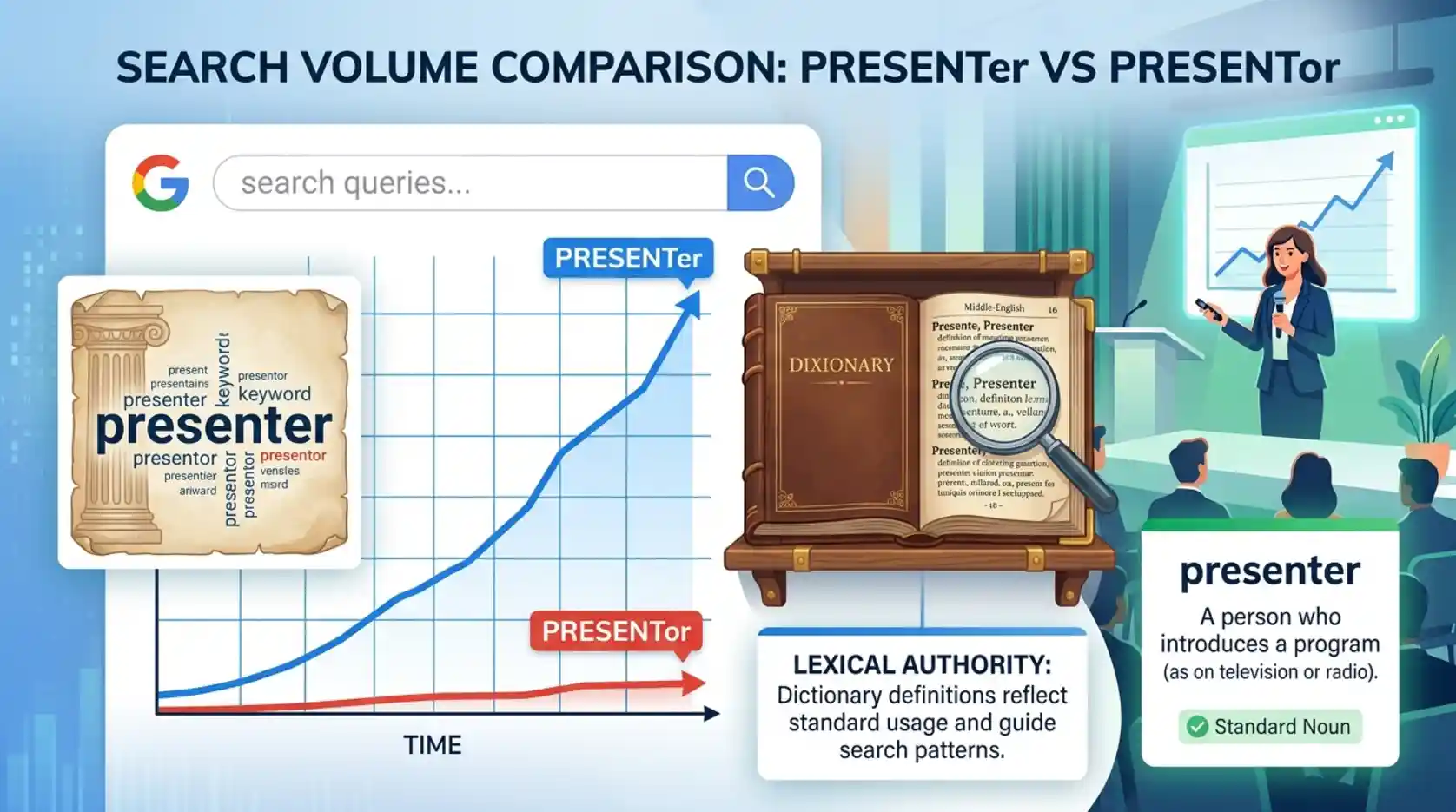
Search tools like Google Trends show how often people look up a word. I can’t give you exact numbers here, and I won’t invent any. Numbers change over time, and you can check the live data yourself.
Here is what is generally true about this kind of search:
- “Presenter” is the far more common term. It appears in jobs, TV, events, and software.
- “Presentor” shows up mostly as a typo or a spelling question. People search it to check if it is right.
- Interest rises around events. Conference seasons, school terms, and TV schedules bring more searches.
- Context shifts by country. In the UK and Commonwealth, “presenter” is often tied to TV and radio hosts. In the US, it is often tied to meetings, webinars, and slideshows.
How to check it yourself:
- Go to Google Trends.
- Type “presenter” and “presentor” as two terms.
- Pick a country and a time range.
- Compare the two lines.
You will see “presenter” far above the other.
Keyword variations side by side:
| Term | Status | Typical use |
| presenter | Correct | TV, meetings, webinars, events |
| presenters | Correct (plural) | Teams, panels, lineups |
| presenter’s | Correct (possessive) | “The presenter’s notes” |
| presentor | Incorrect | Common typo |
| presentors | Incorrect | Common typo (plural) |
| precentor | Correct, but a different word | Church choir leader |
FAQs
1. Is it presenter or presentor?
It is “presenter.” “Presentor” is a spelling mistake.
2. Is “presentor” ever correct?
No. Standard dictionaries do not list it as a normal English spelling. Use “presenter.”
3. Is there a British and American spelling for presenter?
No. Both use “presenter.” The US/UK split applies to other words, like color and colour.
4. Why do people write “presentor”?
Many similar words end in -or, like sponsor and mentor. The ending also sounds the same, so people guess.
5. What is the plural of presenter?
The plural is “presenters.”
6. What is the difference between presenter and precentor?
A presenter shows or introduces something. A precentor leads singing in a church. They are two different words.
7. Can I use “presenter” for a TV host?
Yes. In the UK, it is a common word for TV and radio hosts. In the US, “host” is more common, but “presenter” is still correct.
8. How can I remember the right spelling?
Think: teach → teacher, write → writer, present → presenter. A verb plus -er names the person.
Conclusion
Let’s sum up what you learned.
The correct spelling is presenter. “Presentor” is a mistake. It happens because many words end in -or, and the two endings sound the same. But “presenter” follows a simple rule. Take the verb present, add -er, and you have the person who does it.
There is no US or UK split here. You can use “presenter” in emails, news, social posts, reports, and formal documents, anywhere in the world.
Remember these quick tips:
- Use presenter and presenters.
- Avoid presentor and presentors.
- Do not mix it up with precentor, a choir leader.
- When in doubt, use the verb-plus-er rule.
Correct spelling builds trust. It shows care and skill, and readers notice. Now you can write this word with full confidence, If you are sending a quick message or building a big slide deck.
Next time you type it, you will know what to do. Keep it simple: presenter.