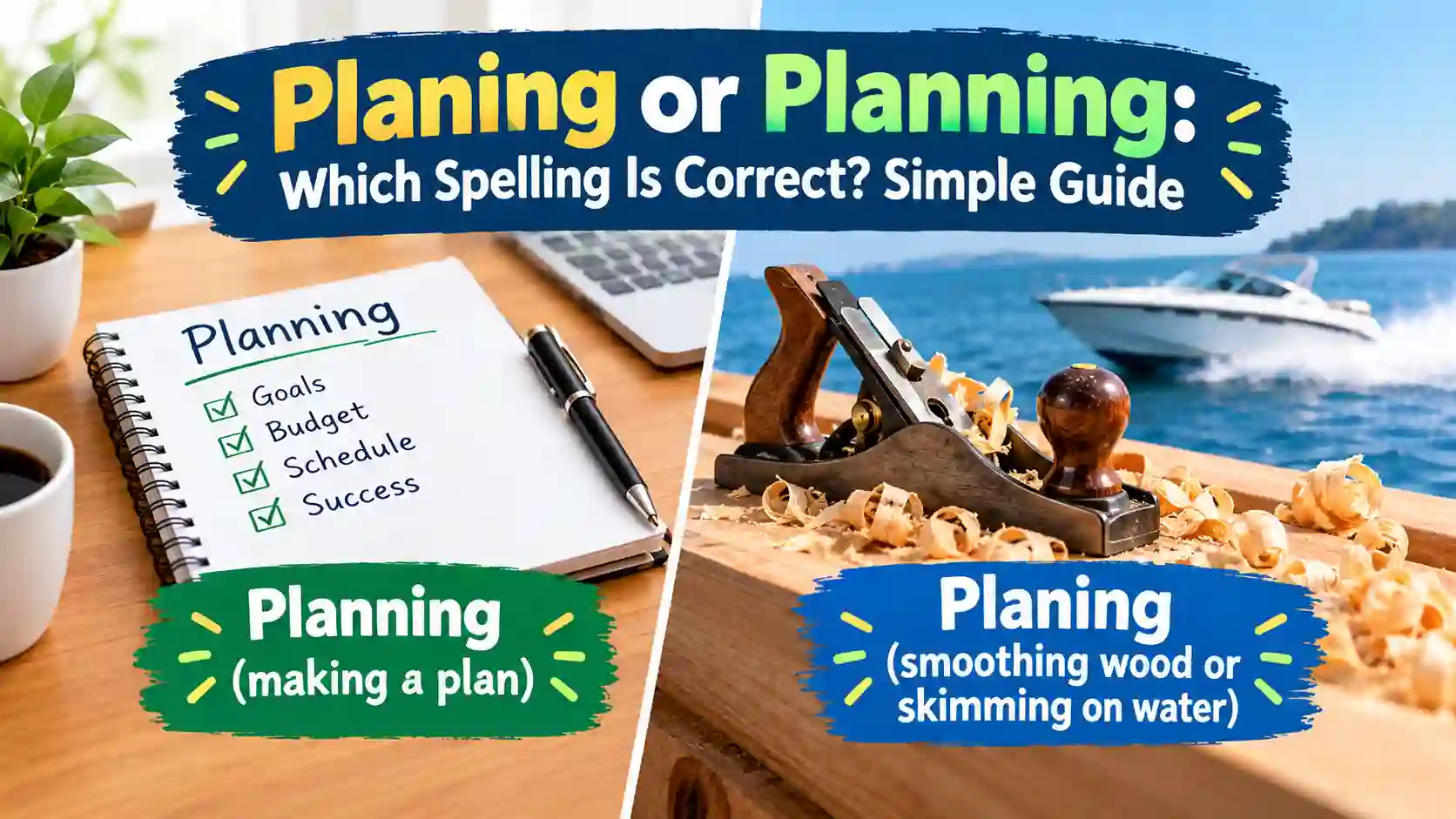
You type a word. It looks wrong. You type it again. Still odd. Is it planing or planning?
Millions of people get stuck at this exact spot. The two words look almost the same and sound almost the same. But they mean very different things.
People search for “planing or planning” for many reasons. Some write emails and want to look sharp, Some are students, Some work with wood or boats and see “planing” in a manual. Some made a typo and want a fast fix.
Here is the good news. This is not a UK versus US fight. Both words are correct English. They just have different jobs.
In this guide, you will get a quick answer first. Then you will learn where each word comes from, how the spelling rules work, and which mistakes to avoid. You will also find real examples, usage notes, comparison tables, and an FAQ.
By the end, you will not mix them up again.
Planing or Planning – Quick Answer
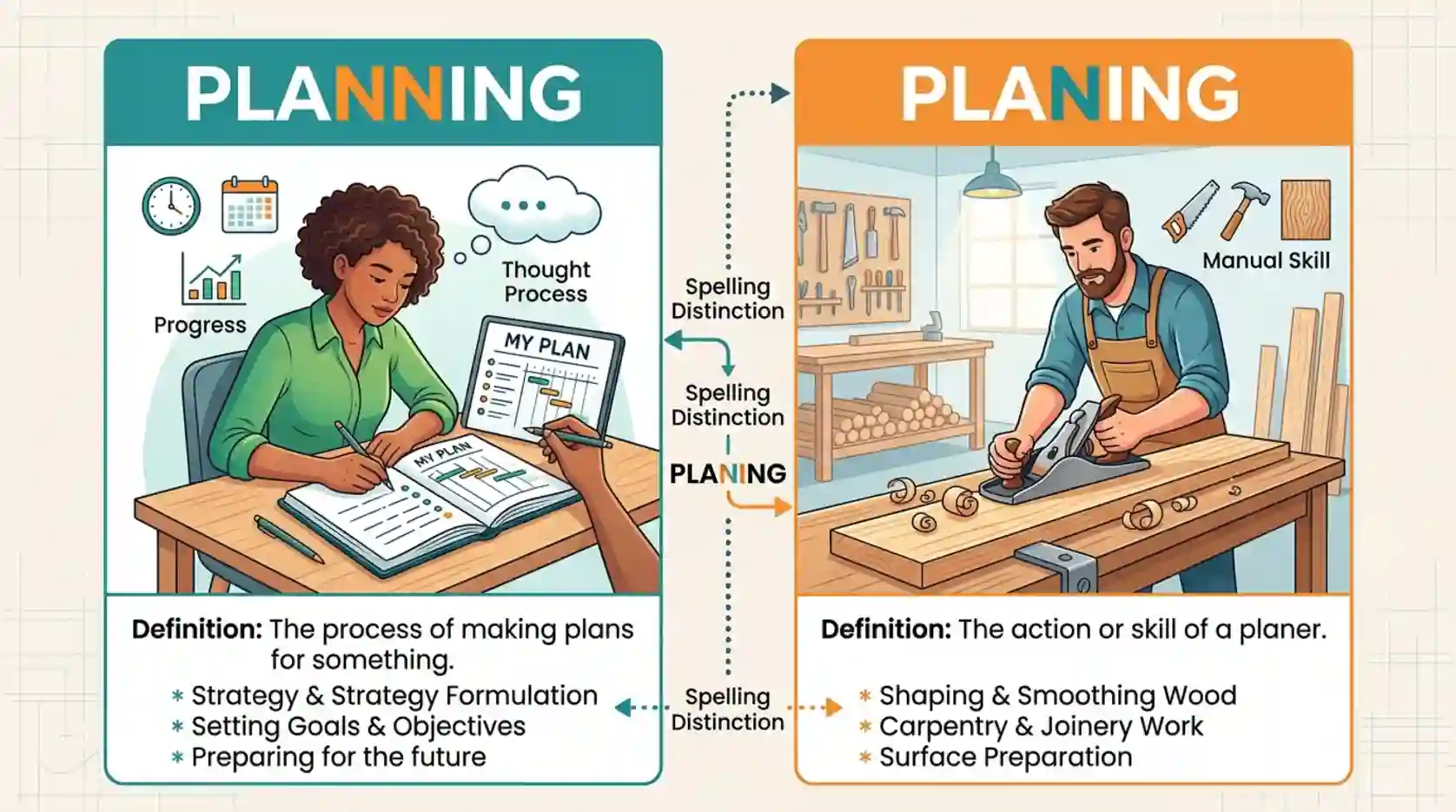
Planning means making a plan. It is the word you want 95% of the time.
- “We are planning a trip.”
- “Project planning starts on Monday.”
- “She is planning her wedding.”
Planing means smoothing a surface with a plane (a tool). It also means a boat skimming across water.
- “He is planing the wooden door.”
- “The speedboat is planing at high speed.”
Easy test: Are you making a plan? Use planning (double N). Are you smoothing wood or skimming on water? Use planing (one N).
The Origin of Planing and Planning
The two words come from different roots.
Planning comes from the word plan. Plan entered English in the 1600s from French. French took it from Latin planus, which means “flat.” At first, a plan was a flat drawing of a building. Later, it meant any idea for how to do something.
Planing comes from the word plane. This is the tool with a flat blade. It also traces back to Latin planus. The Late Latin verb planare meant “to make level.”
So both words share a flat, level ancestor. That is one reason they look alike.
The spelling difference comes from a simple English rule:
- Plan is short. It ends in vowel + consonant. So we double the N: plan → planning.
- Plane ends in a silent E. We drop the E before adding -ing: plane → planing.
One word doubles a letter. The other drops a letter. That is the whole story.
British English vs American English Spelling
Here is the key fact: the US and UK spell both words the same way. Planning is planning everywhere. Planing is planing everywhere.
The real difference is between the two words, not between the two countries.
| Feature | Planning | Planing |
| Root word | plan | plane |
| Spelling rule | Double the N | Drop the E |
| Meaning | Making a plan | Smoothing wood or skimming on water |
| US spelling | planning | planing |
| UK spelling | planning | planing |
| Common use | Everyday life, business | Woodwork, boating |
Some words do change between UK and US spelling. In British English, a final L is often doubled. In American English, it often is not.
| Base word | British | American |
| travel | travelling | traveling |
| cancel | cancelled | canceled |
| model | modelling | modeling |
| plan | planning | planning |
| plane | planing | planing |
Notice the last two rows. They do not change. So you can stop worrying about regional rules here.
Which Spelling Should You Use?
Pick the word by meaning, not by country.
- US readers: Use planning for plans. Use planing for wood or boats.
- UK and Commonwealth readers: The same. No change.
- Global audience: The same. Both words work worldwide.
Professional advice:
- Writing about projects, budgets, events, or goals? Use planning.
- Writing about carpentry, machines, or boat speed? Use planing.
- Not sure? Say the meaning out loud. If it means “making a plan,” add the second N.
Common Mistakes with Planing and Planning
1st Mistake : Writing “planing” for a plan.
- Wrong: We are planing the meeting.
- Right: We are planning the meeting.
2nd Mistake : Writing “planning” for wood.
- Wrong: He is planning the board smooth.
- Right: He is planing the board smooth.
3rd Mistake : Using one N because “it looks cleaner.”
Short words like plan double the last letter. Think of run → running and stop → stopping.
4th Mistake : Mixing it up with “planting.” These are different words. Planting is about seeds.
5th Mistake : Mixing it up with “plaining” or “planeing.” Neither is a word. Skip them.
Memory trick: Planning has two Ns because a plan needs numbers and notes. It is a stretch, but it sticks.
Planing and Planning in Everyday Examples
Emails
- “We are planning the launch for May.”
- “Thanks for planning the team lunch.”
News
- “The city is planning a new bus line.”
- “Workers were planing the beams for the bridge repair.”
Social media
- “Planning my weekend. Any ideas?”
- “Planing this oak table was so satisfying.”
Formal writing
- “The committee is planning a full review of the budget.”
- “The hull reached a planing speed of 20 knots.”
Notice how planning shows up in most places. Planing stays in tools, wood, and boats.
Planing or Planning – Google Trends and Usage Data
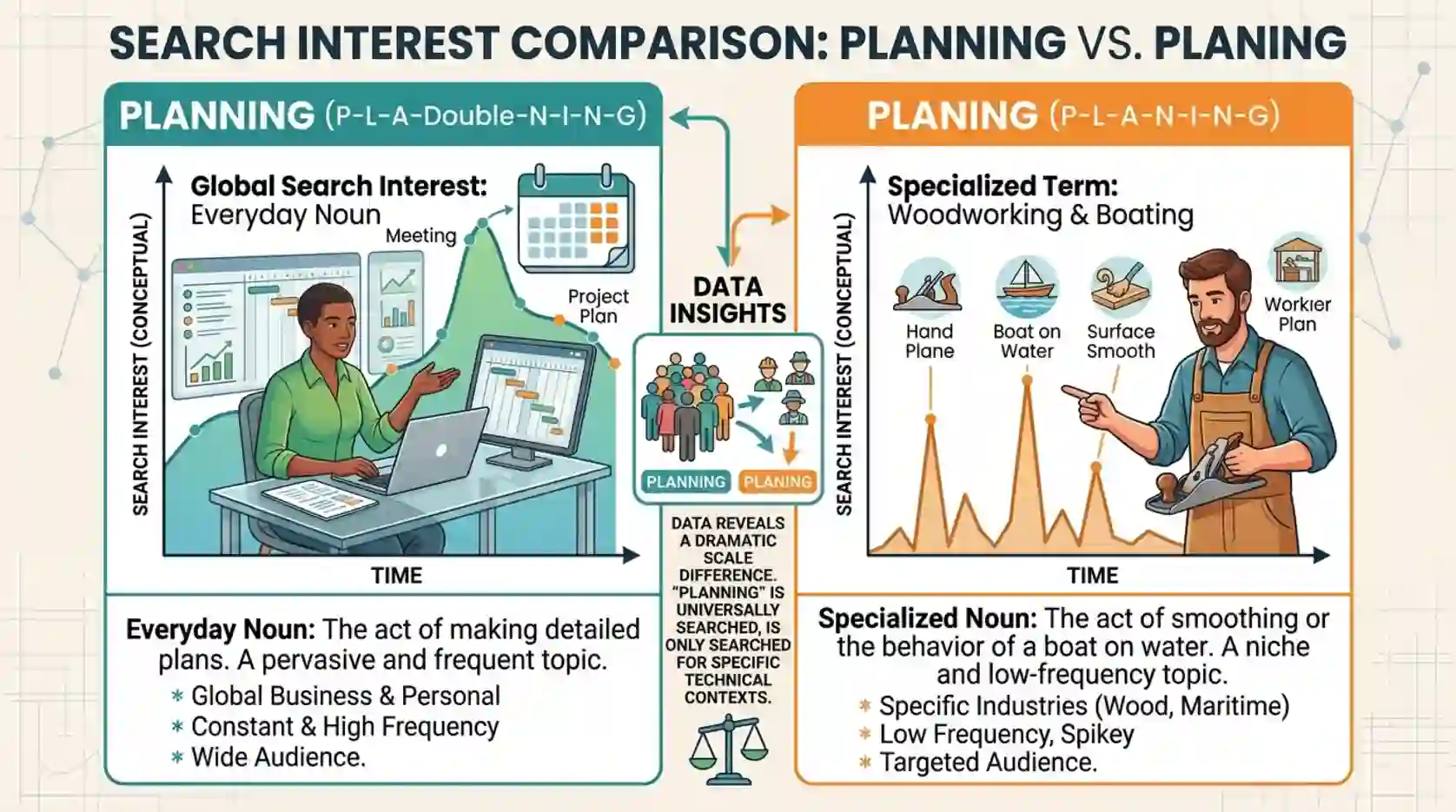
I can’t pull live Google Trends numbers here, so I won’t invent any. Here is what the usual pattern looks like, and how you can check it yourself.
- “Planning” is searched far more than “planing.” It is an everyday word in every English-speaking country.
- “Planing” gets smaller, steady interest. It rises with woodworking and boating topics, often in the US, UK, Canada, and Australia.
- The phrase “planing or planning” is mostly searched by people who are unsure of the spelling, including students and English learners.
To see the real data, go to Google Trends. Type “planing” and “planning” and compare them. Switch the country filter to see regional differences. Remember that some “planing” searches are simply typos for “planning.”
| Variation | Meaning | Usage level | Typical context |
| planning | making a plan | Very high | Business, life, events |
| planing | smoothing wood or skimming on water | Low | Woodwork, boats |
| planned | past of plan | High | Past events |
| planed | past of plane | Low | Finished woodwork |
| planner | person or tool that plans | High | Offices, diaries |
| planer | machine that planes wood | Low | Workshops |
Planing or Planning – FAQs
1. Is “planing” a real word?
Yes. It means smoothing wood with a plane. It also describes a boat skimming over water.
2. Is “planning” spelled with one N or two?
Two. It is planning.
3. Is planing a British spelling of planning?
No. It is a different word with a different meaning. The UK and the US spell both words the same way.
4. Why does “planning” have a double N?
Plan is a short word that ends in vowel + consonant. English doubles the last letter before -ing.
5. Why does “planing” have only one N?
It comes from plane. We drop the silent E and add -ing.
6. Which spelling is right for a business email?
Planning. Business writing almost always means making plans.
7. What is the past tense of each word?
Plan becomes planned. Plane becomes planed.
8. What does “planing” mean on a boat?
It means the boat rises up and skims across the water’s surface at speed.
Conclusion
Planing and planning are two real words. They are not spelling twins from the US and UK. They have different roots and different jobs.
Planning comes from plan. It means thinking ahead and setting goals. Use it for projects, trips, budgets, and events. It has two Ns.
Planing comes from plane. It means smoothing wood or skimming over water. Use it for carpentry and boats. It has one N.
The spelling is the same in the US, UK, and the rest of the world. Do not change it based on your audience. Change it based on your meaning.
Here is your fast check. Ask yourself one question: “Am I making a plan?” If yes, write planning. If you are working with wood or a speeding boat, write planing.
Most of the time, you want planning. When in doubt, read the sentence aloud and ask what it means. The right spelling will be clear.
Bookmark this page for the next time you are unsure. Then write with confidence.