You are reading a sentence: “Tom and Sam arrived, but the latter left early.” Who left? If you paused, you are not alone.
Millions of people search “latter or former” because the two words look alike and feel alike. Both point back to something already named, Both sound formal. Both are easy to swap by mistake.
A mix-up can flip the meaning of a sentence. Your reader may think the wrong person did the thing. That hurts emails, essays, reports, and exams.
This guide clears it up. You get a quick answer first. Then you learn where the words come from, how to use them, and when to skip them. You will see real examples, common mistakes, and easy memory tricks.
We also cover a question many people ask: is there a British and American spelling difference? Short answer: no. Both words are spelled the same everywhere.
By the end, you will know which word to use every time.
Latter or Former – Quick Answer
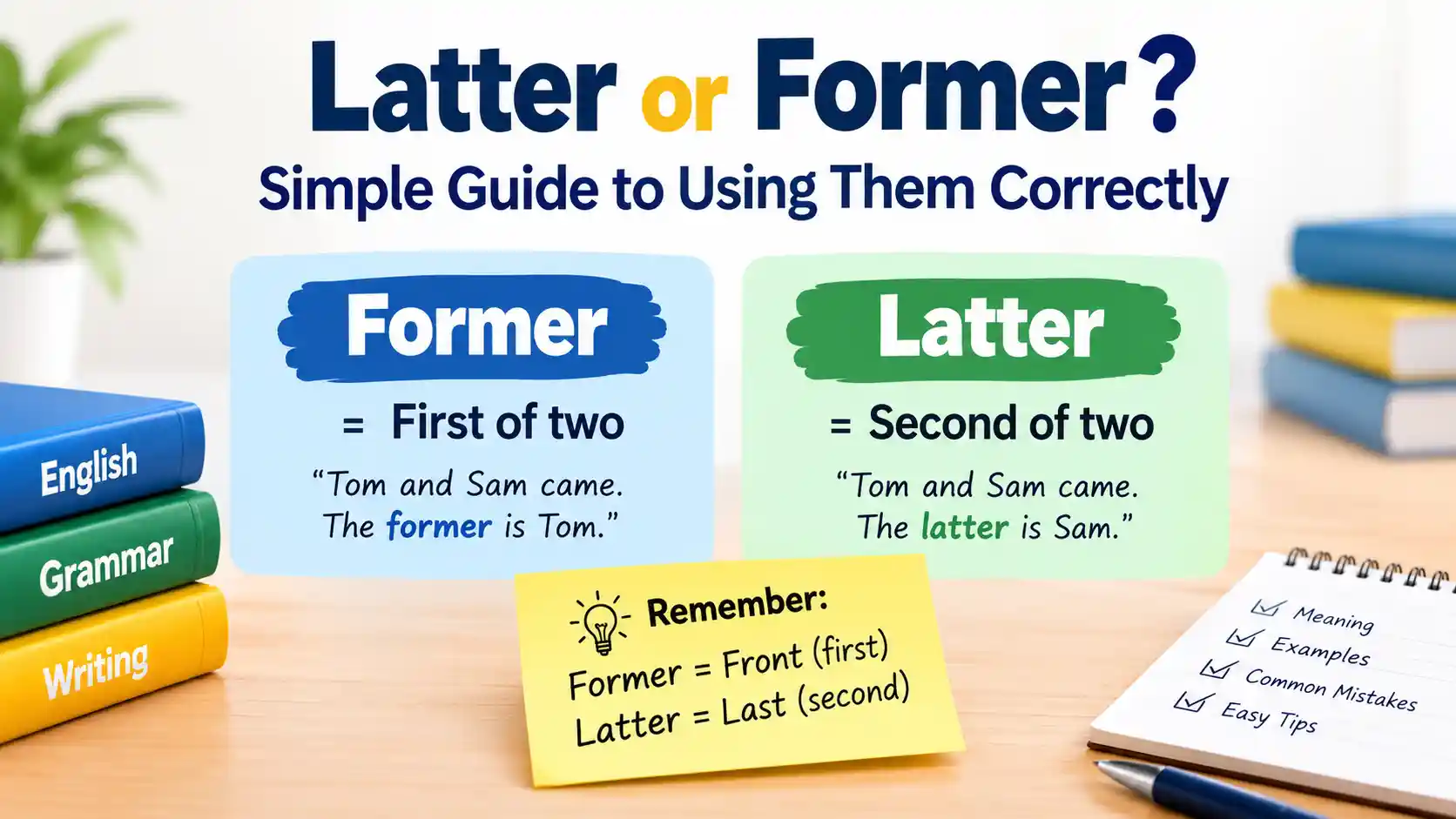
- Former means the first of two things named.
- Latter means the second of two things named.
Examples:
- “I like tea and coffee. The former is warm and calm. The latter wakes me up.” (Former = tea. Latter = coffee.)
- “Anna and Maria called. The latter left a message.” (Latter = Maria.)
Important rule: Use these words only when you have two items. For three or more, use “first” and “last.”
The Origin of Latter and Former
Both words are very old English.
Former comes from the Old English word forma, meaning “first.” The “-er” ending was added later, and it stuck.
Latter comes from the Old English word lætra, meaning “later” or “slower.” It began as a form of “late.” Over time it came to mean “the second of two.”
Why do people ask about spelling? “Latter” looks like “later,” and the two are close cousins. “Former” also looks like “formal.” These look-alikes cause typos and mix-ups.
There is one spelling for each word. The history of English split many words into UK and US versions, such as colour and color. Latter and former were never split.
British English vs American English Spelling
Here is the good news. There is no spelling difference between British and American English for these words. The difference, if any, is in style and habit.
| Feature | British English | American English |
| Spelling of “former” | former | former |
| Spelling of “latter” | latter | latter |
| Use in formal writing | Common | Common |
| Use in casual speech | Rare | Rare |
| Preference | Slightly more used in formal prose | Often replaced with names or “the second” |
Both versions teach the same rule: two items only, and use them in writing more than in speech.
Which Spelling Should You Use?
Use the one spelling: latter and former. Your choice is about style, not spelling.
- US readers: Plain writing is favored. Many editors suggest repeating the name instead. Use these words in formal or academic work.
- UK and Commonwealth readers: These words are common in reports, law, and essays. They are fine in formal writing.
- Global audience: Keep it simple. If your readers speak English as a second language, name the items again. It is clearer.
Pro tip: If the reader must look back more than a few words, skip “latter” and “former” and use the name.
Common Mistakes with Latter or Former
Mistake 1: Using them for three or more items.
Wrong: “We have red, blue, and green. The latter is my favorite.”
Right: “We have red, blue, and green. The last is my favorite.” Or just say “Green is my favorite.”
Mistake 2: Mixing up the order.
Wrong: “Tom and Sam came. The former is Sam.”
Right: “The former is Tom.”
Mistake 3: Confusing latter with later.
Wrong: “I will call you latter.”
Right: “I will call you later.”
Mistake 4: Confusing former with formal.
Wrong: “Please wear former clothes.”
Right: “Please wear formal clothes.”
Mistake 5: Using them too far from the items.
If the two items are in another paragraph, the reader gets lost. Name them again.
Latter or Former in Everyday Examples
In an email:
“We can meet Monday or Tuesday. The former works better for me.”
In the news:
“The mayor and the governor spoke. The latter promised new funds.”
On social media:
“Pizza or tacos tonight? Honestly the latter. 🌮”
In formal writing:
“The study tested diet and exercise. The former showed small gains. The latter showed large gains.”
In a report:
“Two options were reviewed: renting or buying. The former costs less today. The latter pays off over time.”
Latter or Former – Google Trends & Usage Data
Exact search numbers change often, so check Google Trends for live data. Here is the general pattern:
- Context: Searches rise during school and exam seasons. Students and writers look up the meaning.
- Country: English-speaking countries such as the US, UK, India, Canada, Australia, and Pakistan show steady interest. Countries where English is a second language often search for the meaning and examples.
- Type of search: Most people look for “meaning,” “difference,” and “example.” Few search for spelling because there is only one spelling.
- Usage: The words appear more in books, news, and academic writing than in casual talk.
This tells us the real need: people want to know which is which, not how to spell them.
Comparison Table: Latter vs Former Side by Side
| Feature | Former | Latter |
| Meaning | The first of two | The second of two |
| Position | Earlier mentioned | Later mentioned |
| Opposite of | Latter | Former |
| Works with 3+ items? | No | No |
| Example | “The former is Tom.” | “The latter is Sam.” |
| Often confused with | Formal | Later |
| Memory trick | Former = Front | Latter = Last |
FAQs
1. What does “latter” mean?
It means the second of two things you just named.
2. What does “former” mean?
It means the first of two things you just named.
3. Can I use latter and former with three items?
No. Use “first,” “second,” or “last” instead.
4. Is there a UK and US spelling difference?
No. Both words are spelled the same in all English.
5. How can I remember which is which?
Think “Former = Front” (first) and “Latter = Last” (second).
6. Is “latter” the same as “later”?
No. “Later” is about time. “Latter” points to the second item.
7. Should I use these words in casual writing?
You can, but simple names are often clearer. They fit best in formal writing.
8. What is the opposite of “former”?
The opposite is “latter.”
Conclusion
Here is what to remember. Former means the first of two. Latter means the second of two. Use them only when you have exactly two items. For three or more, use “first” and “last.”
There is no British or American spelling difference. Both words are spelled the same around the world. The only difference is style. Americans often prefer plain repetition, while British and Commonwealth writers use these words freely in formal work.
Watch out for the common traps. Do not mix up “latter” and “later.” Do not mix up “former” and “formal.” And do not make your reader hunt for the items. If they are far away, name them again.
When in doubt, ask one question: will my reader understand this at once? If not, rewrite it. Clear writing always wins.
Use the memory trick: Former = Front. Latter = Last. Keep it in your pocket, and you will never mix them up again.