You are writing a sentence. You type “She stayed home.” Then you pause. Is it stayed or staid? They sound the same. They look almost the same. One wrong letter can make your sentence look sloppy.
That is why so many people search “stayed or staid.” They want a fast answer. They also want to know if this is a UK vs US spelling thing. (It is not.)
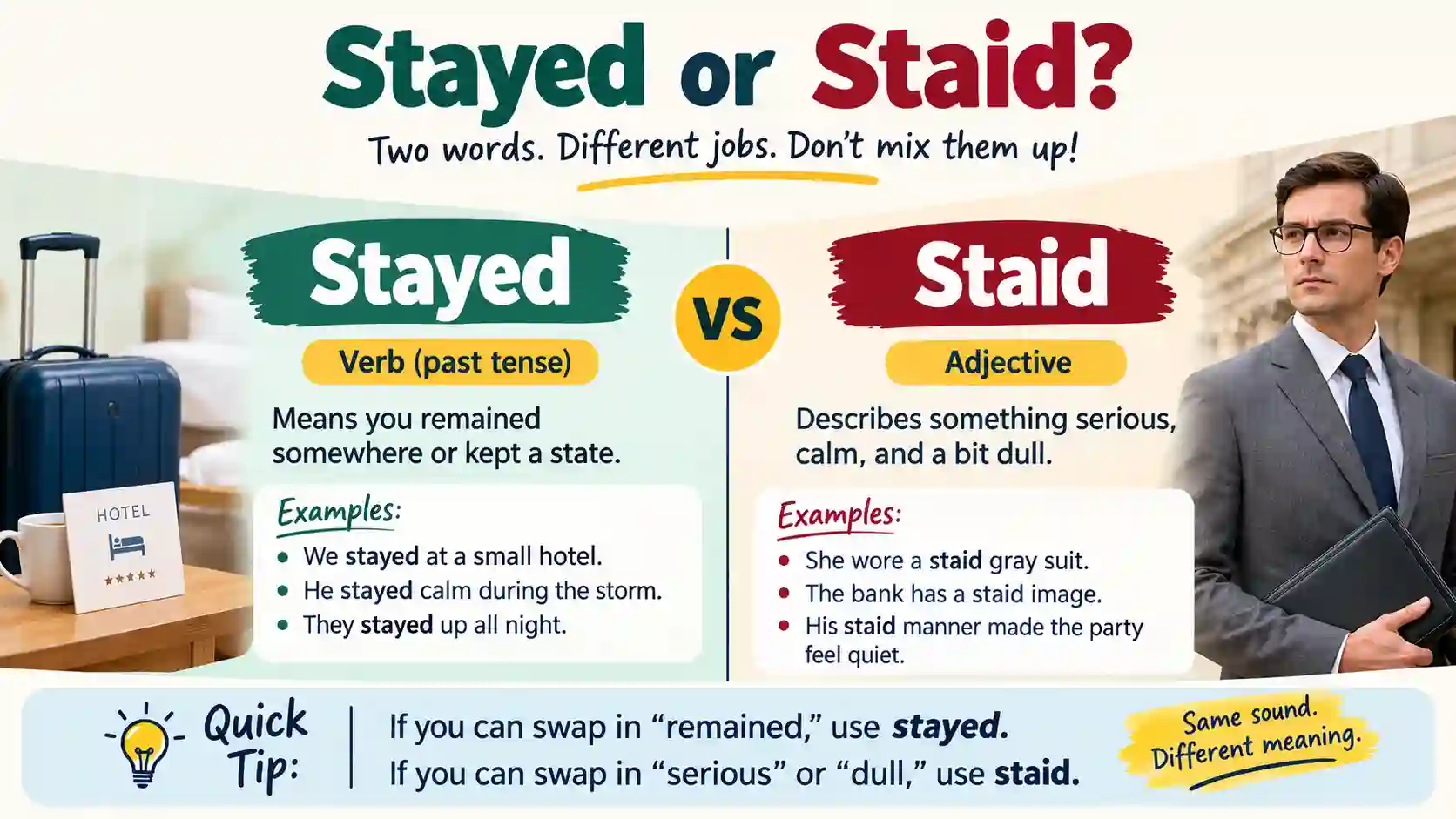
Here is the good news. The rule is simple. Stayed is a verb. It means you remained somewhere or kept a state. Staid is an adjective. It describes something serious, calm, and a bit dull.
In this guide, you will get a quick answer first. Then you will see where the words come from, how they are used, and which mistakes to avoid. You will also find real-life examples, a usage overview, and a short FAQ.
By the end, you will never mix them up again.
Stayed or Staid – Quick Answer
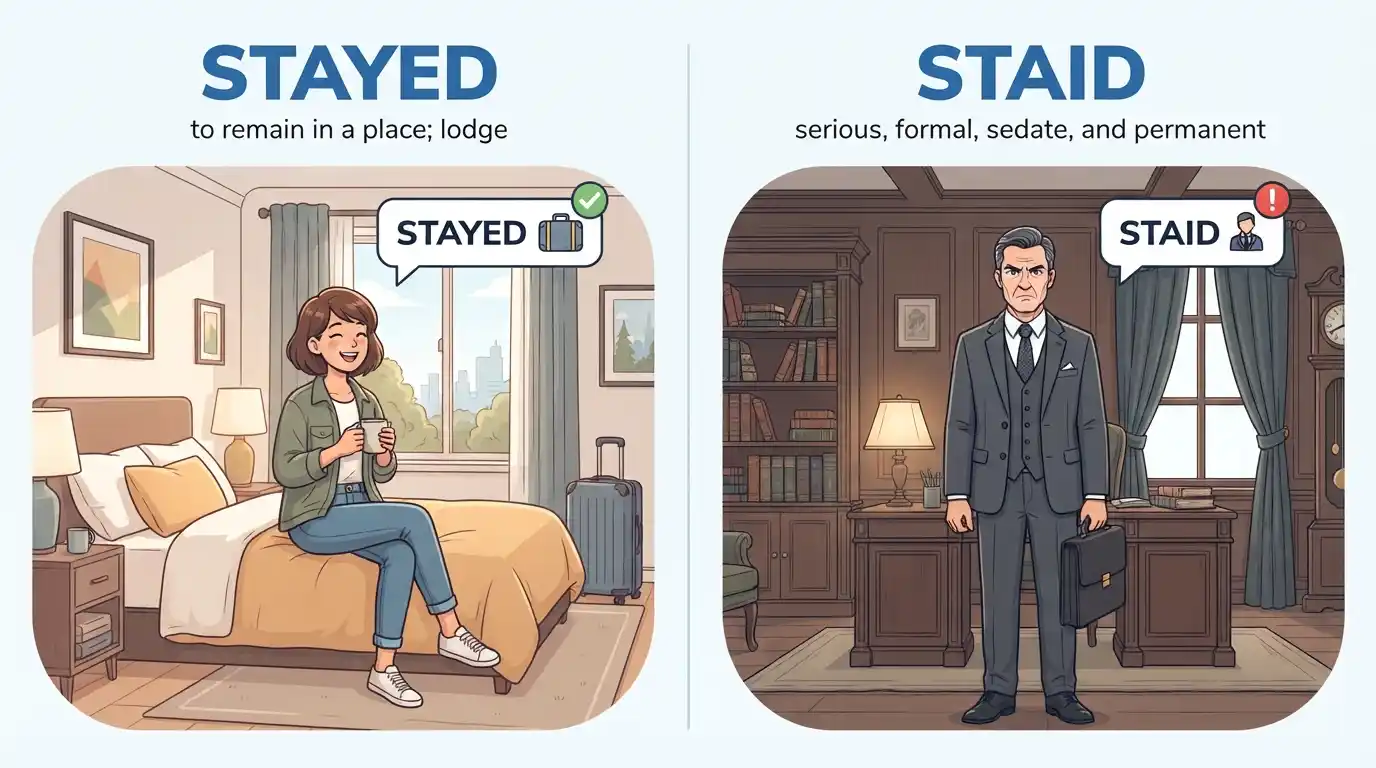
- Stayed is the past tense of the verb “stay.”
- Staid is an adjective meaning serious, calm, and old-fashioned.
Examples with the verb:
- We stayed at a small hotel.
- He stayed calm during the storm.
- They stayed up all night.
Examples with the adjective:
- She wore a staid gray suit.
- The bank has a staid image.
Memory trick: If you can swap in “remained,” use the spelling with the y. If you can swap in “serious” or “dull,” use the spelling with the i.
Trick to remember: If you can swap in “remained,” use stayed. If you can swap in “serious” or “dull,” use staid.
The Origin of Stayed and Staid

Both words come from the same root. That is why they look alike.
Both words share one root, which is why they look alike. The verb “stay” entered English from Old French, and before that from Latin stare, “to stand.” The core idea is to stand still or stay put.
In the 1500s and 1600s, spelling was not fixed, and writers often used “staid” as a spelling of the past tense of “stay.” Over time, its meaning drifted toward a person who is settled, steady, and sober. Later it picked up its modern feel: serious and a little boring.
Meanwhile, “stayed” became the standard past tense. English ended up with two spellings for two jobs:
- the y spelling for the verb
- the i spelling for the adjective
So the difference exists because one old form split into two words. You may still see the i spelling used as a verb in old books, but today that use is considered wrong.
British English vs American English Spelling
Many English words differ by region, like color and colour. This pair is not one of them. Both British and American writers use the same rules.
| Word | Part of speech | Meaning | US usage | UK/Commonwealth usage |
| stayed | Verb (past tense) | remained, lodged, kept a state | Same | Same |
| staid | Adjective | serious, sedate, dull | Same | Same |
Examples:
- US: “We stayed in Boston for a week.” ✔
- UK: “We stayed in Brighton for a week.” ✔
- US: “A staid law firm.” ✔
- UK: “A staid country club.” ✔
Neither word has a different spelling in the UK or US. If you see “staid” used as a past-tense verb, it is not a regional style. It is an error, or a very old form.
Which Spelling Should You Use?
You do not choose by region. You choose by meaning.
US audience: Use stayed for actions in the past. Use staid only to describe something stiff or serious.
UK and Commonwealth audience (Australia, India, Canada, and others): The same rule applies. No local variant exists.
Global audience: Keep it simple. Use stayed in almost every sentence about the past. Use staid rarely. It is a more formal, literary word, and some non-native readers may not know it.
Quick decision guide:
- Is it an action that happened? → stayed
- Is it a quality of a person, place, or thing? → staid
- Not sure? → Use stayed, or pick a plainer word like serious or formal.
Common Mistakes with Stayed and Staid
1st Mistake : Using “staid” as a verb.
❌ We staid at my aunt’s house.
✔ We stayed at my aunt’s house.
2nd Mistake : Using “stayed” to describe a boring person.
❌ He is a stayed man.
✔ He is a staid man.
3rd Mistake : Thinking “staid” means “stayed” in the UK.
It does not. Both countries use stayed for the verb.
4th Mistake : Mixing up the sound.
They are pronounced the same (stayd), so spell-check may not catch the error. Read your sentence aloud and test the meaning.
5th Mistake : Using “staid” to mean “stained” or “stable.”
❌ A staid reputation (when you mean “damaged”)
✔ A staid reputation (means “serious and traditional”)
6th Mistake : Confusing “stayed” with “stay” tense.
❌ I stayed here every day now.
✔ I stay here every day now. / I stayed here every day last year.
Stayed or Staid in Everyday Examples
Email:
- “Thank you for the update. I stayed late to finish the report.”
- “The proposal felt a bit staid. Can we make it livelier?”
News:
- “Prices stayed flat in September.”
- “The staid institution surprised everyone with a bold new logo.”
Social media:
- “We stayed in and watched movies all weekend. Zero regrets.”
- “My office dress code is so staid. Send help.”
Formal writing:
- “The defendant stayed within the agreed limits.”
- “The professor’s staid lecture style suited the topic.”
Legal use (a special case): Courts use stayed to mean paused. “The judge stayed the order.” That is still the verb stay, so the spelling is the same.
Stayed or Staid – Google Trends & Usage Data

I can’t pull live Google Trends numbers from here, so I won’t invent any. Here is what is reliably true about how people use and search for the pair, and how to check it yourself.
Usage patterns:
- Stayed is far more common than staid in everyday writing. It is a basic verb used constantly.
- Staid is rare and mostly seen in news features, reviews, and books.
- Searches for “stayed or staid” come from people who write for work or school, such as students, bloggers, and editors.
By country: Interest tends to come from English-speaking countries such as the US, UK, Canada, Australia, and India. This reflects the large number of writers and learners there, not a spelling difference.
By context: Searches often rise around exam season and when writers edit articles.
How to verify: Open Google Trends, enter “stayed or staid,” and compare it with “staid meaning.” Filter by country and time range to see current numbers.
Stayed vs Staid vs Related Words – Comparison Table
| Word | Type | Meaning | Example |
| stayed | Verb, past tense | remained | She stayed late. |
| stay | Verb, present | remain | Please stay here. |
| staying | Verb, -ing form | remaining | We are staying home. |
| staid | Adjective | serious, dull, sedate | A staid, formal dinner. |
| staidly | Adverb | in a serious, calm way | He nodded staidly. |
| staidness | Noun | the quality of being staid | The staidness of the town. |
| stayed (legal) | Verb | paused or put on hold | The court stayed the case. |
FAQs About Stayed or Staid
1. Is “staid” a real word?
Yes. It is an adjective meaning serious, calm, and a little dull.
2. Is “staid” the British spelling of “stayed”?
No. They are two different words. Both the UK and US use stayed for the past tense of stay.
3. Can I use “staid” as the past tense of “stay”?
No. In modern English, always use stayed. “Staid” as a past tense is old and now seen as an error.
4. How do I remember which is which?
Stayed has the y from stay. Staid has an i, like “i”nflexible or a stiff manner. Also, you can swap remained for stayed and serious for staid.
5. Do they sound the same?
Yes. Both are pronounced “stayd.” That’s why people confuse them.
6. Is “staid” an insult?
It can be. It often hints that something is boring or old-fashioned. But it can also be neutral, meaning calm and dependable.
7. What is a good synonym for “staid”?
Try sedate, sober, conventional, formal, or stuffy, depending on tone.
8. Is “stayed” used in legal writing?
Yes. A judge may say an order was “stayed,” meaning it was put on hold.
Conclusion
The question “stayed or staid” has a clear answer. These are two separate words, not regional spellings.
Use stayed when you talk about the past action of staying. It means remained, lodged, or paused. It is by far the more common word. “We stayed at home.” “Sales stayed flat.” “The court stayed the order.”
Use staid when you describe something serious, calm, and a bit dull. It is an adjective. “A staid suit, staid bank.”
Do not use staid as a verb. Do not worry about UK or US differences. There are none for this pair.
If you are unsure, say the sentence with a simple swap. Can you say remained? Choose stayed. Can you say serious or dull? Choose staid. If neither fits, rewrite the sentence with a plainer word.
Because the two words sound alike, spell-check will not always save you. A quick read-through will. Keep this guide handy, and you will get it right every time.