Have you ever typed “that was so funner” and then stopped, unsure if it even looks right? You are not alone. This is one of the most searched grammar questions in English. People type it into Google every day because “fun” breaks the normal rules. Most short adjectives just add “-er,” like “fast” becomes “faster.” But “fun” does not follow that pattern the same way everywhere.
This confusion is real. Some dictionaries now list “funner” as informal but acceptable. Teachers and editors, though, still prefer “more fun” in anything formal. So which one is correct? The short answer: both are used, but they fit different situations.
In this article, you will get a quick answer, the history behind the confusion, a British vs. American comparison, common mistakes, real-life examples, and a full FAQ section. By the end, you will know exactly which form to use, when, and why — without any guesswork.
Funner or More Fun – Quick Answer
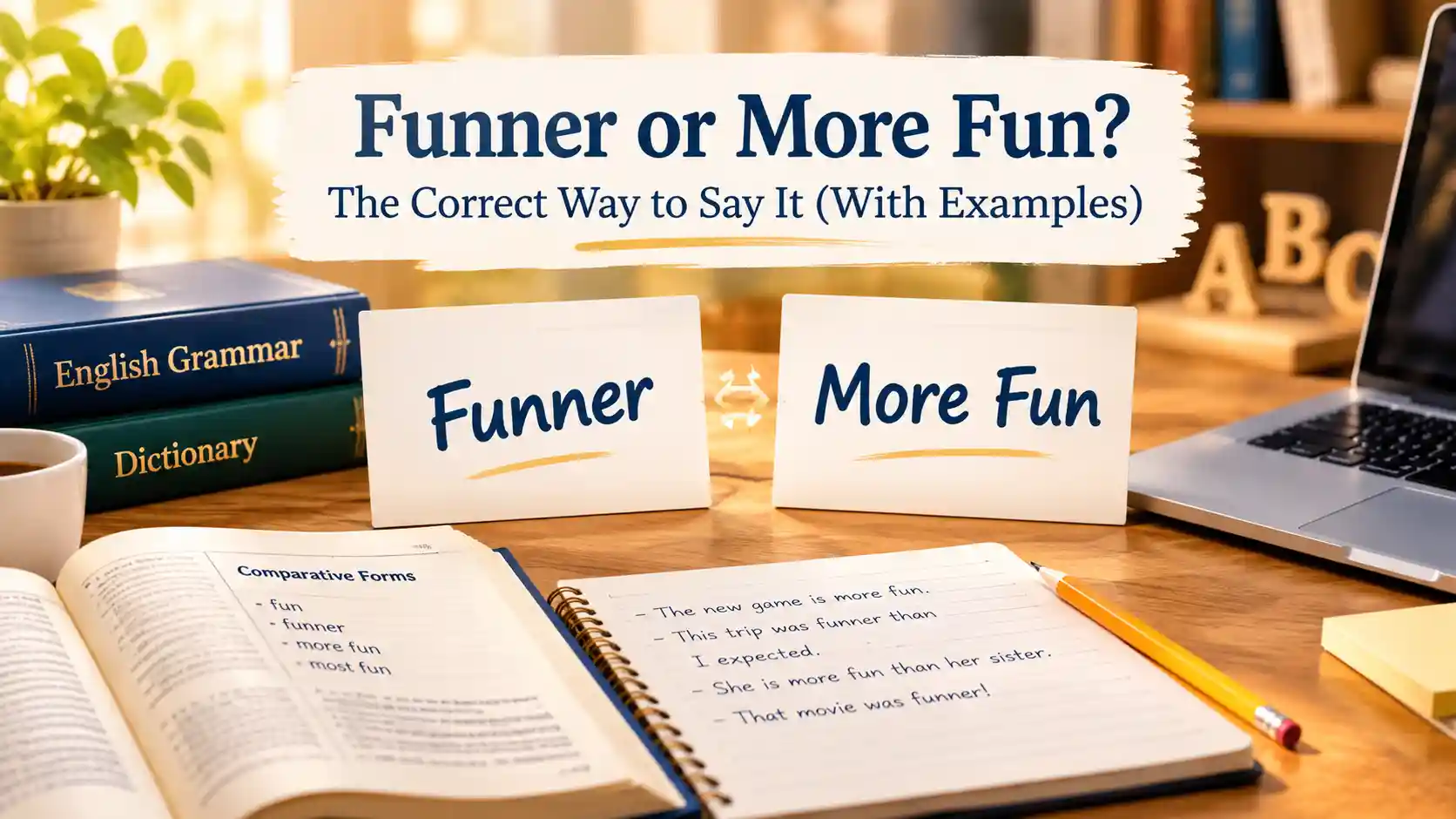
Use “more fun” in formal writing, school papers, business emails, and professional content. It is the safe, universally correct choice.
Use “funner” only in casual, playful speech or informal writing, like texting friends or writing a light social media caption.
Examples:
- Formal: “The new curriculum is more fun for students.” ✅
- Casual: “This game is funner than the last one!” (informal, acceptable in speech)
If you are ever unsure, choose “more fun.” It works in every context and never sounds wrong.
The Origin of Funner or More Fun
“Fun” started out as a noun, not an adjective. In the 1700s, it meant a trick, joke, or amusement — as in “he did it for fun.” People did not originally say “a fun party” or “this is fun.” That usage came much later.
Because “fun” was a noun, it never had a traditional comparative form like “faster” or “taller.” Nouns don’t take “-er” endings. Over the 20th century, “fun” slowly became used as an adjective too — “a fun trip,” “a fun person.” Once that shift happened, people naturally started trying to make it work like other short adjectives, leading to “funner” and “funnest.”
Grammar rules, though, are slower to change than everyday speech. Style guides and dictionaries still treat “fun” as having an unusual, incomplete shift into adjective status. That is why “funner” feels informal even though people use it constantly out loud.
British English vs American English Spelling
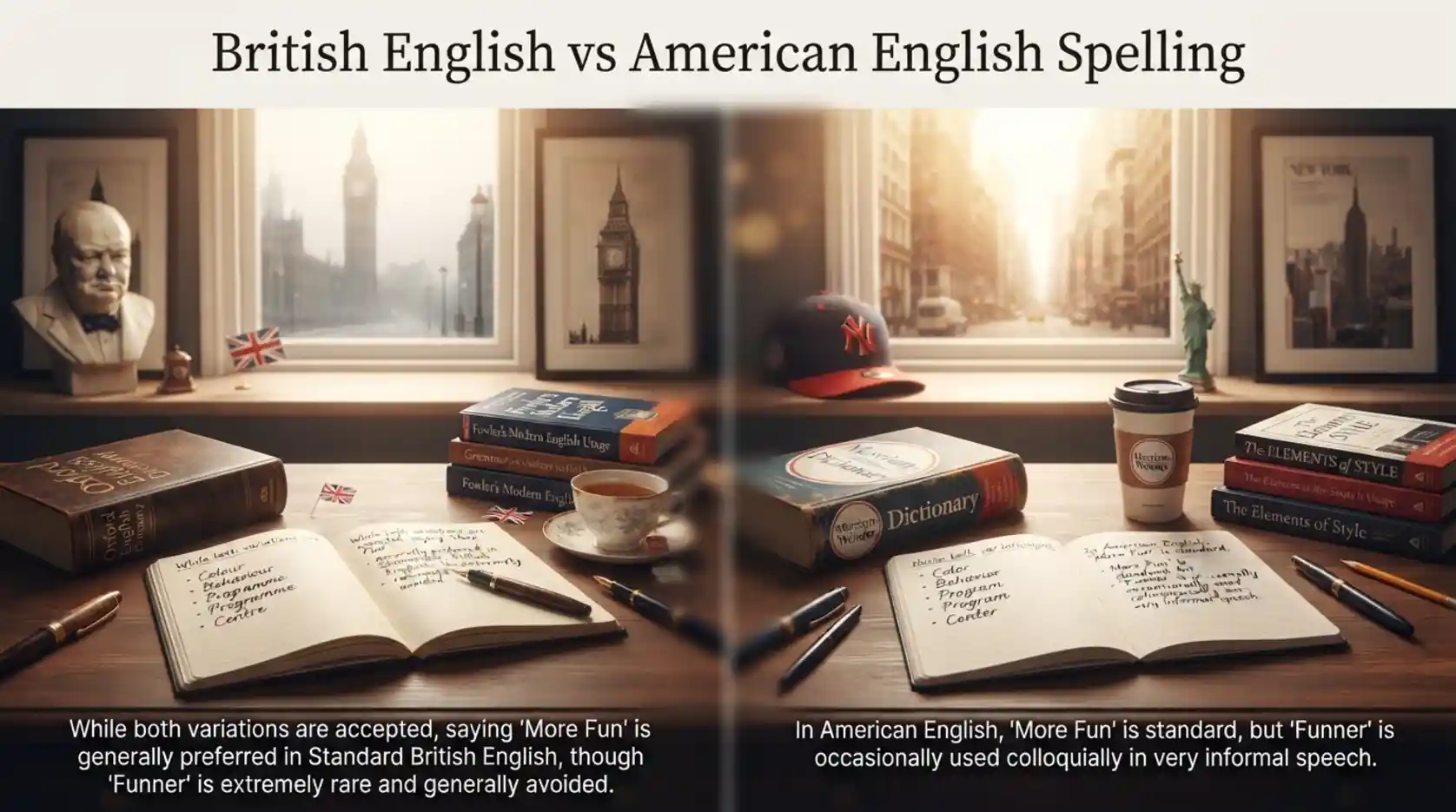
Both British and American English treat “more fun” as the standard, correct comparative form. There is no real spelling difference here like “colour” vs. “color.” The difference is about formality, not country.
However, American casual speech uses “funner” and “funnest” more often, especially among children and in pop culture. British English speakers tend to avoid “funner” even in casual settings, sticking with “more fun” almost always.
| Feature | American English | British English |
| Formal writing | More fun | More fun |
| Casual speech | Funner (common, informal) | More fun (funner is rare) |
| Dictionary status | Informal, sometimes listed | Rarely listed as standard |
| Children’s speech | Funner is very common | More fun is more common |
| Superlative form | Funnest (informal) | Most fun |
Which Spelling Should You Use?
Your choice depends on your audience and purpose.
If you are writing for:
- School, work, or business → Always use “more fun.” It is grammatically safe and professional.
- US casual audiences (texting, social captions) → “Funner” is acceptable and often sounds friendly or playful.
- UK or Commonwealth audiences (Canada, Australia, etc.) → Stick with “more fun.” “Funner” is much less accepted here.
- Global or international audiences → Use “more fun.” It avoids confusion and reads as correct everywhere.
- Creative or marketing copy → “Funner” can work if you want a fun, informal brand voice. Use it on purpose, not by accident.
The simple rule: formal or unsure? Use “more fun.” Casual and intentional? “Funner” is fine.
Common Mistakes with Funner or More Fun
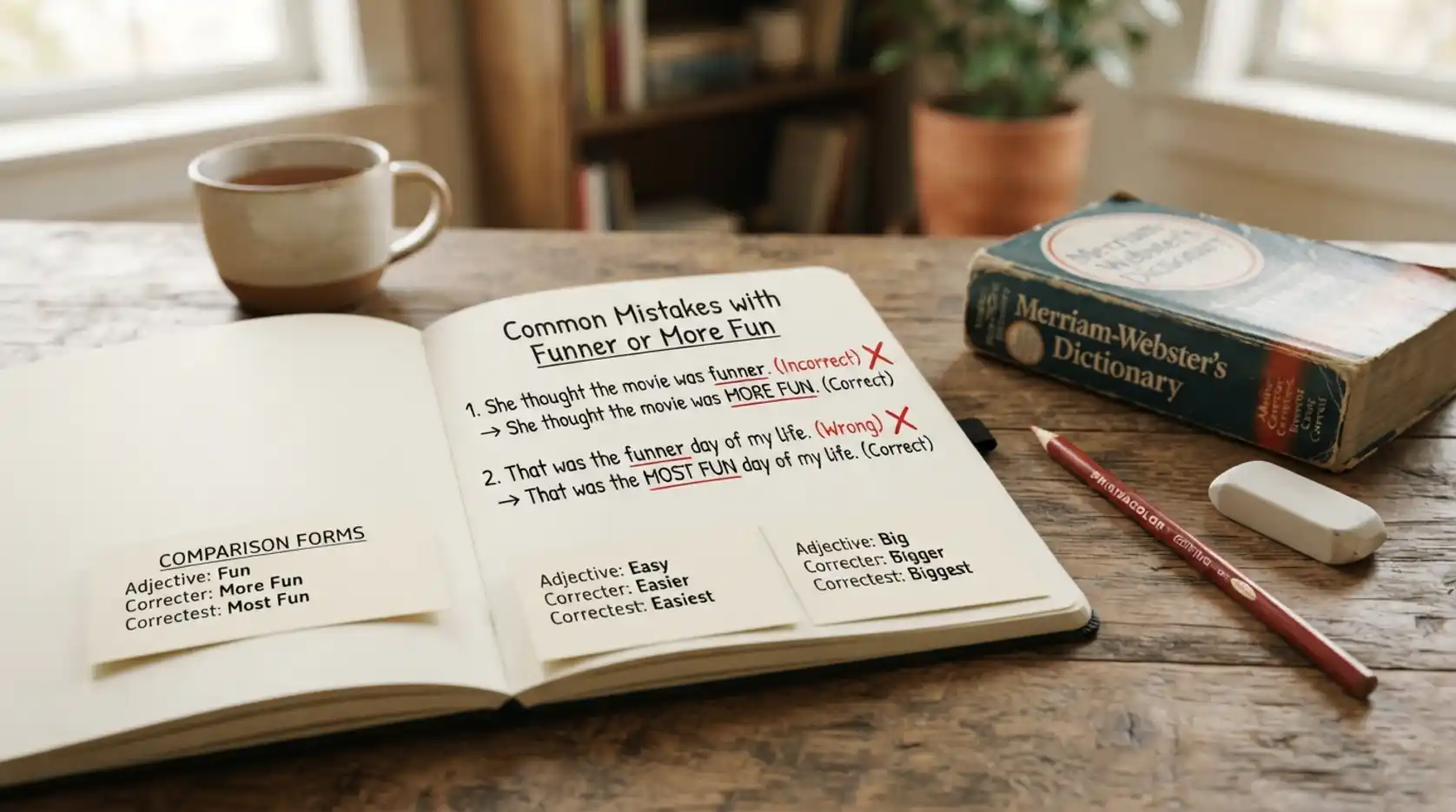
One common mistake is using “funner” in formal writing, such as a resume, school essay, or business email. In these situations, “more fun” is a better choice. For example, you can write, “The workshop was more fun than expected.”
Another mistake is using “most fun” and “funnest” interchangeably without considering the tone. “Most fun” is more suitable for formal writing, while “funnest” can be used in casual speech or playful writing.
Some people also assume that “funner” is always wrong. However, it is used in informal English and appears in some dictionaries. The important point is to consider the context and choose the form that suits your audience.
Another common error is saying “more funner.” This combines two comparative forms and should be avoided. Choose either “more fun” or “funner,” depending on the level of formality.
Finally, avoid using “funnest” in academic or professional writing. In these contexts, “most fun” is the more appropriate choice.
Funner or More Fun in Everyday Examples
Email (professional): “Thank you for organizing the retreat — it was more fun than last year’s event.”
News or article writing: “Critics say the sequel is more fun and faster-paced than the original film.”
Social media caption (casual): “This trip was WAY funner than I expected 😂🔥”
Text message to a friend: “Ngl the new gym class is funner than yoga.”
Formal report: “Survey results show employees found the hybrid schedule more fun and more engaging.”
These examples show the same pattern: professional and public writing leans on “more fun,” while personal, casual messages allow “funner” without issue.
Funner or More Fun – Google Trends & Usage Data
Search interest in “funner or more fun” spikes consistently, showing that this remains an ongoing point of confusion rather than a settled rule. The question tends to be searched more in the United States than in the United Kingdom, Canada, or Australia, matching the pattern of “funner” being more culturally accepted in American casual English.
Usage also skews by context: search and usage data patterns typically show “more fun” dominating in written, formal, and professional content, while “funner” appears more in spoken language, children’s content, and informal social posts. This lines up with the general rule that “more fun” is the safer, more widely searched, and more widely accepted term across formal content overall.
Keyword Variations Comparison
| Variation | Formality | Common Region | Use Case |
| More fun | Formal | US & UK | Writing, business, school |
| Funner | Informal | Mostly US | Speech, texting, casual posts |
| Most fun | Formal | US & UK | Superlative, formal writing |
| Funnest | Informal | Mostly US | Casual superlative |
| Funnier | Different word | US & UK | Refers to humor, not enjoyment |
FAQs About Funner or More Fun
1. Is “funner” a real word? Yes, it exists and appears in casual speech and some dictionaries as informal. It is not standard in formal writing.
2. Is “funner” grammatically correct? It is grammatically debated. “Fun” originated as a noun, so it does not follow typical adjective comparison rules the way “faster” or “taller” do.
3. Should I use “funner” in an essay? No. Always use “more fun” in essays, reports, and academic writing.
4. What is the superlative form of “fun”? Formally, “most fun.” Informally, some speakers use “funnest.”
5. Do British people say “funner”? Rarely. British English strongly favors “more fun” in both formal and casual contexts.
6. Why does “fun” not follow normal adjective rules? Because “fun” started as a noun and only recently shifted toward adjective use, it never fully adopted standard “-er” comparison rules like older adjectives.
7. Is it okay to use “funner” in marketing or branding? Yes, if it matches your brand voice. Many brands use “funner” intentionally for a playful, youthful tone.
8. What is the safest choice if I am unsure? Always choose “more fun.” It is correct in every context, formal or informal.
Conclusion
The debate between “funner” and “more fun” comes down to formality, not right versus wrong. “More fun” is the standard, safe, and universally accepted choice for formal writing, business communication, school work, and any professional content. “Funner” is not incorrect — it is simply informal, more common in American casual speech, and best used in texting, social captions, or intentionally playful branding.
Understanding the origin helps explain the confusion: “fun” began as a noun and only gradually became an adjective, which is why it never fully picked up standard comparison rules like older words such as “fast” or “tall.” That history is also why British English rarely uses “funner,” while American casual speech embraces it.
The simple rule to remember: when in doubt, use “more fun.” It works everywhere, sounds professional, and never risks sounding incorrect. Save “funner” for casual, personal, or deliberately playful writing where a relaxed tone fits.