Have you ever typed “sheer” and then paused, wondering if you meant “shear”? You are not alone. These two words sound exactly the same, but they mean completely different things. One describes something thin and see-through. The other means to cut.
People search for “sheer or shear” for a simple reason: English is full of words that sound alike but are spelled differently. Linguists call these homophones. Mixing them up is easy, and it happens to native speakers and learners alike. A wrong choice can also send the wrong message. “Sheer curtains” and “shear curtains” are not the same idea at all.
This confusion is not about British versus American spelling. Both words exist in every English-speaking country, and both are spelled the same way everywhere. The real issue is that your ear cannot tell them apart, only your eye can.
This guide gives you a fast answer first, then walks through the history, the correct usage, common mistakes, and real examples, so you can use the right word every time.
Sheer or Shear – Quick Answer
Here is the short version.
Sheer is an adjective. It describes something thin, light, or almost see-through. It can also mean “complete” or “total,” and as a verb, it means to swerve or turn sharply.
- She wore a sheer white blouse.
- That was sheer luck.
- The car sheered off the road.
Shear is mainly a verb. It means to cut something, often with a sharp tool, most commonly wool from a sheep. It is also a noun in physics and engineering, referring to a force that causes layers to slide against each other.
- The farmer will shear the sheep in spring.
- Use shears to trim the hedge.
- The metal failed under shear stress.
Quick rule: if you mean “thin” or “see-through,” use sheer. If you mean “to cut,” use shear.
The Origin of Sheer and Shear
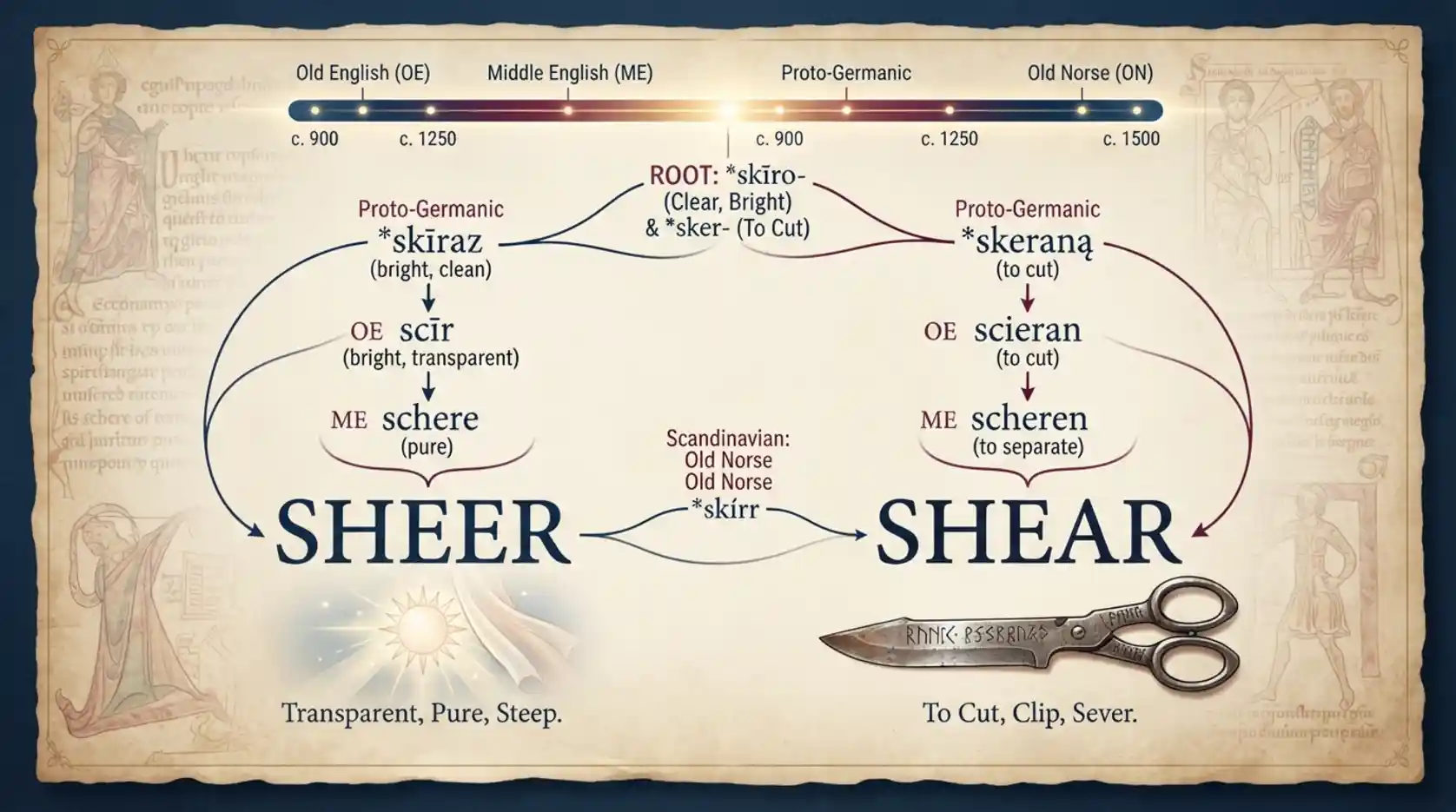
These two words come from different roots, which is why their meanings never overlap, even though their sound does.
Shear comes from the Old English word sceran, meaning “to cut.” It is one of the oldest verbs in the English language, tracing back to Proto-Germanic skeraną. This root also gave English the word “shears,” the cutting tool, and “share,” in the old sense of a plowshare, a blade that cuts through soil.
Sheer has two separate histories tangled into one spelling. The adjective meaning “thin” or “transparent” likely comes from a Scandinavian source related to “shine” or “shiny,” describing fabric so fine that light passes through it. The verb meaning “to swerve,” used mostly in sailing, comes from a different old Germanic root related to changing direction.
So why do sheer and shear sound the same today? Pure coincidence of sound change over centuries. English absorbed words from Old English, Old Norse, and other Germanic languages, and their pronunciations drifted together even as their spellings and meanings stayed apart. This is common in English. Think of “flower” and “flour,” or “the” and “thee.” Similar sound, unrelated origin.
British English vs American English Spelling
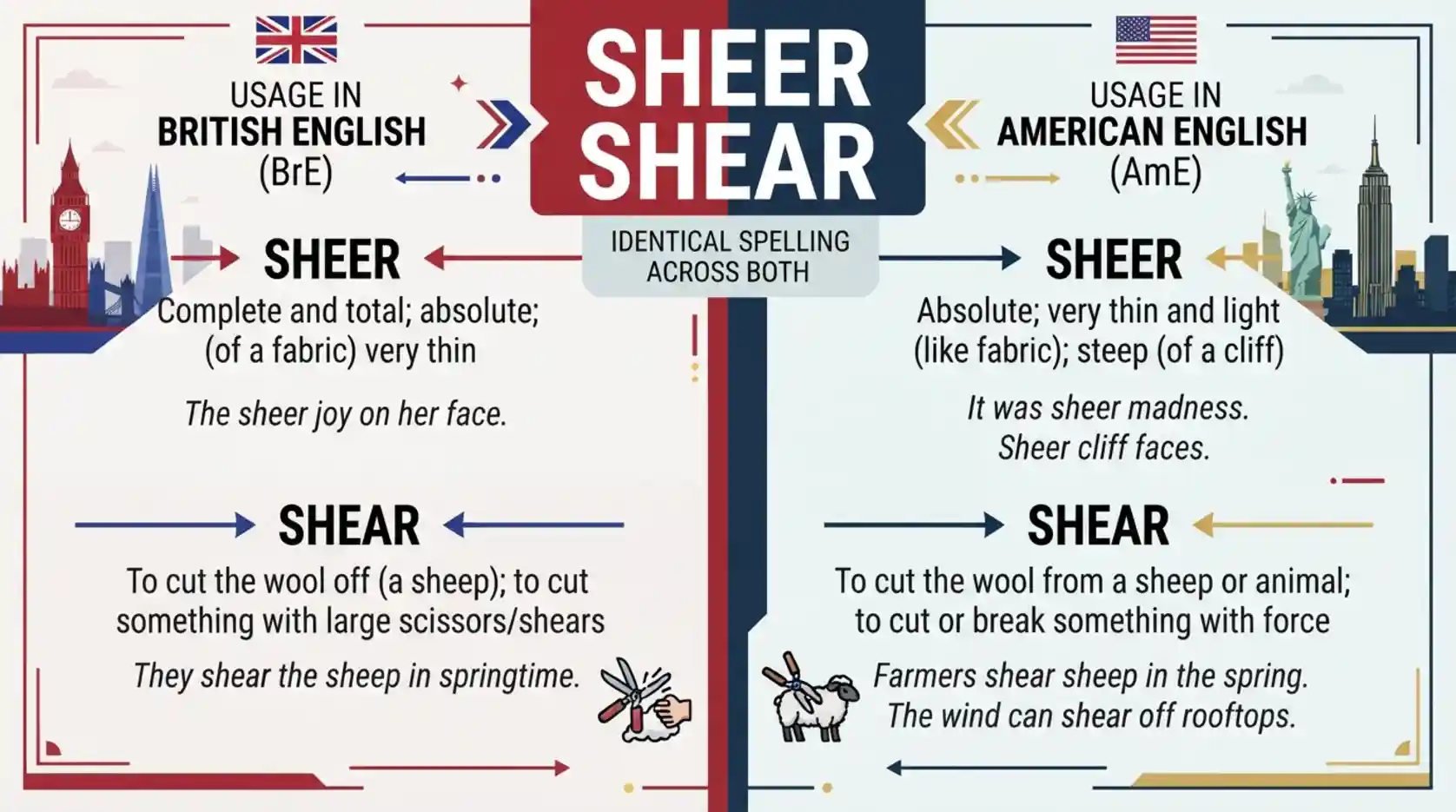
Here is an important point that clears up a lot of confusion: sheer and shear are spelled the same way in British English and American English. This is not a color/colour type of difference. There is no regional variant to choose between.
What does differ slightly is usage frequency and context. British English uses “shear” often in farming and engineering writing, tied to a long history of sheep farming and heavy industry. American English uses “shear” just as correctly, though it appears more in technical, scientific, and news contexts today.
| Feature | British English | American English |
| Spelling of “sheer” | sheer | sheer |
| Spelling of “shear” | shear | shear |
| Common noun form | shears (garden shears) | shears (also used) |
| Common technical use | shear stress, wind shear | shear stress, wind shear |
| Regional spelling variant? | No | No |
| Common trap | Confusing with “sheer” (sound) | Confusing with “sheer” (sound) |
The takeaway: you do not need to pick a “British” or “American” spelling here. You need to pick the correct word based on meaning.
Which Spelling Should You Use?
Since spelling is not the issue, the real question is which word fits your sentence. Here is guidance by audience and context.
For US writers: Use “sheer” for anything thin, transparent, or extreme in degree (sheer determination, sheer size). Use “shear” for cutting actions or technical/physics terms (wind shear, shear force).
For UK and Commonwealth writers (Australia, Canada, New Zealand, Ireland): The same rule applies. Farming and agricultural writing will use “shear” and “shearing” often, especially around sheep and wool industries.
For global or ESL writers: Learn the meaning pair, not the spelling. Picture a pair of scissors for “shear” (both start with sh, and shears cut). Picture sunlight through thin curtains for “sheer.” This mental image sticks better than any spelling rule.
For technical and scientific writing: “Shear” is standard in physics, engineering, geology, and meteorology (shear stress, wind shear, shear strength). Never substitute “sheer” here, it will look like an error to expert readers.
Common Mistakes with Sheer or Shear
- Writing “sheer stress” instead of “shear stress.” The correct engineering and physics term is always “shear stress.” “Sheer stress” is a spelling error, even though it reads smoothly.
- Writing “shear luck” instead of “sheer luck.” When you mean total or complete, the word is “sheer,” not “shear.”
- Confusing “shears” with “sheers.” Shears is a cutting tool, like scissors. Sheers, as a plural noun, refers to sheer curtains or sheer fabric. Both are real words, but they mean different things.
- Using “sheer off” instead of “shear off.” In engineering, a bolt or pin that breaks under force is said to “shear off.” Using “sheer off” here is incorrect, though “sheer off” is correct when describing a boat or vehicle swerving suddenly.
- Autocorrect swaps. Spellcheckers rarely catch this error because both words are spelled correctly, just used wrongly. Always proofread manually for this pair.
Sheer or Shear in Everyday Examples
In emails:
“Please find attached the shear stress report for the new bridge support.”
“I was amazed by the sheer volume of applications we received this year.”
In news headlines:
“Wind shear blamed for turbulence on transatlantic flight.”
“Sheer chaos erupts as markets react to interest rate news.”
On social media:
“This dress is so sheer, perfect for summer nights 🌙”
“Watched a sheep get sheared for the first time today, wild process!”
In formal writing:
“The committee was impressed by the sheer scale of the proposal.”
“Technicians measured the shear force applied to the steel beam.”
Notice the pattern: “sheer” appears with words about degree, light, or transparency. “Shear” appears with words about cutting, force, or breaking.
Sheer or Shear – Google Trends & Usage Data

Search interest in both words tends to spike around different triggers. “Sheer curtains” and “sheer fabric” see steady, seasonal search demand, especially in spring and summer when people shop for home decor and lightweight clothing. “Shear” sees interest tied to agriculture (sheep shearing season), aviation and weather news (wind shear incidents), and engineering or DIY searches (shear pins, shear bolts).
Search demand for “sheer or shear” as a comparison phrase reflects genuine everyday confusion rather than a debate between spelling systems. People searching this term are usually double-checking a specific sentence they are about to publish, send, or submit, which is why quick, example-based answers rank well and get used the most.
Interest in the pair is fairly consistent across English-speaking countries, since the confusion is about sound, not geography.
Keyword Variations Comparison Table
| Term | Part of Speech | Meaning | Example |
| Sheer | Adjective | Thin, transparent | Sheer stockings |
| Sheer | Adjective | Total, complete | Sheer joy |
| Sheer | Verb | To swerve sharply | The ship sheered away |
| Shear | Verb | To cut, especially wool | Shear the sheep |
| Shear | Noun | A cutting force | Shear stress on the beam |
| Shears | Noun (plural) | A cutting tool | Garden shears |
| Sheers | Noun (plural) | Sheer curtains/fabric | Hang the sheers |
FAQs
Is it “sheer luck” or “shear luck”?
It is “sheer luck.” Here, “sheer” means total or complete, describing luck with no other explanation behind it.
Is it “wind sheer” or “wind shear”?
The correct term is “wind shear.” It refers to a sudden change in wind speed or direction and is a standard term in aviation and meteorology.
What is the difference between “shears” and “sheers”?
“Shears” are a cutting tool, similar to large scissors. “Sheers” refers to thin, see-through curtains or fabric. They are pronounced the same but spelled and used differently.
Do British and American English spell these words differently?
No. Both “sheer” and “shear” are spelled identically in British and American English. There is no regional spelling variant for this word pair.
Is “sheer” always an adjective?
Mostly, but not always. “Sheer” can also work as a verb meaning to swerve or change direction suddenly, commonly used in nautical contexts, as in “the boat sheered off course.”
What does “shear stress” mean?
Shear stress is a technical term in physics and engineering. It describes a force that causes two layers of a material to slide against each other, rather than pulling them apart or pushing them together.
How can I remember the difference between sheer and shear?
Picture scissors when you think of “shear,” since both words relate to cutting. Picture sunlight through a thin curtain when you think of “sheer.” Linking each word to a clear image makes the difference easier to recall.
Conclusion
Sheer and shear sound identical but carry entirely different meanings, and mixing them up is one of the most common small errors in English writing. “Sheer” describes something thin, transparent, or total in degree, while “shear” means to cut or refers to a cutting force, especially in technical fields like engineering and meteorology. This is not a British versus American spelling issue. Both words are spelled the same everywhere English is written. The confusion comes purely from how they sound, not from regional rules.
The fastest way to get it right is to remember one simple test: if you are talking about cutting or a force that causes sliding, use “shear.” If you are talking about something thin, see-through, or complete, use “sheer.” Keep an eye out for technical terms like “shear stress” and “wind shear,” since these are fixed phrases that never take the other spelling.
With this quick rule in mind, plus the examples and comparison table above, you should never second-guess this word pair again, If you are writing an email, a headline, or a technical report.