While holding a jar of olives in the kitchen, you read the label and wonder: are olives a fruit or a vegetable?. Many people ask this every day.
The confusion is easy to understand. Olives taste salty and sharp. They sit on pizza, in salads, and next to cheese. That feels like a vegetable. But olives grow on trees, and they hold a seed. That feels like a fruit.
So which one is it? Science gives one answer. The kitchen gives another. This article clears it up fast. You will get a quick answer first.
Then you will learn where the word “olive” comes from, how people talk about olives in the US and UK, and how to explain it to others. You will also see common mistakes, real examples, and answers to common questions.
Let’s settle the debate about olives, fruit or vegetable, once and for all.
Olives Fruit or Vegetable – Quick Answer
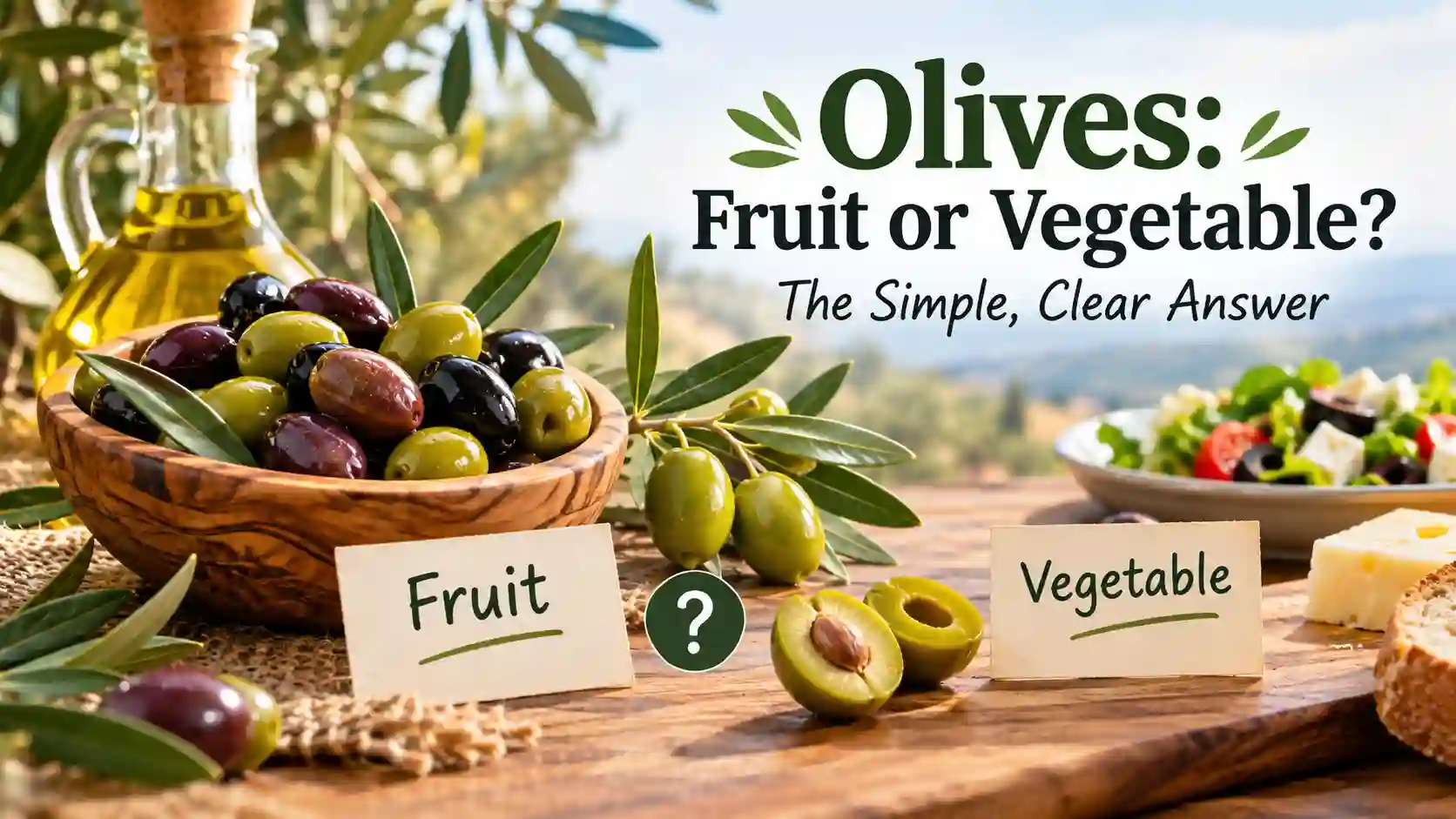
Olives are a fruit.
Here is why. A fruit grows from the flower of a plant and holds seeds. An olive grows from the flower of the olive tree. It holds one hard seed, called a pit or stone. That makes it a fruit. Botanists call it a drupe, or stone fruit.
Other drupes include:
- Peaches
- Cherries
- Plums
- Mangoes
In the kitchen, though, olives act like a vegetable. They are salty, not sweet. People serve them in savory dishes. So you can say this:
- Botanically: fruit
- In cooking: used like a vegetable
Both are true. The tree does not care how we cook it.
The Origin of “Olives”: Why the Fruit or Vegetable Question Exists
The word “olive” is old. It comes from the Latin word oliva. The Romans likely took it from the Greek word elaia. It came into English through Old French around the 1200s.
People have grown olives for thousands of years. They first grew in the Mediterranean region. Farmers there pressed them for oil and cured them for food.
Now the question. Why do people call olives a vegetable? There are three reasons.
- Taste. A fresh olive is very bitter. People soak it in brine or salt to make it safe and tasty. The result is salty, not sweet.
- Use. Cooks put olives in main dishes, not desserts.
- Shops. Stores often place olives near pickles and vegetables, not near apples and grapes.
So the habit comes from the kitchen, not from science. The word “fruit” in science means something different from the word “fruit” at dinner.
British English vs American English: Olives and Food Words
Good news: the spelling of “olive” is the same in British and American English. Both say olive and olives.
The real difference is in the food words around it. Some words change between countries. Here is a simple table.
| Topic | American English | British English |
| Spelling of the word | olive | olive |
| Olive without a pit | pitted olive | stoned olive (or pitted) |
| Olive oil flavor | flavor | flavour |
| Color of green olives | color | colour |
| Eggplant | eggplant | aubergine |
| Zucchini | zucchini | courgette |
| Short word for vegetables | veggies | veg |
Notice the pattern. “Olive” stays the same. But words like “flavor” and “flavour” do change. If you write about olives, watch those words.
There is also a rule of law story. In 1893, a US court called the tomato a vegetable for tax reasons. It is a fruit in science. This case shows how “kitchen rules” can beat “science rules” in daily life. Olives work the same way.
Which Term Should You Use? Fruit or Vegetable?
Pick the word that fits your reader.
- US readers: Say “olives are a fruit, but we eat them like a vegetable.” Use American spelling, like “flavor.”
- UK and Commonwealth readers: Use the same idea. Use British spelling, like “flavour.” You can say “veg” in casual writing.
- Global readers: Keep it simple. Say “Olives are a fruit (a stone fruit).” Then add a short note about cooking use.
A quick guide by setting:
- Science, school, or health writing: Use “fruit.”
- Recipes and menus: Use “olives” with no label, or say “savory fruit.”
- Nutrition labels and diets: Check the rules. Some diet plans list olives as a fat, not a vegetable.
Common Mistakes with “Olives Fruit or Vegetable”
Here are the errors people make most, with fixes.
| Mistake | Correction |
| “Olives are a vegetable.” | Olives are a fruit. Cooks use them like a vegetable. |
| “Olives are a nut.” | No. The olive has a stone, like a peach. It is not a nut. |
| “Olives are a berry.” | Not exactly. Olives are drupes, not berries. |
| “Fruit must be sweet.” | No. Many fruits are not sweet, like avocados and tomatoes. |
| “Black and green olives are two plants.” | They are often the same fruit at different stages of ripeness. |
| “Fresh olives can be eaten off the tree.” | They taste very bitter. They need curing first. |
Olives Fruit or Vegetable in Everyday Examples
Here is how the idea shows up in real life.
Email:
“Hi Sam, please note the salad has olives. They are a fruit, so they are fine for your fruit-only snack plan. Best, Mia”
News style:
“Farmers say the olive harvest was strong this year. Olives are a fruit, and the trees need warm, dry summers.”
Social media:
“Fun fact: olives are a fruit, not a vegetable! 🫒 #foodfacts”
Formal writing:
“The olive (Olea europaea) is a drupe. Although culinary tradition treats it as a savory food, it is botanically classified as a fruit.”
Menu:
“Marinated olives with herbs and lemon.”
Notice how the tone changes but the fact stays the same.
Olives Fruit or Vegetable – Google Trends and Usage Data
I do not have live Google Trends numbers, so I will not invent any. Here is what is safe to say, and how to check it yourself.
Common patterns for questions like this:
- Search interest for “fruit or vegetable” food questions tends to rise with viral posts and quiz shows.
- Interest often peaks around cooking seasons and holidays, when people plan food.
- Countries with big olive traditions, such as Spain, Italy, and Greece, often search in their own languages.
- English-speaking countries like the US, UK, India, and Pakistan search mainly for the quick answer.
How to check the data:
- Open Google Trends.
- Type “olives fruit or vegetable.”
- Compare it with “is olive a fruit” and “are olives vegetables.”
- Filter by country and time range.
- Look at “Related queries” for new ideas.
Keyword variations side by side
| Keyword variation | Likely search intent |
| olives fruit or vegetable | Quick answer, classification |
| is an olive a fruit | Yes/no answer |
| are olives vegetables | Checking a common belief |
| are olives a fruit or a nut | Comparing types |
| are olives a drupe | Science-minded readers |
| olive fruit nutrition | Health and diet |
Use these variations in headings and FAQs. They match how real people search.
FAQs About Olives: Fruit or Vegetable?
1. Are olives a fruit or a vegetable?
Olives are a fruit. They are stone fruits called drupes. Cooks use them like a vegetable.
2. Why are olives not sweet if they are a fruit?
Fruit means the part of a plant that holds seeds. It does not have to be sweet. Olives are low in sugar and high in oil.
3. Are black olives and green olives the same fruit?
Mostly, yes. Green olives are picked earlier. Black olives are picked riper. Some black olives are also treated to change color.
4. Are olives a nut?
No. An olive has a hard stone inside, like a cherry. It is not a nut.
5. Can I eat olives straight from the tree?
You can, but you will not enjoy it. Raw olives are very bitter. Curing removes the bitter taste.
6. Is olive oil made from a fruit?
Yes. Olive oil is pressed from the whole olive fruit.
7. Do olives count as a vegetable serving in a diet?
It depends on the plan. Many dietitians count olives as a healthy fat. Check your plan’s rules, and ask a health professional for advice.
8. Is the spelling different in the UK and the US?
No. It is “olive” in both. Only nearby words, like “flavor” and “flavour,” change.
Conclusion
Let’s sum it up. Olives are a fruit. They grow from a flower and hold a seed, which makes them drupes, just like peaches and cherries. In the kitchen, we treat them like a vegetable because they are salty . Both ideas are correct, and each one fits its own setting.
The word “olive” comes from Latin and Greek. It is spelled the same in American and British English. Only words like “flavor” and “flavour” or “eggplant” and “aubergine” change from country to country.
Here is your simple advice:
- For school, science, and health writing, say olives are a fruit.
- For menus and recipes, use olives as you like. No label is needed.
- For a global audience, say olives are a fruit, used like a vegetable in cooking.
- Avoid calling olives a nut or a berry.
Next time someone asks about olives, fruit or vegetable, you will have a clear, friendly answer ready. Share it at the dinner table, and enjoy your olives.