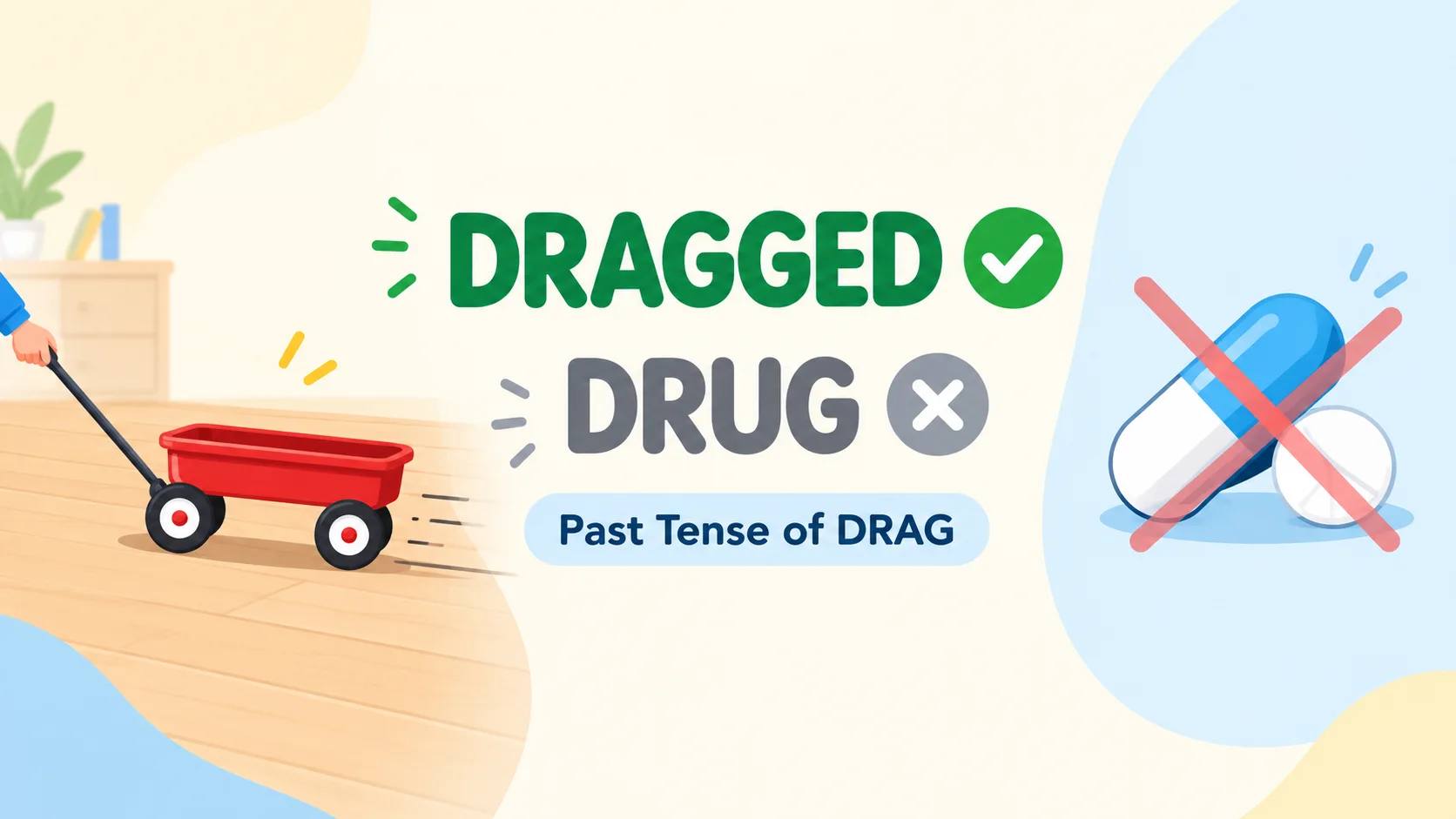
If you’ve ever written “I drug the box across the room” and then paused, wondering if that’s even a real word, you’re not alone. Millions of English speakers search for “drug or dragged” every year because the past tense of “drag” causes real confusion.
Here’s the short story. “Dragged” is the standard, correct past tense of “drag” in formal English. “Drug” is a regional, informal variant used mostly in the Southern and Midland United States. Both show up in speech. Only one shows up in most writing.
This mix-up happens because English learners, students, and even native speakers hear “drug” used casually and assume it’s a valid alternative to “dragged.” It sounds similar to how “dig” becomes “dug.” But “drag” doesn’t follow that pattern.
This article gives you the quick answer, the history behind the confusion, spelling rules across English dialects, real examples, and clear advice on which word to use. By the end, you’ll never second-guess this word again.
Drug or Dragged – Quick Answer
Use “dragged” in all formal, professional, and written English. It is the standard past tense and past participle of “drag.”
- Correct: She dragged the suitcase up the stairs.
- Correct: He has dragged his feet on this project for weeks.
- Informal/regional: He drug the couch into the garage.
“Drug” as a past tense of “drag” is considered nonstandard. It is common in casual speech in parts of the American South and Midwest, but dictionaries and style guides mark it as dialectal, not correct.
The Origin of Drug or Dragged
“Drag” comes from Old Norse draga and Old English dragan, both meaning “to pull.” Regular English verbs form their past tense by adding “-ed.” That’s why “drag” became “dragged.”
So why does “drug” exist at all? Many English verbs follow irregular patterns, like “dig” to “dug” or “swim” to “swam.” Some speakers applied that same pattern to “drag,” turning it into “drug” by analogy. This happened naturally in spoken dialects, especially in rural American English, over the past two centuries.
Language experts call this an “analogical formation.” It’s not a mistake in the sense of ignorance. It’s a natural pattern speakers created, even though it never became the accepted standard form.
British English vs American English Spelling
Both British and American English agree on this one. “Dragged” is correct in both. There is no British-versus-American spelling split here, unlike words such as “colour/color” or “realise/realize.”
The real divide isn’t British versus American. It’s standard versus regional dialect.
| Version | Region | Status | Example |
| Dragged | UK and US, all formal writing | Standard, correct | She dragged the chair closer. |
| Drug | Parts of Southern/Midland US | Regional, informal | He drug the ladder outside. |
| Drug (noun) | Global | Standard, but different word entirely | She took the drug for pain relief. |
Note the important trap: “drug” is also a completely separate, correct English word meaning medicine or a controlled substance. That’s why the confusion spreads so easily.
Which Spelling Should You Use?
- In the United States: Use “dragged” in writing, school work, business emails, and news. Say “drug” only if you’re deliberately reflecting Southern or rural dialect in dialogue or casual speech.
- In the UK, Canada, Australia, and other Commonwealth countries: “Drug” as a past tense of “drag” is rarely used at all. Stick with “dragged” everywhere.
- For global or professional audiences: Always choose “dragged.” It’s understood everywhere and carries no risk of sounding incorrect.
- For fiction or dialogue: “Drug” can work if you want a character to sound authentically regional. Use it on purpose, not by accident.
Common Mistakes with Drug or Dragged
- Writing “drug” in formal documents. Wrong: “The meeting drug on for hours.” Correct: “The meeting dragged on for hours.”
- Confusing the verb with the noun. “He drug the injured man to safety” is wrong. “He dragged the injured man to safety” is right. Don’t confuse this with “drug” meaning medicine.
- Assuming “drug” is simply an accepted alternative everywhere. It isn’t. Most dictionaries label it dialectal or informal.
- Using “drug” in academic or business writing. This can make writing look careless, even if the meaning is clear.
- Overcorrecting in dialogue. Writers sometimes replace natural regional speech with “dragged,” losing character voice when “drug” was intentional.
Drug or Dragged in Everyday Examples
Email:
“I dragged the file into the shared folder yesterday.”
News writing:
“Investigators say the suspect dragged the victim several feet before fleeing.”
Social media (casual, regional):
“lol I drug myself out of bed at 5am today”
Formal writing:
“The negotiations dragged into a third week without resolution.”
Fiction dialogue (regional voice):
“He drug that old truck outta the ditch himself,” Earl said.
Drug or Dragged – Google Trends & Usage Data
Search interest in “drug or dragged” spikes mainly from the United States, especially states in the South and Midwest, where the informal usage is common in daily speech. Searches often come from students checking grammar homework, writers editing dialogue, and non-native English learners confused by conflicting examples online.
In the UK, Australia, and Canada, search volume for this comparison is low, since “drug” as a past tense barely appears in those dialects. Globally, “dragged” dominates in published writing, news archives, and books by a wide margin, confirming its status as the accepted standard.
| Term | Common Region | Typical Use |
| Dragged | Global | Writing, formal speech, media |
| Drug | US South/Midland | Casual regional speech only |
| Drug (medicine) | Global | Unrelated noun, different meaning |
FAQs
Is “drug” ever correct as a past tense?
It’s used in some regional American dialects, but it’s not considered standard or correct in formal writing.
What is the past participle of “drag”?
“Dragged.” Example: “The box has been dragged across the floor.”
Why do some Americans say “drug” instead of “dragged”?
It developed through analogy with irregular verbs like “dig/dug,” becoming common in Southern and Midland US speech.
Is “drug” grammatically wrong?
Most dictionaries and style guides label it nonstandard or dialectal, not outright wrong in speech, but incorrect for formal writing.
Should I use “drug” in a school essay?
No. Always use “dragged” in academic writing.
Does British English ever use “drug” as a past tense?
Rarely, if ever. British English consistently uses “dragged.”
Can “drug” and “dragged” both appear in fiction?
Yes. Use “dragged” for narration and “drug” for dialogue if a character’s regional voice calls for it.
Conclusion
The “drug or dragged” confusion comes down to one simple rule: “dragged” is correct, and “drug” is a regional, informal variant heard mainly in parts of the American South and Midwest. Both British and American English agree that “dragged” is the proper past tense of “drag,” so there’s no real transatlantic spelling divide here, unlike other classic UK-US differences.
Use “dragged” in emails, essays, news writing, and any professional context. Save “drug” for casual speech or intentional dialogue that reflects a specific regional voice. Remember, too, that “drug” is also a completely different, standard word when it means medicine, so context matters.
When in doubt, “dragged” is always the safe, correct, globally understood choice. Keep that rule in mind, and you’ll never trip over this common English mix-up again.