You pour ethanol into water. It mixes fast. You pour oil into water. It just sits there. Why? The answer is polarity. That is why so many people ask, “ethanol polar or nonpolar?”
Students search this before a chemistry test. Cooks search it when they make vanilla extract. People who make hand sanitizer, perfume, and fuel ask it too. The answer can feel tricky. Ethanol has one part that loves water. It also has one part that does not. So people get confused.
Here is the short version. Ethanol is a polar molecule. It is not as polar as water. But it is polar enough to mix with water in any amount. That is the key fact.
In this article, you will get a quick answer first. Then you will learn where the words come from, how they are spelled, and what mistakes to avoid. You will also see real examples, common questions, and clear advice.
Let’s clear up the confusion for good.
Ethanol Polar or Nonpolar – Quick Answer
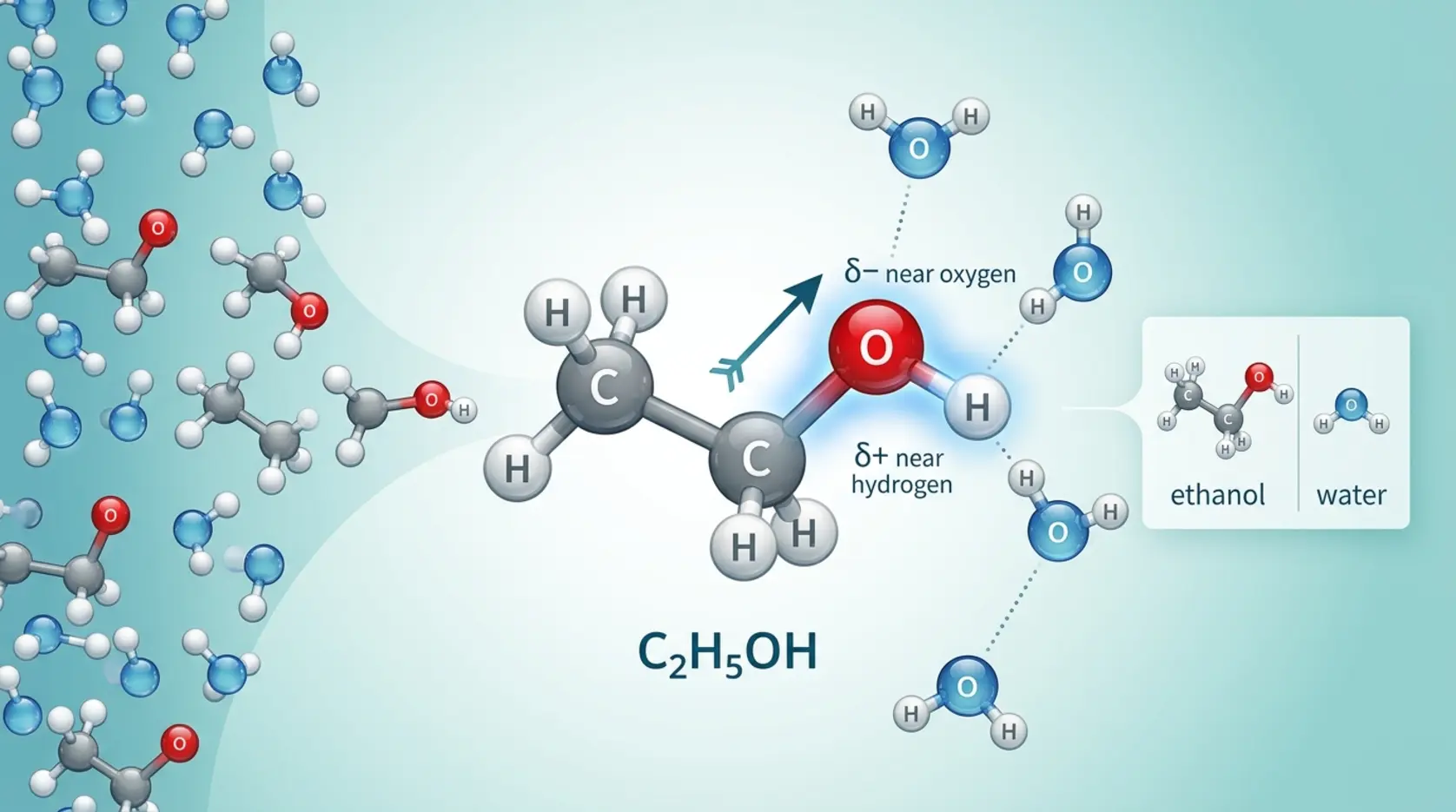
Ethanol is polar.
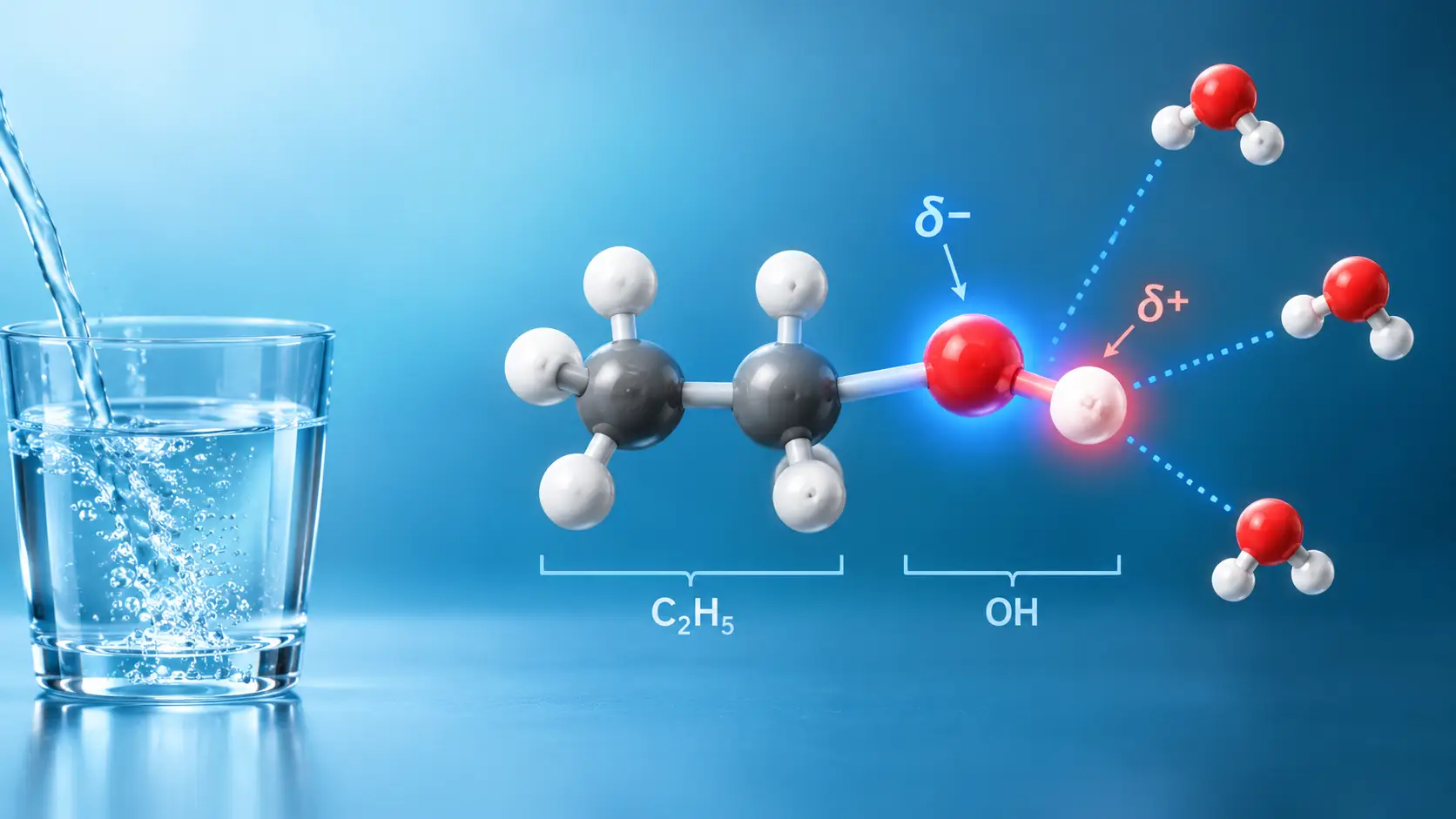
Formula of ethanol is C₂H₅OH. Look at the end of the molecule. It has an O–H group. Oxygen pulls electrons toward itself. This gives oxygen a small negative charge. It gives hydrogen a small positive charge. That uneven charge is what “polar” means.
The molecule is also bent around the oxygen atom. So the charges do not cancel out. Ethanol has a dipole moment of about 1.7 debye. That is a clear sign of a polar molecule.
Ethanol can also form hydrogen bonds. This is why it mixes so well with water.
But there is a twist. Ethanol has a short carbon tail (CH₃CH₂–). That tail is nonpolar. So ethanol is polar with a small nonpolar side.
Simple examples:
- Ethanol mixes with water in any ratio.
- It dissolves many oils and scents. That is why perfume uses it.
- It dissolves less salt than water does.
- It has a lower dielectric constant than water (about 25 vs. about 80). This means it is less polar than water.
Bottom line: Ethanol is a polar solvent. Chemists call it “polar protic.”
The Origin of “Ethanol” and “Polar”
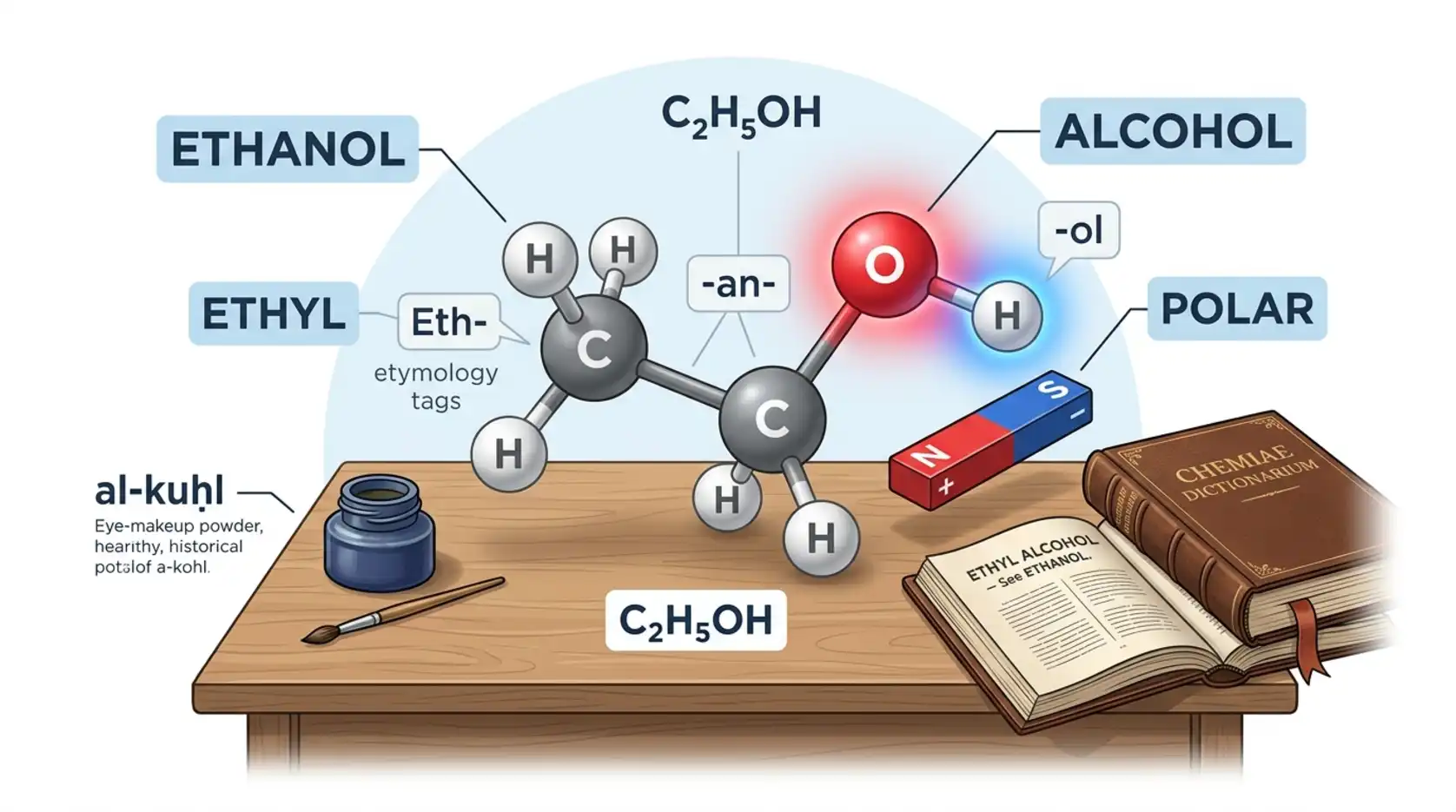
Words have stories. These two do too.
Ethanol. The word has three parts. “Eth-” comes from ethane, a gas with two carbon atoms. “-an-” shows single bonds. “-ol” shows an alcohol group. The “-ol” ending was set in a global naming system agreed on in 1892 in Geneva. Chemists wanted one clear way to name compounds.
Ethyl. This word comes from the old word “ether.” It is why you still hear “ethyl alcohol.”
Alcohol. This word comes from Arabic, “al-kuḥl.” It first meant a fine powder used as eye makeup. Later, it came to mean a pure spirit made by distilling.
Polar. This comes from Latin “polus,” which means “pole.” Think of the two poles of a magnet. A polar molecule has two “poles,” one slightly positive and one slightly negative.
Why do spelling differences exist? “Ethanol” is spelled the same everywhere. The split happens with “nonpolar.” Some writers join it. Some add a hyphen. Both styles grew out of how English handles the prefix “non-.” The next section shows how.
British English vs American English Spelling
Good news: “ethanol” has one spelling. But related science words often differ. Here is a simple guide.
| Word | American English | British English | Note |
| Not polar | nonpolar | non-polar (also nonpolar) | Both are correct |
| Ethanol | ethanol | ethanol | Same everywhere |
| Other name | ethyl alcohol | ethyl alcohol | Same everywhere |
| Volume unit | liter | litre | Used for ethanol amounts |
| Element | sulfur | sulphur (older UK); sulfur (modern science) | Sulfur is now standard in science |
| Car fuel | gasoline | petrol | Ethanol is blended into both |
The rule of thumb: American writers usually join “non-” words. British writers often keep the hyphen. Science journals in both countries accept “nonpolar.”
Which Spelling Should You Use?
Pick the spelling that fits your reader.
- US readers: Write “nonpolar.” Write “liter.”
- UK and Commonwealth readers: Write “non-polar” or “nonpolar.” Write “litre.” Both are fine, but stay the same all the way through.
- Global readers: Use “nonpolar.” Science papers use it a lot. It also matches the way many search engines see the word.
Pro tip: Never mix styles in one article. Do not write “nonpolar” in one line and “non-polar” in the next.
For SEO, you can use both forms. Use one in your headline. Use the other once or twice in the text. This helps you reach both groups of searchers.
Common Mistakes with “Ethanol Polar or Nonpolar”
Here are the errors people make most.
Mistake 1: “Ethanol is nonpolar because it has carbon and hydrogen.”
Fix: The O–H group makes the whole molecule polar.
Mistake 2: “Ethanol is as polar as water.”
Fix: Ethanol is less polar. The carbon tail lowers its polarity.
Mistake 3: “Polar means charged.”
Fix: Polar molecules have small partial charges. Ions like Na⁺ have full charges. They are not the same.
Mistake 4: Mixing up names.
Fix: Ethanol (C₂H₅OH) is not ethanal (an aldehyde) or ethanoic acid (vinegar acid). One or two letters change everything.
Mistake 5: Saying “ethanol is only polar or only nonpolar.”
Fix: It is polar overall. It just has a nonpolar part. That is why it dissolves so many things.
Mistake 6: Misspelling it as “ethonal” or “ethenol.”
Fix: The correct spelling is e-t-h-a-n-o-l.
“Ethanol Polar or Nonpolar” in Everyday Examples
You will see this question in many places. Here is how people use it.
In an email:
“Hi Ms. Lee, quick question for the lab. Is ethanol polar or nonpolar? I need to pick the right solvent.”
In the news:
“Ethanol is a polar solvent. That is why it works well in hand sanitizers, the report said.”
On social media:
“Why does ethanol mix with water but oil does not? Because ethanol is polar. #chemistry #science”
In formal writing:
“Ethanol is a polar protic solvent. It forms hydrogen bonds and dissolves both polar and some nonpolar compounds.”
In a classroom:
“Ethanol has an O–H bond. Oxygen is more electronegative than hydrogen. So the molecule is polar.”
“Ethanol Polar or Nonpolar” – Google Trends and Usage Data
I can’t pull live Google Trends numbers here, so this section describes the general pattern. You can check the exact figures at trends.google.com.
When people search: Interest usually rises during school and college terms. It often dips in summer. Exam season is a common peak.
Where people search: The phrase is popular wherever many students study chemistry in English. That includes the US, India, the UK, Canada, and Australia.
Why people search:
- Students want a fast answer for homework.
- Cooks and makers want to know how ethanol dissolves flavors and scents.
- Workers in labs and factories want to pick the right solvent.
Spelling trend: “Nonpolar” and “non-polar” are both searched. Many people also type the question in different ways, as the table below shows.
Keyword Variations Side by Side
| Search phrase | Likely reader | Main need |
| ethanol polar or nonpolar | Students, general readers | Quick answer |
| is ethanol polar or non-polar | UK and Commonwealth readers | Quick answer |
| is ethanol polar | Students | Yes or no answer |
| is ethanol a polar solvent | Lab workers, makers | Use in practice |
| ethyl alcohol polarity | Older texts, pharmacy readers | Same answer, older name |
| ethanol polarity index | Chemistry students | Numbers and comparison |
Frequently Asked Questions
1. Is ethanol polar or nonpolar?
Ethanol is polar. Its O–H group creates uneven charge and allows hydrogen bonding.
2. Why does ethanol mix with water?
Both are polar. Both form hydrogen bonds. So they blend in any ratio.
3. Is ethanol more polar than water?
No. Water is more polar. Ethanol’s carbon tail makes it a bit less polar.
4. Can ethanol dissolve nonpolar substances?
Some, yes. Its carbon tail helps it dissolve oils, scents, and many plant compounds. It does not dissolve all nonpolar things well.
5. Is ethanol a polar protic or polar aprotic solvent?
Ethanol is polar protic. It has an H attached to oxygen, so it can donate hydrogen bonds.
6. Is it “nonpolar” or “non-polar”?
Both are correct. Americans usually write “nonpolar.” Many British writers use “non-polar.”
7. Is ethyl alcohol the same as ethanol?
Yes. They are two names for the same compound, C₂H₅OH.
Conclusion
Let’s sum it up. Ethanol is polar. Its O–H group pulls electrons and makes uneven charge. It can form hydrogen bonds. That is why it mixes so well with water.
Ethanol also has a short carbon tail that is nonpolar. That tail helps it dissolve oils and scents. So ethanol works well in perfume, extracts, sanitizers, and labs.
Remember these key points:
- Ethanol is polar, but less polar than water.
- It is a polar protic solvent.
- “Ethanol” has one spelling worldwide.
- “Nonpolar” and “non-polar” are both correct. Pick one and stay consistent.
- Do not confuse ethanol with ethanal or ethanoic acid.
Usage advice: If you write for US readers, use “nonpolar.” If you write for UK or Commonwealth readers, “non-polar” is fine. If your audience is global, “nonpolar” is the safe choice.
Now you have a quick answer, a clear reason, and a few tips to explain it to anyone. The next time someone asks, “ethanol polar or nonpolar?”, you will know exactly what to say.