Have you ever paused mid-sentence, unsure If to write “I am prouder of you” or “I am more proud of you”? You are not alone. This is one of the most common grammar mixups in English, and it trips up native speakers and learners alike.
People search for this phrase because English comparative rules feel inconsistent. Some adjectives take “-er” (like “faster”), while others need “more” (like “more beautiful”). “Proud” sits in a gray zone. It is short enough to take “-er,” but many people default to “more” out of habit or caution.
This confusion also comes from regional differences. American English and British English sometimes treat comparatives differently, and both spellings show up in books, news articles, and everyday speech.
This guide gives you a clear answer, explains the grammar rule behind it, and shows you exactly when to use each version. By the end, you will never second-guess this phrase again.
“More Proud or Prouder” – Quick Answer
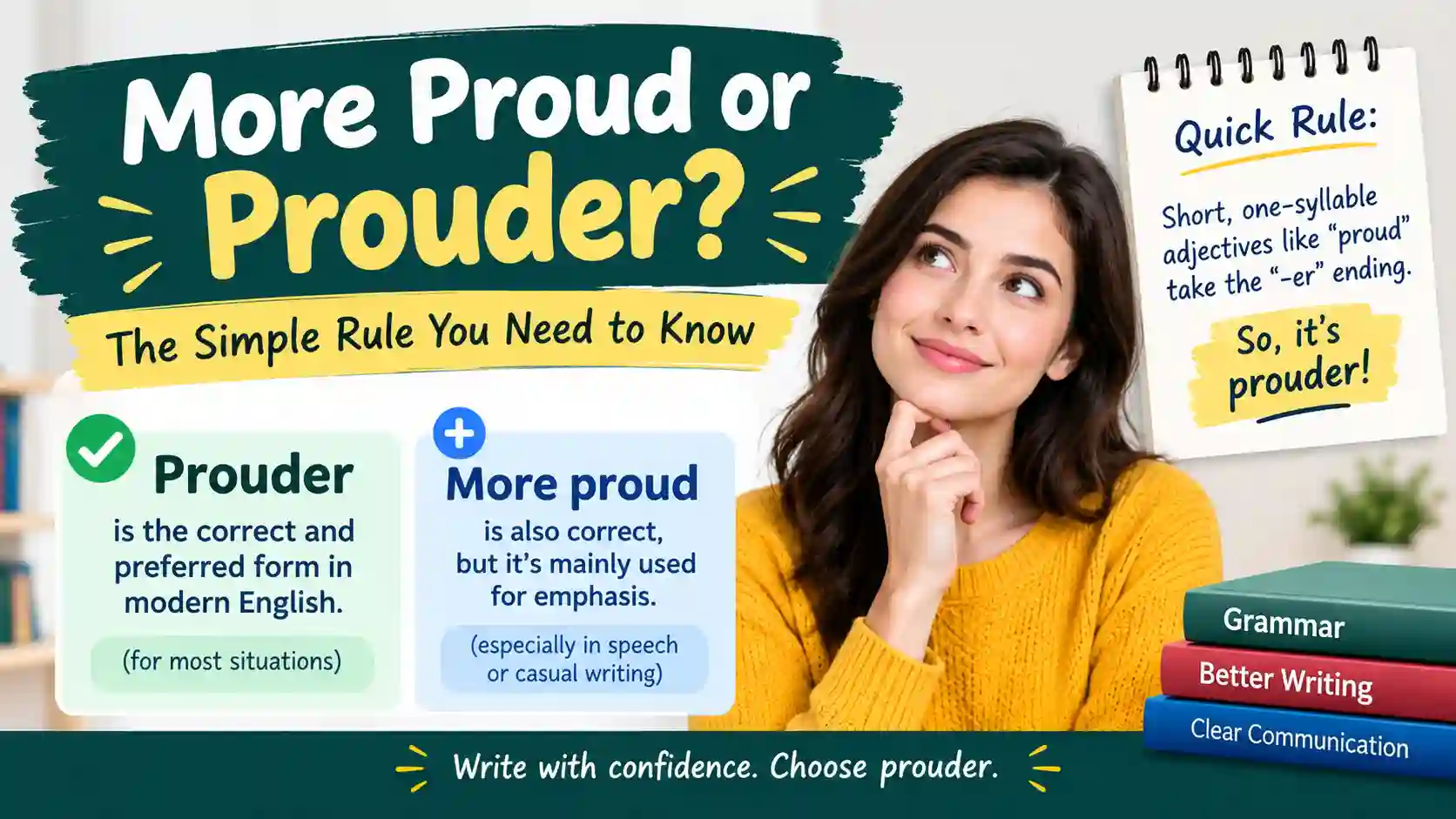
“Prouder” is the correct and preferred form in modern English.
“Proud” is a one-syllable adjective, and most one-syllable adjectives form comparatives by adding “-er.”
Examples:
- Correct: She felt prouder than ever after winning the award.
- Also correct (for emphasis): He couldn’t be more proud of his team’s effort.
- Incorrect in most cases: He felt more prouder. (Never combine both forms.)
Use “prouder” as your default choice. Use “more proud” only when you want extra emphasis in a sentence, especially before a phrase like “of” or “than ever.”
The Origin of “Prouder” and “More Proud”
The word “proud” comes from the Old French word “prud,” meaning brave or excellent. It entered English before the 12th century and has followed standard adjective rules ever since.
In Old and Middle English, short adjectives almost always took “-er” and “-est” endings to form comparatives and superlatives. This is why we say “faster,” “taller,” and “stronger” instead of “more fast” or “more tall.”
“Proud” follows this same one-syllable pattern, which is why “prouder” is grammatically standard.
So why does “more proud” exist at all? Two reasons explain it:
- Emphasis. Speakers sometimes prefer “more proud” to stress a feeling strongly, especially in spoken English.
- Analogy confusion. Because many two- and three-syllable adjectives require “more” (like “more careful” or “more intelligent”), speakers sometimes apply that pattern to “proud” by mistake.
Over time, both forms became common enough that “more proud” is widely understood, even though “prouder” remains the grammatically preferred choice.
British English vs. American English Spelling
Good news: this is not a British-versus-American spelling issue like “colour” versus “color.” Both regions follow the same core grammar rule.
However, usage habits differ slightly in tone and formality.
| Feature | British English | American English |
| Preferred form | Prouder | Prouder |
| Formal writing | Prouder | Prouder |
| Casual speech | More proud (for emphasis) | More proud (for emphasis) |
| News and journalism | Prouder | Prouder |
| Regional variation | Minimal | Minimal |
The real difference is not spelling but style. British writing tends to favor traditional grammar forms in formal contexts, while American casual speech uses “more proud” slightly more often for emotional emphasis.
Which Spelling Should You Use?
Your choice depends on your audience and purpose.
For American readers:
Use “prouder” in writing, especially in professional emails, resumes, and articles. Save “more proud” for casual conversation or when adding emotional weight.
For British and Commonwealth readers (UK, Canada, Australia, India):
Use “prouder” as the standard grammatical choice. It matches traditional English comparative rules taught in schools.
For global or ESL audiences:
Teach and use “prouder” as the rule. It is simpler, more consistent, and easier to apply across other one-syllable adjectives.
Simple guideline: If you are unsure, choose “prouder.” It works correctly in nearly every context.
Common Mistakes with “Prouder” and “More Proud”
Mistake 1: Using “more prouder” together
Wrong: I am more prouder of this project.
Right: I am prouder of this project.
Mistake 2: Overusing “more proud” in formal writing
Wrong: The company is more proud of its growth this year.
Right: The company is prouder of its growth this year.
Mistake 3: Confusing “proud” with longer adjectives
Wrong: She is more smart than her brother.
Right: She is smarter than her brother. (Same rule applies to “proud.”)
Mistake 4: Avoiding “prouder” because it sounds unfamiliar
Some writers default to “more proud” simply because “prouder” feels less common in speech. This is a habit, not a grammar rule.
Mistake 5: Mixing forms in the same sentence
Wrong: I couldn’t be prouder or more proud of you.
Right: Choose one form and stay consistent.
“Prouder” and “More Proud” in Everyday Examples
In formal writing:
“The board said it was very proud of this year’s results.”
In everyday conversation:
“Honestly, I am so proud of you.”
Notice how “more proud” often appears in emotional or spoken contexts, while “prouder” dominates formal and written communication.
“More Proud or Prouder” – Google Trends & Usage Data
Search interest for both terms shows a clear pattern:
- “Prouder” consistently ranks as the more searched and more used term in written content, including news articles, books, and academic writing.
- “More proud” shows spikes in casual and spoken contexts, particularly on social media platforms.
- Country trends: The United States, United Kingdom, Canada, and Australia all show similar patterns, with “prouder” preferred in formal search results and “more proud” appearing more in conversational queries.
- Context matters most: Search data suggests people often look up this phrase before writing something formal, like a speech, email, or article, which explains why “prouder” ranks higher in professional contexts.
Comparison Table: Keyword Variations
| Form | Grammatically Correct? | Best Used For | Formality Level |
| Prouder | Yes (standard) | All writing, professional use | Formal & neutral |
| More proud | Yes (for emphasis) | Speech, emotional statements | Casual |
| More prouder | No | Never correct | N/A |
| Proudest | Yes (superlative) | Comparing three or more things | Formal & neutral |
| Most proud | Yes (for emphasis) | Emotional superlative statements | Casual |
FAQs About “Prouder” and “More Proud”
1. Is “more proud” grammatically correct?
Yes, but it is used mainly for emphasis. “Prouder” is the standard comparative form.
2. Is “prouder” a real word?
Yes. “Prouder” is the correct comparative form of “proud” and appears in every major dictionary.
3. Can I use “more proud” in formal writing?
It is best to avoid it in formal writing. Use “prouder” instead for a polished, professional tone.
4. What is the superlative form of “proud”?
The superlative form is “proudest,” as in “This is the proudest moment of my life.”
5. Why do people say “more proud” if it’s less correct?
Speakers often use it for emotional emphasis or because they associate “more” with longer adjectives.
6. Is “more prouder” ever correct?
No. Combining “more” and “-er” is a double comparative and is always incorrect.
7. Does British English use a different rule than American English?
No. Both follow the same grammar rule. The difference lies in formal versus casual usage habits, not spelling.
Conclusion
The debate between “more proud” and “prouder” comes down to one simple rule: short, one-syllable adjectives like “proud” take the “-er” ending. This makes “prouder” the grammatically correct and preferred choice in almost every situation, from emails and news articles to formal speeches and professional writing.
“More proud” is not wrong, but it works best in casual speech or when you want to add emotional emphasis, such as saying, “I couldn’t be more proud of you.” Just remember never to combine both forms into “more prouder,” which is always incorrect.
If you write for American, British, or global audiences, the same standard applies. When in doubt, choose “prouder.” It is simpler, more traditional, and fits naturally into both spoken and written English.
Understanding this small grammar rule helps you write with more confidence and clarity, If you’re crafting a heartfelt message, a professional email, or a public speech.