You are typing a sentence. You want to add a small note inside curved marks. Then you stop. Is it parenthesis or parentheses?
Many people get stuck here. The two words look almost the same. They sound almost the same. But they are not the same.
People search for “parenthesis or parentheses” because they want a fast, safe answer. They may be writing an email, a school essay, or a report. They do not want to look careless.
Here is the good news. The rule is simple. One is parenthesis. More than one is parentheses. That is it.
The confusion comes from two things. First, these marks come in pairs, so people often say “parentheses” even when they mean one mark. Second, British and American speakers use different names for these marks.
This guide clears it all up. You will get a quick answer, the history of the word, real examples, common mistakes, and answers to common questions. Read on, and you will never mix them up again.
Parenthesis or Parentheses – Quick Answer
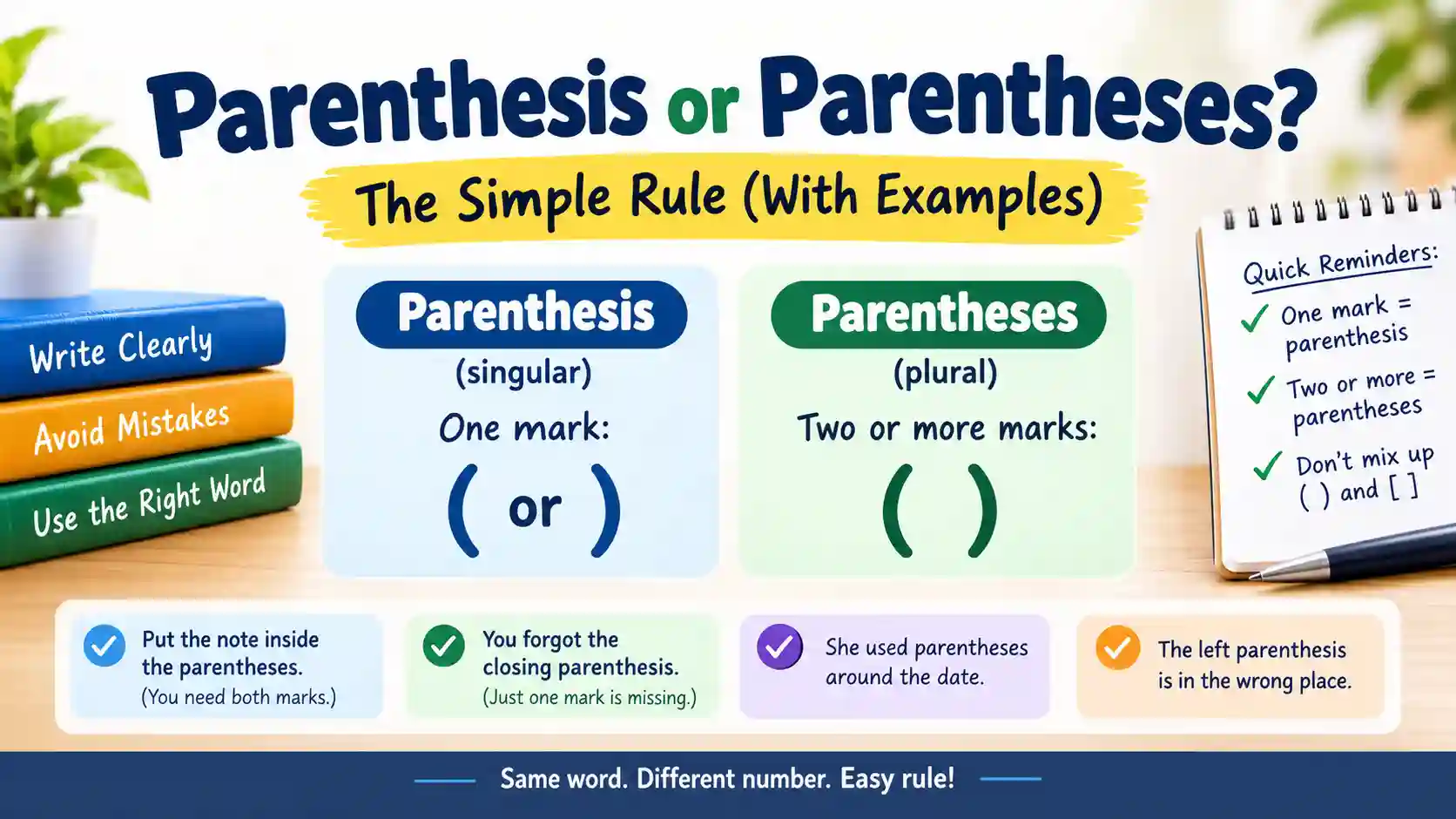
Parenthesis is singular. It means one mark: ( or ).
Parentheses is plural. It means two or more marks: ( ).
Here are examples:
- Put the note inside the parentheses. (You need both marks.)
- You forgot the closing parenthesis. (Just one mark is missing.)
- She used parentheses around the date.
- The left parenthesis is in the wrong place.
Easy memory trick: Words that end in -sis change to -ses in the plural. Think of crisis and crises. Now think of parenthesis and parentheses.
The Origin of Parenthesis
The word comes from Greek. It has three small parts:
- para means “beside”
- en means “in”
- thesis means “a placing”
Put together, it means “a placing in beside.” That fits well. You place extra words in beside the main sentence.
The word came into English through Latin in the 1500s. At first, it did not mean the mark. It meant the extra phrase itself. Later, people used it for the curved marks that wrap that phrase.
Why is the plural odd? English kept the Greek pattern. Greek nouns ending in -sis make plurals ending in -ses. That is why we say:
- analysis → analyses
- basis → bases
- thesis → theses
- parenthesis → parentheses
So the two spellings are not a mistake. They are the singular and plural of one word.
British English vs American English Spelling
Here is an important fact. There is no spelling difference between British and American English here. Both use parenthesis for one and parentheses for many.
The real difference is the name people choose.
- In American English, ( ) are called parentheses.
- In British English, ( ) are usually called brackets.
British writers do know the word parentheses. They use it in formal or technical writing. But in daily speech, they say “brackets.”
There is also a mix-up with other marks:
| Mark | American English | British English |
| ( ) | parentheses | brackets (or round brackets) |
| [ ] | brackets (or square brackets) | square brackets |
| { } | braces (or curly brackets) | curly brackets (or braces) |
| Singular of ( ) | parenthesis | bracket |
| Plural of ( ) | parentheses | brackets |
Note the trap. In American English, “brackets” means [ ]. In British English, “brackets” usually means ( ). This is why people get confused when they read across both styles.
Which Spelling Should You Use?
Use the spelling that matches your reader.
Writing for a US audience: Use parenthesis (one) and parentheses (many). Call [ ] “brackets.”
Writing for a UK or Commonwealth audience: Use brackets in everyday writing. Use parentheses in formal, academic, or technical work. Be clear about what you mean if you use [ ].
Writing for a global audience: Use parentheses. Almost everyone understands it. It is also the standard word in coding, math, and science.
Simple tip: Pick one style and stay with it. Do not switch in the middle of a document.
Common Mistakes with Parenthesis or Parentheses
1 Mistake: Using “parenthesis” for the plural
- Wrong: Put the words in parenthesis.
- Right: Put the words in parentheses.
2 Mistake : Saying “parentheses” for a single mark.
- Wrong: You missed one parentheses.
- Right: You missed one parenthesis.
3 Mistake : Spelling the plural wrong.
- Wrong: parenthesises, parenthesis’s, parenthesees
- Right: parentheses
4 Mistake : Confusing Brackets and Parentheses
- Wrong: Put the number in square parentheses.
- Right: Put the number in square brackets.
5 Mistake : Bad punctuation around them.
- Wrong: I went home (it was late) .
- Right: I went home (it was late).
Parenthesis or Parentheses in Everyday Examples
In an email:
Please review the attached file (see page 3) before Friday.
In a news article:
The mayor (a former teacher) said the plan will help schools.
On social media:
Just finished my first marathon (and I’m never running again).
IIn formal writing:
Add the year of publication in parentheses after the author’s name.
When talking about the marks:
The error says “missing closing parenthesis” on line 12.
Parenthesis or Parentheses – Google Trends & Usage Data
I cannot pull live Google Trends numbers here, so I will not invent any. Here is what is generally true about how people search, which you can confirm yourself in Google Trends:
- United States: People search “parentheses” often. They also search “parenthesis or parentheses” when they are unsure of the plural.
- United Kingdom, Australia, Ireland: People search “brackets” far more than “parentheses.”
- India and other Commonwealth countries: Both words appear, with “brackets” common in daily use.
- Students and coders: Searches rise during school terms. They also rise around math and programming topics.
- Search intent: Most people want to know which form is right. Others want to know the difference between parentheses and brackets.
To check the data, open Google Trends and compare the terms below by country and time range.
| Term | Meaning | Where it is most common |
| parenthesis | one mark, or an inserted phrase | US, formal writing worldwide |
| parentheses | two or more marks | US, math, coding, academic work |
| brackets | round marks ( ) | UK, Australia, Commonwealth |
| square brackets | [ ] | Worldwide |
| round brackets | ( ) | UK, Commonwealth, schools |
FAQs
1. Is it parenthesis or parentheses?
Both are correct. Parenthesis is one mark. Parentheses is two or more.
2. What is the plural of parenthesis?
The plural is parentheses. It follows the same pattern as crisis and crises.
3. Is “parenthesises” a word?
No. Do not use it.
4. Are parentheses and brackets the same thing?
In British English, often yes. In American English, no. Parentheses are ( ). Brackets are [ ].
5. How do you say parentheses?
Say “puh-REN-thuh-seez.” The singular is “puh-REN-thuh-sis.”
6. Is a parenthesis the mark or the phrase?
Both. Long ago, it meant the extra phrase. Today, it most often means the mark.
7. Should punctuation go inside or outside the parentheses?
If the parentheses hold a full sentence, put the period inside. If they hold part of a sentence, put the period outside.
Conclusion
The answer is easy. Use parenthesis for one mark. Use parentheses for two or more.
Remember three things.
First, the spelling does not change between British and American English. What changes is the name. Americans say “parentheses.” Many British writers say “brackets.”
Second, the plural follows an old Greek pattern. -sis becomes -ses, just like crisis becomes crises. If you can remember that, you will not forget this rule.
Third, avoid common mistakes. Do not use “parenthesis” when you mean a pair. Do not mix up ( ) and [ ].
If you are unsure who will read your work, choose parentheses. Nearly everyone understands it, and it fits school, business, math, and code.
Now you know the rule, the history, and the traps. Next time you add a small note to a sentence, you can write with confidence.