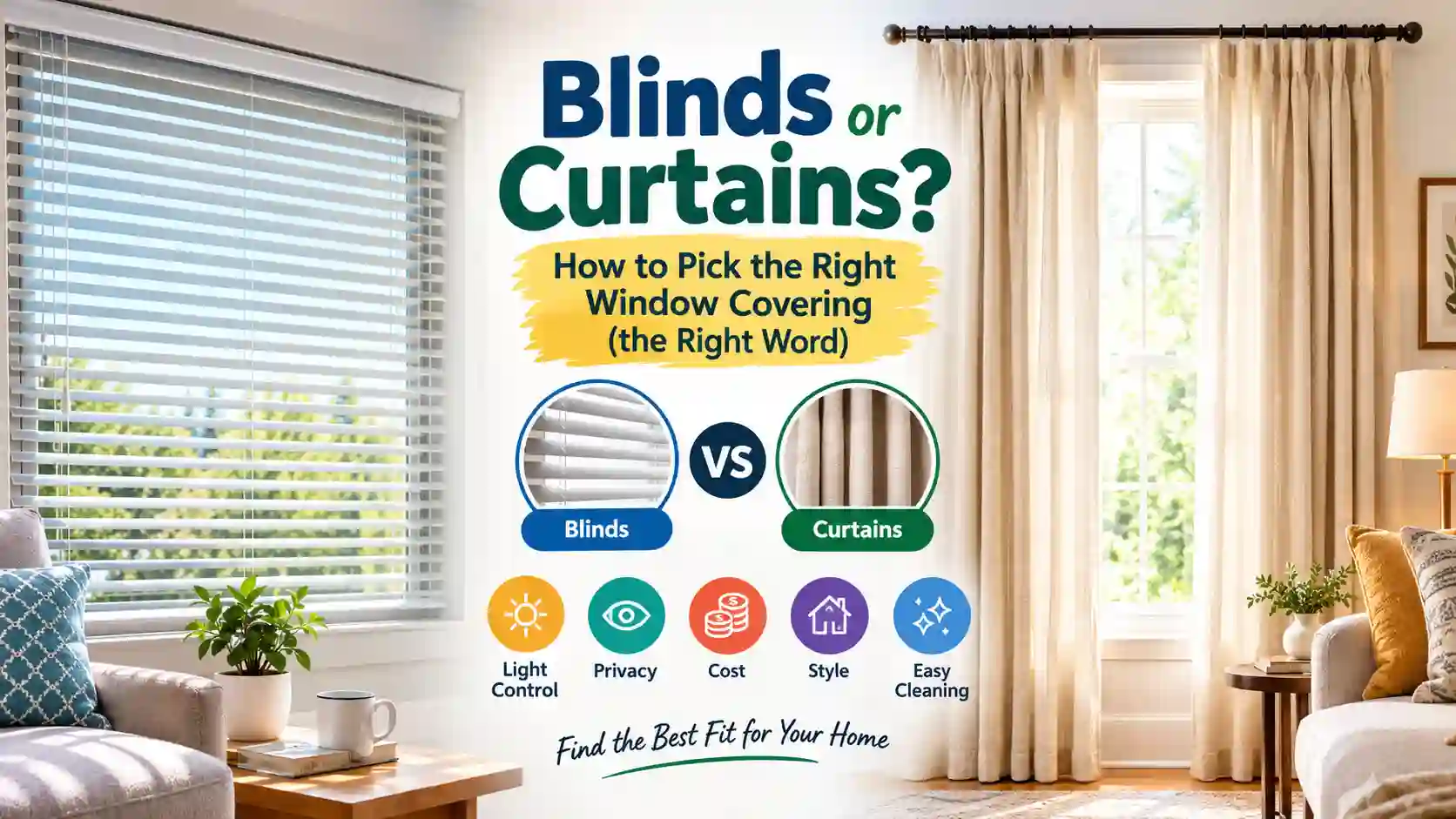
You stand in front of a bare window. The sun is in your eyes. Your neighbor can see your couch. You need a cover, fast. But which one? Blinds or curtains?
Millions of people ask this question every month. It sounds small. It is not. The wrong choice can cost you money, comfort, and style.
People search “blinds or curtains” for many reasons. Some want the cheaper option some want more privacy and Some want to block light so they can sleep. Others just want the room to look good.
There is also a mix-up with words. In the US, people say “drapes” and “shades.” In the UK, people say “curtains,” “blinds,” and “net curtains.” The same item can have different names.
This guide clears it all up. You will get a quick answer, a short history, clear tables, real examples, and expert tips. By the end, you will know what to buy.
Blinds or Curtains – Quick Answer
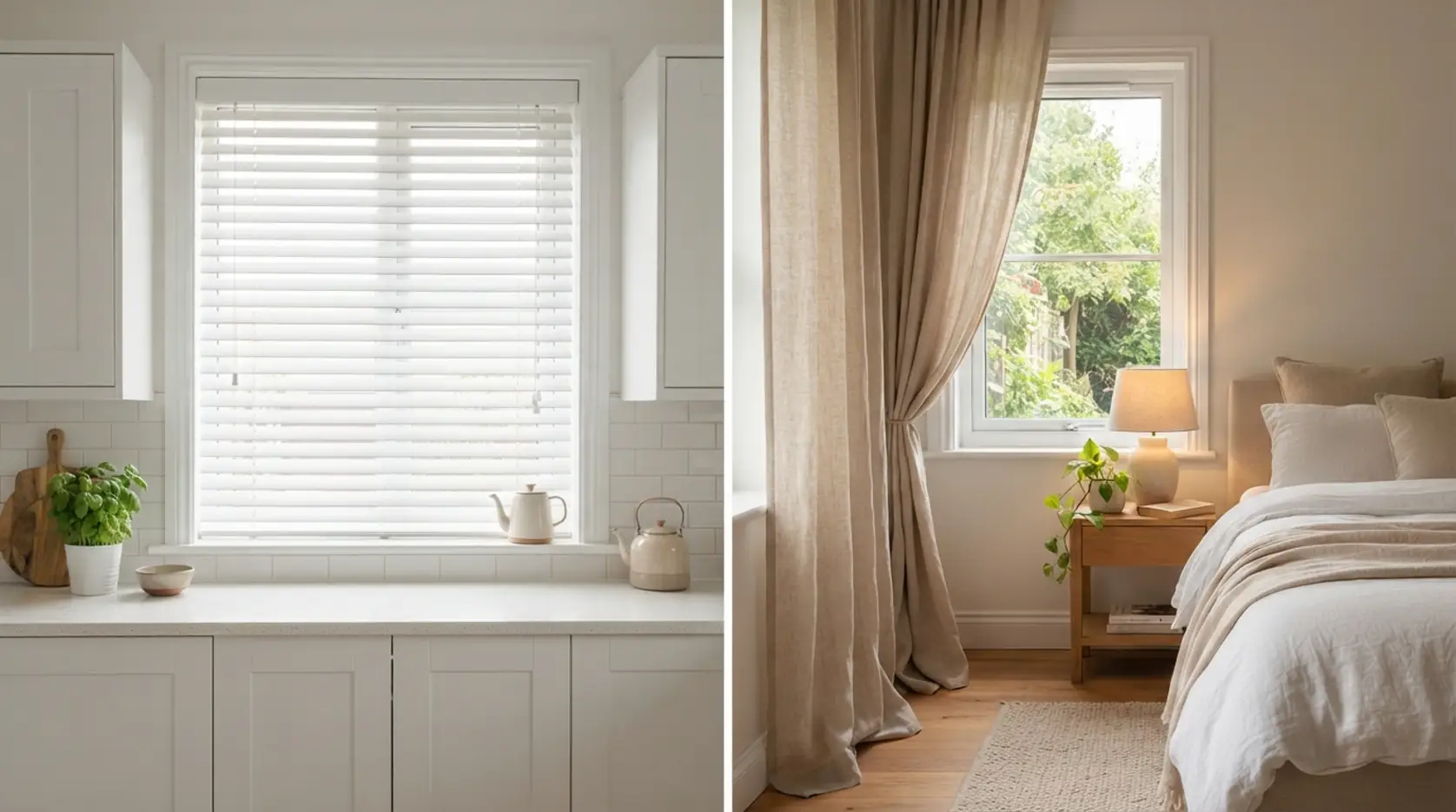
Choose blinds if you want control, a clean look, and easy cleaning. They work well in kitchens, bathrooms, and offices.
Choose curtains if you want softness, warmth, and style. They work well in bedrooms and living rooms.
Choose both if you want the best of each. Many homes use blinds for light control and curtains for looks.
Here are quick examples:
- Kitchen window: blinds. They are easy to wipe clean.
- Bedroom: blackout curtains. They block light and keep the room warm.
- Home office: blinds. You can tilt the slats to cut screen glare.
- Living room: curtains, or curtains over blinds. This adds style and comfort.
The Origin of Blinds and Curtains

Window covers are very old. People first hung cloth or animal skins over openings to keep out wind and cold.
Curtains come from the Old French word cortine, which comes from the Latin cortina. Both mean a hanging cloth. Rich homes in the Middle Ages used heavy curtains to block drafts in stone castles.
Blinds got their name because they “blind” the view. They keep light and eyes out. Early blinds in Persia and Egypt were made of reeds. In the 1700s, Venice traders brought wooden slat blinds to Europe. That is why we say “Venetian blinds.”
Drapes is the American word for heavy, lined curtains. It comes from the French drap, meaning cloth.
The words differ by country because English grew in two places. Each side kept its own habits.
British English vs American English Terms
The word “blinds” is the same in both countries. But many other terms are not.
| Item | British English | American English |
| Fabric hung on a rod | Curtains | Curtains or drapes |
| Heavy, lined fabric | Heavy curtains | Drapes |
| Thin see-through fabric | Net curtains, voile | Sheers |
| Roll-up fabric cover | Roller blind | Roller shade |
| Slatted cover | Venetian blind | Horizontal blinds |
| Pleated fabric cover | Pleated blind | Pleated shade |
| Rod that holds the fabric | Curtain pole | Curtain rod |
Quick rule: in the US, a “shade” is usually one piece of fabric. A “blind” has slats. In the UK, “blind” often covers both.
Which Word Should You Use?
Pick your words by who is reading.
- US readers: Use “blinds,” “shades,” “curtains,” and “drapes.”
- UK and Commonwealth readers: Use “blinds,” “curtains,” and “net curtains.” Say “roller blind,” not “roller shade.”
- Global readers: Use “blinds” and “curtains.” Everyone knows these two. Add the local term once in brackets if needed, like “sheers (net curtains).”
If you sell products online, use the local word in each country. A US shopper may search “drapes.” A UK shopper will search “curtains.”
Common Mistakes with Blinds or Curtains
Mistake 1: Mixing up the terms. People think blinds and shades are the same. In the US, they are not. Blinds have slats. Shades are solid fabric.
Mistake 2: Hanging curtains too low. Hang the rod high, close to the ceiling. This makes the room look taller.
Mistake 3: Buying curtains too short. They should touch the floor or hover just above it.
Mistake 4: Measuring wrong. For blinds, decide first: inside the window frame or outside. Measure the width and height at three points. Use the smallest number for inside fits.
Mistake 5: Picking by looks only. A pretty sheer will not give you privacy at night.
Mistake 6: Ignoring the room. Fabric curtains in a steamy bathroom can get moldy. Use moisture-safe blinds instead.
Blinds or Curtains in Everyday Examples
Email to a seller:
“Hi, do your blinds come in white? I also need curtains to match.”
News headline:
“Why More Homeowners Choose Blinds or Curtains to Cut Energy Bills”
Social media post:
“Can’t decide on blinds or curtains for my new flat. Help! 😅”
Formal writing (property listing):
“All bedrooms include fitted blinds. Curtains in the living room are included in the sale.”
Customer review:
“The blackout curtains work well. The blinds in the kitchen are easy to clean.”
Blinds or Curtains – Search Trends and Usage

I did not pull live Google Trends data for this article, so I will not quote exact numbers. Here is what usually shows up, and how to check it yourself.
- Seasonal peaks: Searches often rise in spring and early summer. People redecorate then. Another bump often comes in autumn, when people want warmth.
- Country differences: The UK, US, Canada, Australia, and Ireland all search this phrase. In the US, “blinds vs curtains” and “blinds vs shades” are common. In the UK, “curtains or blinds” is common.
- Intent: Most people want a comparison. Many also add a room name, like “bedroom,” “kitchen,” or “living room.”
- Related searches: Look for “best window coverings,” “blackout blinds,” and “curtains over blinds.”
To check current data, open Google Trends. Enter “blinds or curtains,” set the country, and compare it with “blinds vs curtains.” Use the “Related queries” box to find ideas.
Comparison Table: Blinds vs Curtains Side by Side
| Feature | Blinds | Curtains |
| Light control | Excellent (tilt slats) | Good to excellent (depends on fabric) |
| Privacy | High | High with lined fabric |
| Cost | Low to mid | Low to high |
| Cleaning | Wipe or dust | Wash or vacuum |
| Insulation | Fair | Good with thick lining |
| Style | Clean, modern | Soft, warm |
| Best rooms | Kitchen, bath, office | Bedroom, living room |
| Noise blocking | Low | Some |
| Phrase | Meaning | Common in |
| Blinds | Slatted or rolled cover | UK and US |
| Shades | Solid fabric cover | US |
| Curtains | Hanging fabric panels | UK and US |
| Drapes | Heavy, lined curtains | US |
| Net curtains | Thin see-through panels | UK |
FAQs
1. Are blinds or curtains better?
Neither wins in every room. Blinds are better for control and easy cleaning. Curtains are better for warmth and style.
2. Which is cheaper, blinds or curtains?
Basic blinds and basic curtains cost about the same. Custom curtains and wood blinds cost more. Price depends on size, fabric, and material.
3. Can I use blinds and curtains together?
Yes. Blinds handle light and privacy. Curtains add style and extra insulation. Many designers use this mix.
4. Which is better for blocking light?
Blackout curtains with a side-to-side fit block the most light. Blackout blinds are close behind.
5. Which keeps a room warmer?
Thick, lined curtains. They trap air against the window. Cellular blinds also insulate well.
6. What is the difference between blinds and shades?
In the US, blinds have slats. Shades are one piece of fabric. In the UK, “blinds” often covers both.
7. Which is easier to clean?
Blinds. A quick dust or wipe is often enough. Many curtains can go in the washing machine, but they take more effort.
Conclusion
So, blinds or curtains? The answer depends on your room and your needs.
Pick blinds when you want control, privacy, and easy cleaning. They suit kitchens, bathrooms, and offices. Pick curtains when you want softness, warmth, and style. They suit bedrooms and living rooms. If you cannot choose, use both. Blinds do the work. Curtains add the look.
Remember a few simple tips. Measure twice. Hang curtain rods high. Choose moisture-safe blinds for wet rooms. Match the fabric weight to your goal: light fabric for glow, thick fabric for darkness and warmth.
Also remember the words. In the US, “drapes” and “shades” are common. In the UK, “net curtains” and “roller blinds” are common. Use the term your readers know. If your audience is global, “blinds” and “curtains” are safe.
Now you have what you need. Look at each window, think about the room, and choose with confidence.