You are writing an email. You type, “Thank you for ___ me to the team.” Do you write welcome or welcomed? You stop, think and search.
Many people mix up welcome and welcomed. The words look close. They sound close. Both are right, but only in the right place.
People search this keyword for a few reasons. Some think it is a spelling fight, like color and colour. some are not sure about tense. Some write for work and cannot afford a mistake.
Here is the good news. This is not a spelling problem. Welcome and welcomed are two forms of one word. One is the base form. One is the past form. The trick is knowing when to use each.
In this guide, you get a quick answer first. Then you will see where the word comes from, how US and UK writers use it, and which mistakes to avoid. You will also find real examples, two tables, and a short FAQ.
Read on. In five minutes, you will not doubt this word again.
Welcome or Welcomed – Quick Answer
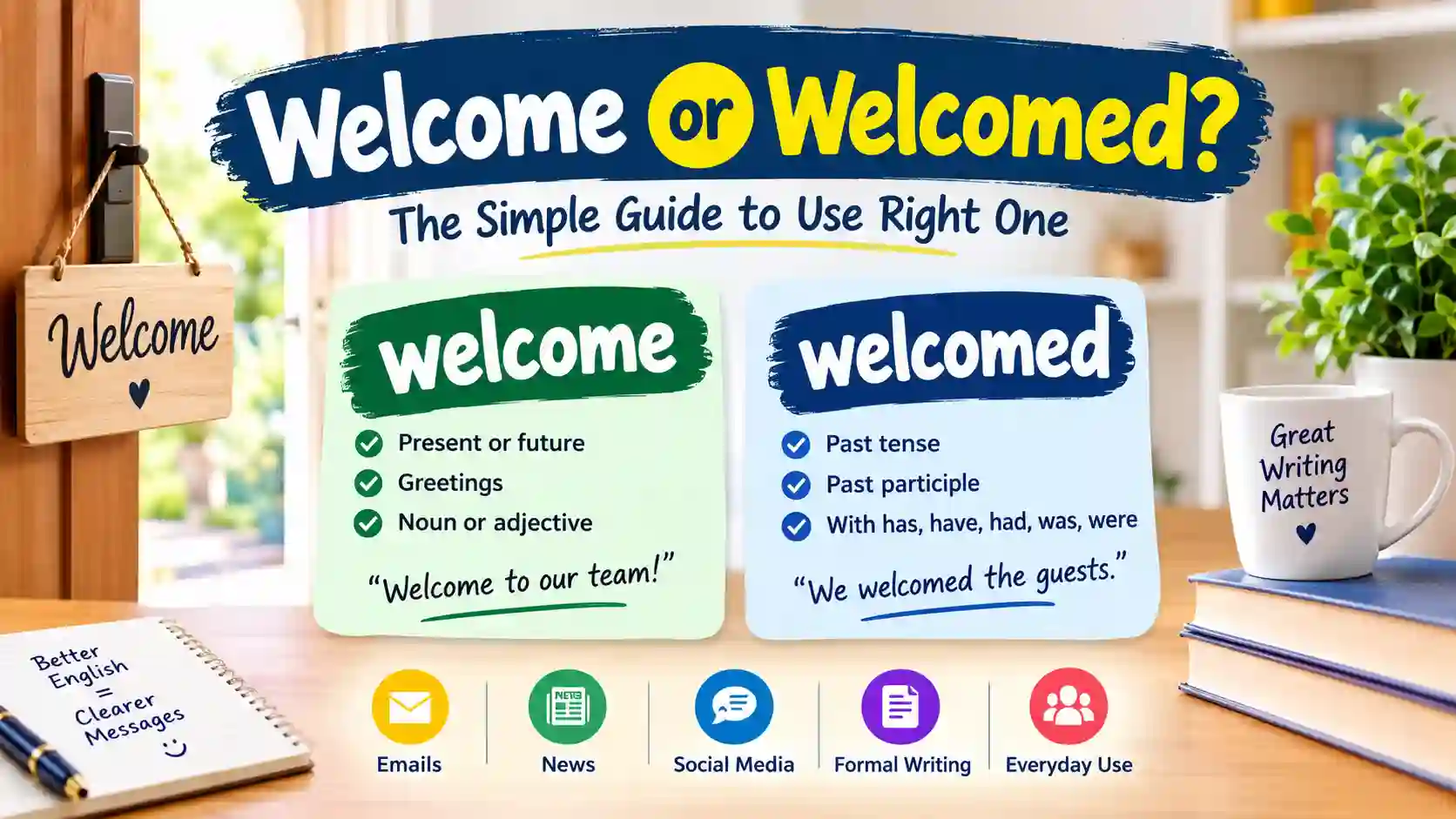
Use “welcome” for now, for later, and for greetings. Use “welcomed” for the past.
Welcome (present or future)
- “We welcome you to our store.”
- “Please welcome our new teacher.”
- “New ideas are always welcome.” (adjective)
- “Thanks!” “You’re welcome.” (reply to thanks)
Welcomed (past)
- “We welcomed you to our store last week.”
- “The crowd welcomed the team home.”
- “She has welcomed many guests.” (with has, have, or had)
- “He was welcomed with a smile.” (with was or were)
Quick test: Did it already happen? Use welcomed. Is it happening now or soon? Use welcome.
The Origin of Welcome
Welcome is a very old word. It comes from Old English. The old form was wilcuma. It joined two small words: willa, which means “wish” or “pleasure,” and cuma, which means “guest” or “one who comes.” So a wilcuma was a guest you were happy to see.
Over time, the word changed. Old Norse had a similar word, velkominn. The first part of the word also began to look like well. That is how we got wel and then welcome. So the word now means “you came well,” or “good that you came.”
As a verb, it started as wilcumian. Later, English dropped the old endings. Today it follows the plain rule for most verbs: add -ed for the past.
Why do people think there are spelling differences? Many English words do change between the US and the UK. Writers learn to expect it. But welcome never split into two spellings. It has been steady for hundreds of years.
British English vs American English Spelling
Here is the plain truth: there is no difference. Both the US and the UK write welcome and welcomed.
The confusion comes from other verbs. In the UK, many verbs double the last letter before -ed. In the US, they often do not. But welcome ends in a silent e. So you just add -d. No letter doubles. That is why welcommed is always wrong.
| Base word | American English | British English | Same or different? |
| welcome | welcomed | welcomed | Same |
| travel | traveled | travelled | Different |
| cancel | canceled | cancelled | Different |
| model | modeled | modelled | Different |
| color | colored | coloured | Different |
| welcome (greeting) | welcome | welcome | Same |
So if someone tells you the UK writes it another way, they are mixing it up with words like travelled.
Which Spelling Should You Use?
Good news: you only have one spelling to learn. Pick the form by tense, not by country.
- US readers: welcome (now) and welcomed (past).
- UK and Commonwealth readers (such as India, Pakistan, Australia, and Canada): the same.
- Global readers: the same.
Your own rules still matter. Here is simple advice for each use:
- Signs, buttons, and greetings: use welcome. (“Welcome back!”)
- Stories and reports: use welcomed. (“The mayor welcomed the guests.”)
- Replying to thanks: use you’re welcome, never you’re welcomed.
- Business email: match the time of the action. Past event? Welcomed. Current offer? Welcome.
Common Mistakes with Welcome and Welcomed
| Mistake | Fix | Why |
| “You’re welcomed.” (after thanks) | “You’re welcome.” | This is a fixed phrase. It uses the adjective. |
| “Yesterday we welcome 50 guests.” | “Yesterday we welcomed 50 guests.” | Yesterday needs the past form. |
| “We will welcomed you.” | “We will welcome you.” | After will, use the base form. |
| “Welcommed” or “wellcomed” | “Welcomed” | One l, one m. Just add -d. |
| “Wellcome to our site.” | “Welcome to our site.” | Welcome has one l in the middle. |
| “She has welcome the team.” | “She has welcomed the team.” | Has needs the past form. |
| “Welcomed to the club!” (as a greeting) | “Welcome to the club!” | A greeting is spoken now. |
Welcome and Welcomed in Everyday Examples
Emails
- “Welcome to the team, Sam! We are glad you are here.”
- “Thank you for the warm welcome. I was welcomed by everyone on day one.”
News
- “The president welcomed the new deal on Monday.”
- “Fans welcomed the singer at the airport.”
Social media
- “Welcome to my channel! Hit follow.”
- “Feeling so welcomed in my new city.”
Formal writing
- “The committee welcomes comments from the public.”
- “The board welcomed the report and approved its findings.”
Replying to thanks
- “Thank you for your help.” “You’re welcome.”
Welcome or Welcomed – Google Trends and Usage Data
I can’t pull live Google Trends numbers here, so I won’t invent any. These are the general patterns you can expect and then check yourself:
- “Welcome” is far more popular than “welcomed.” It shows up in greetings, signs, apps, and “you’re welcome.” “Welcomed” is mostly used in news and storytelling.
- Searches for the “or” question (like “welcome or welcomed”) tend to come from English learners and office workers. These are people who write emails and want to be right.
- Strong English-search countries include the US, UK, India, Pakistan, Nigeria, the Philippines, Canada, and Australia. Learners in many other countries also search this topic.
- Context matters. Interest in “you’re welcome” is high all year. Interest in “welcomed” rises around news events, like when a leader or group “welcomes” a decision.
To check it yourself: open Google Trends, enter “welcome” and “welcomed,” set the country, and compare the lines.
Welcome Forms Side by Side
| Form | What it is | Example |
| welcome | base verb, noun, adjective, greeting | “Welcome to our home.” |
| welcomes | present, he/she/it | “She welcomes every guest.” |
| welcomed | past tense and past participle | “They welcomed us warmly.” |
| welcoming | -ing form, or adjective | “The staff were welcoming.” |
| you’re welcome | reply to thanks | “Thanks!” “You’re welcome.” |
| wellcome / welcommed | wrong spelling | Do not use. |
FAQs
1. Is it “welcome” or “welcomed”?
Both are correct. Use welcome for now or the future. Use welcomed for the past.
2. Is “you’re welcomed” correct?
No. After someone says thanks, say “you’re welcome.”
3. Is there a US and UK spelling for “welcomed”?
No. Both write it welcomed. Only some other words, like travelled and traveled, change.
4. Why is it not “welcommed”?
Welcome ends in e. You add only -d. The m stays single.
5. Can “welcome” be a noun?
Yes. “They gave us a warm welcome.”
6. Can “welcome” be an adjective?
Yes. “Feedback is always welcome.” “You are welcome to join.”
7. What is the past tense of “welcome”?
Welcomed. For example: “We welcomed the new class last week.”
Conclusion
Welcome or welcomed? Now you know the answer. They are not two spellings. They are two forms of the same word.
Use welcome for now and for the future and use it on signs, in emails, and in the phrase “you’re welcome. Welcomed is used for the past. Use it when the action is done, as in “She welcomed the guests.”
There is no US or UK split here. Both sides write welcome and welcomed the same way. The real risk is tense, or mixing up welcome and welcomed after “you’re.”
Here is a quick test. Ask yourself, “Did this already happen?” If yes, pick welcomed. If no, pick welcome. If someone said thanks, say “you’re welcome.”
Keep it short. Keep it clear. Read your sentence out loud before you hit send. Your ear will often catch the error your eyes miss.
Share this guide with a friend or teammate who writes a lot. Next time you stop at this word, you will know what to do.