Have you ever typed a word, stopped, and thought, “Wait, is that even a real word?” You are not alone. Many people pause at disenroll or unenroll when they need to leave a class, a health plan, a course, or a program. Both words look correct. Both feel natural. But only one usually fits the situation you are in.
This mix-up happens for a good reason. English lets us build new words by adding prefixes like “dis-” and “un-” to a base word. That freedom is useful, but it also creates confusion.
People search for “disenroll or unenroll” because they want to write or speak correctly, especially in emails, forms, and official documents. Nobody wants to sound unsure in a message to HR, a school, or an insurance company.
This guide gives you a clear answer. You will learn what each word means, where each one comes from, how American and British writers treat them differently, and how to pick the right word every time. By the end, you will never second-guess this word again.
Disenroll or Unenroll – Quick Answer
Both words mean the same thing: to remove yourself, or be removed, from a list, class, program, or plan.
- Unenroll is the more common and more widely accepted word. It works in almost every context.
- Disenroll is used mostly in formal settings, especially in the US. You will see it often in health insurance, Medicare, and school enrollment systems.
Examples:
- “I need to unenroll from the yoga class before Friday.”
- “Please disenroll me from the health plan starting next month.”
If you are not sure which one to use, unenroll is the safer choice. It sounds natural in almost any sentence.
The Origin of Disenroll or Unenroll

Both words come from the same root: enroll. This word entered English from the Old French word “enroller,” which meant to write a name into a roll or list. A “roll” was literally a rolled-up piece of paper used for records.
English speakers later added prefixes to create the opposite meaning.
- Un- is one of the oldest prefixes in English. It comes from Old English and simply means “not” or “the reverse of.” It attaches easily to almost any verb: undo, unlock, unfollow, unenroll.
- Dis- comes from Latin. It also means “reversal” or “removal,” but it carries a slightly more formal, technical tone. Think of words like disconnect, disqualify, and disenroll.
Because English borrows from both Old English and Latin roots, we often end up with two words that mean nearly the same thing. That is exactly what happened here. Neither word is “wrong.” They simply grew from different linguistic branches.
British English vs American English Spelling
Many people expect this to be a true British-versus-American spelling difference, like “colour” versus “color.” It is not quite that simple. Both unenroll and disenroll are accepted in both regions. The real difference is one of preference and frequency, not spelling rules.
- American English uses both words, but leans on disenroll in formal, institutional writing (insurance, healthcare, government forms).
- British and Commonwealth English almost always prefer unenroll or the related noun form “un-enrol.” British spelling also tends to use one “l” in some related words, following general British single-consonant patterns.
| Feature | American English | British English |
| Preferred word | Disenroll or Unenroll (both common) | Unenroll (strongly preferred) |
| Common context | Insurance, healthcare, education | General, everyday use |
| Formality level | Disenroll = formal/technical | Unenroll = neutral |
| Spelling style | Follows US double-L patterns | Follows UK single-L patterns in related forms |
Which Spelling Should You Use?
Your best choice depends on your audience.
If you write for a US audience: Use disenroll for formal or official communication, like health plans, Medicare, or school systems. Use unenroll for everyday, casual writing.
If you write for a UK, Australian, Canadian, or Commonwealth audience: Stick with unenroll. It is the word people expect to see and read.
If you write for a global or mixed audience: Choose unenroll. It is understood everywhere, sounds natural, and avoids any risk of sounding overly formal or region-specific.
Common Mistakes with Disenroll or Unenroll
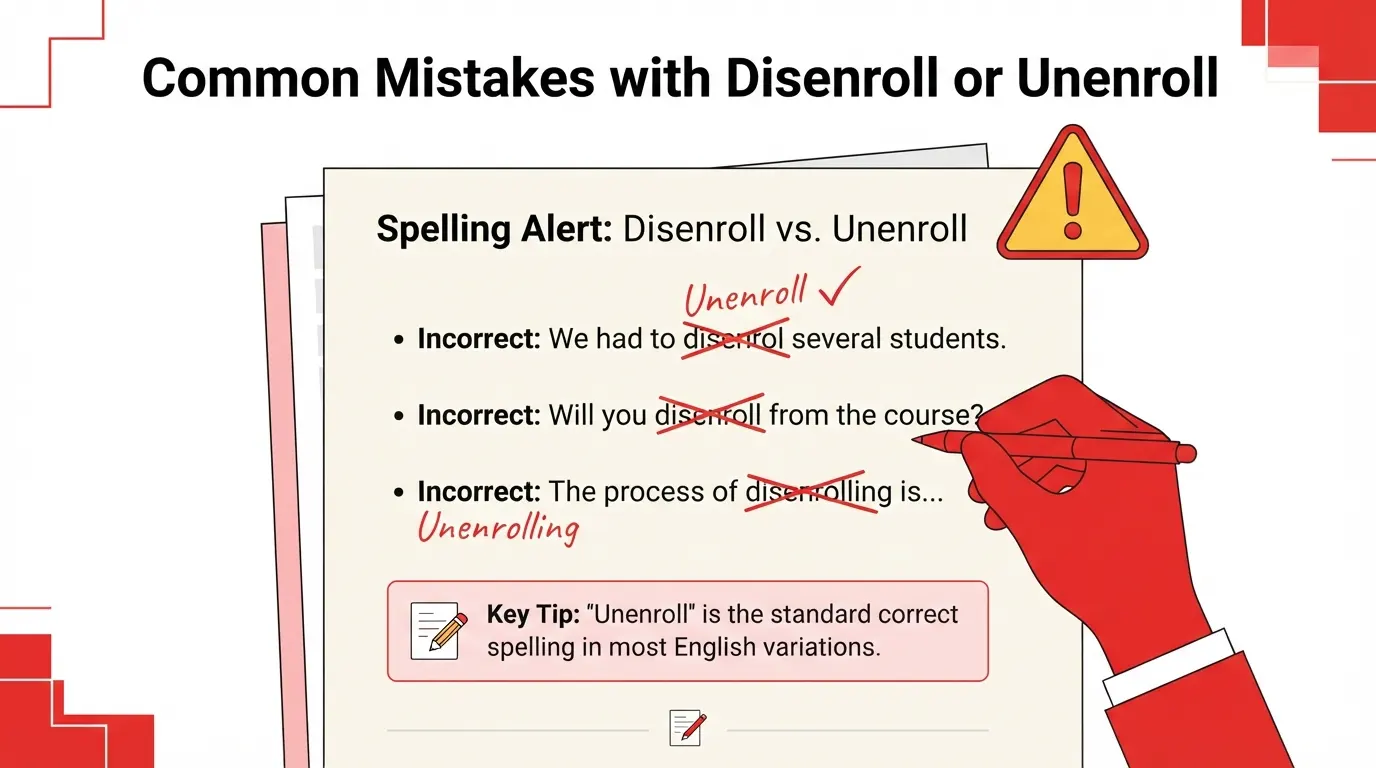
- Using “disenrol” with one L. Incorrect: disenrol Correct (US): disenroll
- Adding both prefixes together. Incorrect: “un-disenroll” This does not exist. Pick one prefix, not both.
- Confusing it with “withdraw.” “Withdraw” is broader. It can apply to money, applications, or actions. “Unenroll” and “disenroll” only apply to lists, programs, or memberships.
- Using “disenroll” in casual speech. It can sound stiff in everyday conversation. Save it for formal writing.
- Forgetting the object of the sentence. Incorrect: “I want to unenroll.” Clearer: “I want to unenroll from the course.”
Disenroll or Unenroll in Everyday Examples
In an email: “Hi team, please unenroll me from the Tuesday training session. Something came up.”
In a news article: “Thousands of families chose to disenroll their children from the district after the policy change.”
On social media: “Just unenrolled from that gym membership. Feels great!”
In formal writing (insurance or HR): “Employees who wish to disenroll from the dental plan must submit a written request within 30 days.”
Notice the pattern: casual and personal messages lean toward unenroll. Institutional and legal writing leans toward disenroll.
Disenroll or Unenroll – Google Trends & Usage Data
Search interest shows a clear pattern. Unenroll consistently gets more search volume worldwide, especially outside the United States. Disenroll shows steady, focused interest almost entirely from US searchers, and it spikes around open enrollment periods for health insurance and Medicare each year.
This makes sense. Countries with national health services, like the UK, rarely need a word like “disenroll” for insurance purposes. The word stays mostly inside the American healthcare and education system, while “unenroll” thrives as the everyday, global choice.
| Term | Global Popularity | Main Region | Typical Use |
| Unenroll | High | Worldwide | General, casual, education |
| Disenroll | Moderate | United States | Insurance, healthcare, formal forms |
| Un-enrol (UK style) | Low-moderate | UK, Commonwealth | Rare, formal British writing |
| Withdraw | High | Worldwide | Broader, not list-specific |
FAQs
1. Is “disenroll” a real word? Yes. It is a real, recognized word, especially common in US healthcare and education contexts.
2. Is “unenroll” more correct than “disenroll”? Neither is more “correct.” Unenroll is more common and versatile. Disenroll is more formal and specific.
3. Can I use these words interchangeably? In most cases, yes. Both mean the same thing. Context and audience decide which one fits better.
4. Which word does Medicare use? Medicare and most US health insurance providers use disenroll in official documents.
5. Do British writers use “disenroll”? Rarely. British English strongly favors unenroll.
6. What is the noun form of these words? “Unenrollment” and “disenrollment” are both used, following the same regional patterns as the verbs.
7. Is there a difference between “unenroll” and “withdraw”? Yes. “Unenroll” applies specifically to removing yourself from an enrollment list. “Withdraw” is broader and can apply to many other situations.
Conclusion
So, disenroll or unenroll: which should you choose? Both words are correct, and both mean the same thing: to leave a list, class, plan, or program. The real difference is tone and region. Unenroll is the safer, more universal choice, understood clearly by readers everywhere.
Disenroll works best in formal, institutional writing, especially in the US, where it shows up often in healthcare and education paperwork.
If you are writing a casual email, a social media post, or a message to a friend, choose unenroll. If you are writing an official letter, a healthcare form, or a legal document for a US audience, disenroll is the stronger fit. British and global audiences should stick with unenroll in almost every case.
Understanding this small difference helps you write with more confidence. You will never again pause mid-sentence, unsure which word sounds right. Pick based on your audience and your tone, and you will always make the correct choice.