You are typing an email. You stop. Is it “favor” or “favour”? You look at the screen. Both look right. Both look wrong. This tiny spelling has tripped up millions of writers.
People search “favor or favour” for one simple reason. They want the right word, and they want it fast. Maybe your boss is in the US. Maybe your client is in London. Or maybe your spell checker marks the word as wrong.
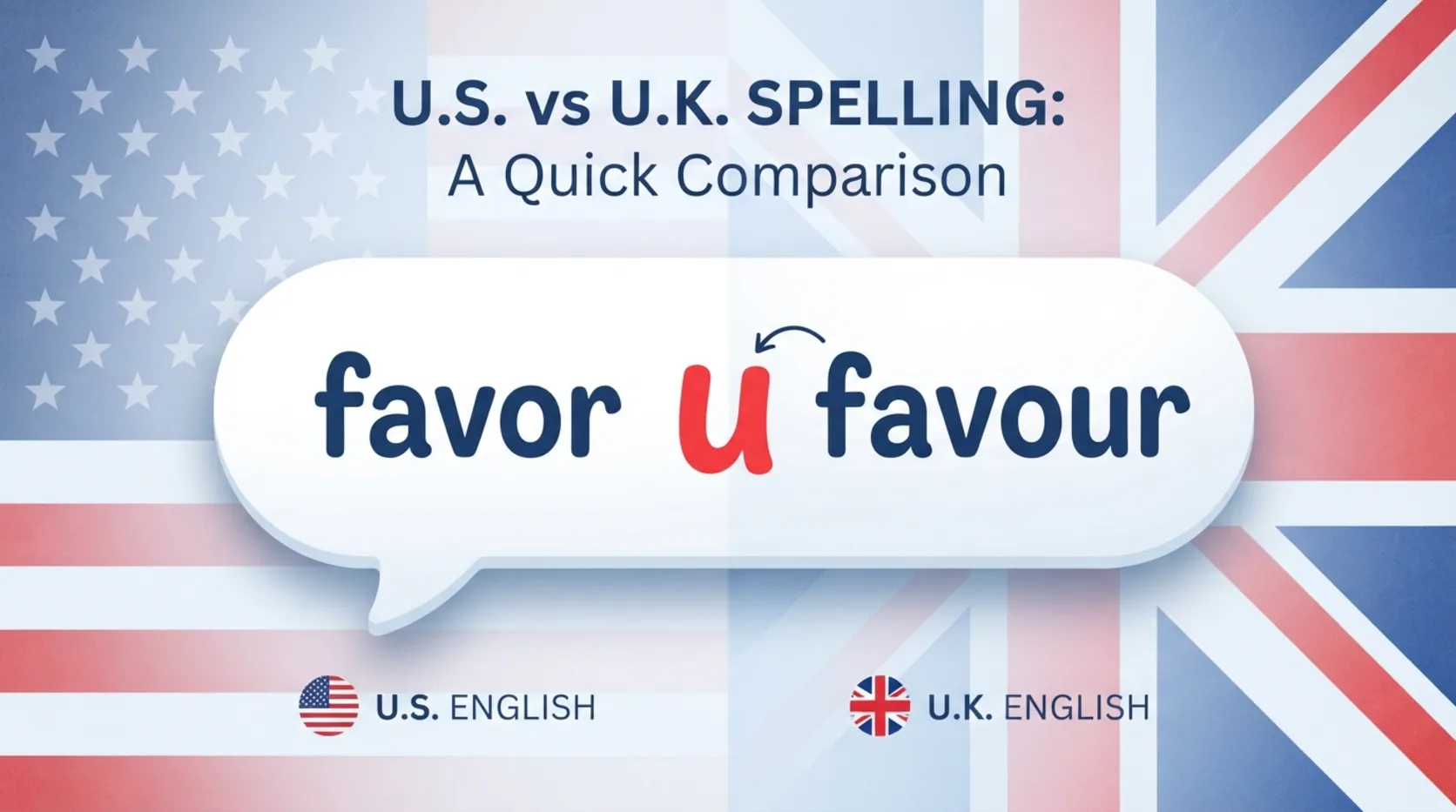
Here is the good news. Both spellings are correct. They mean the same thing. The only difference is where your reader lives. Americans write “favor.” The British, Canadians, Australians, and many others write “favour.”
This article clears up the confusion. You will get a quick answer first. Then you will learn where the two spellings came from. You will see tables, real examples, and common mistakes. You will also find answers to seven common questions.
By the end, you will know which spelling to use. You will also know how to stay consistent, so your writing looks sharp and professional every time.
Favor or Favour – Quick Answer
Favor is the American English spelling.
Favour is the British English spelling.
Both words mean the same thing. They can be a noun or a verb.
- As a noun (an act of kindness): “Can you do me a favor?” (US) / “Can you do me a favour?” (UK)
- As a noun (approval): “The plan is in favor of the team.” (US) / “The plan found favour with the team.” (UK)
- As a verb (to prefer): “I favor the blue one.” (US) / “I favour the blue one.” (UK)
Quick rule: writing for the US? Use favor. Writing for the UK, Canada, Australia, New Zealand, India, or Ireland? Use favour.
The Origin of Favor or Favour

The word is old. It comes from the Latin word favor, which meant goodwill or support. That Latin word came from favere, which meant “to be kind to.”
English borrowed the word around the 1300s. It came through Old French and Anglo-Norman, the French spoken in England after 1066. French words often ended in “-our” when they entered English. That is how “favour” got its “u.”
For a long time, spelling in English was messy. There were no strict rules. Writers spelled words how they liked. Then dictionaries began to fix the rules. In 1755, Samuel Johnson published a famous dictionary in Britain. It kept the “-our” ending. Britain never changed it.
America went a different way. In 1828, Noah Webster published his American Dictionary of the English Language. He wanted spelling to be simple. He also wanted America to have its own style. So he dropped the “u” from words like color, honor, and favor. Americans followed him.
That is why we have two spellings today. One word. Two paths.
British English vs American English Spelling
The “-our” and “-or” split is not just about favor. It shows up in many common words.
The rule: American English uses “-or.” British English uses “-our.”
| American English | British English | Meaning |
| favor | favour | kindness or approval |
| color | colour | a shade like red or blue |
| honor | honour | respect or high regard |
| neighbor | neighbour | person who lives near you |
| labor | labour | work |
| humor | humour | funny quality |
| flavor | flavour | taste |
| behavior | behaviour | how you act |
Words that change when you add endings:
- US: favorite, favorable, favored, favoritism
- UK: favourite, favourable, favoured, favouritism
A helpful note: some British words drop the “u” when you add certain endings. For example, “humour” becomes “humorous,” and “labour” becomes “laborious.” But “favour” keeps its “u” in most forms, like “favourable” and “favourite.”
Which Spelling Should You Use?
The answer depends on your reader. Ask yourself: who will read this?
Writing for a US audience
Use favor. This includes US websites, US companies, and US schools. Also use it if your style guide says American English.
Writing for the UK or Commonwealth
Use favour. This covers the UK, Canada, Australia, New Zealand, India, South Africa, and Ireland. Canadians keep the “u” in “favour,” even though they use some other American spellings.
Writing for a global audience
Pick one and stick with it. Here is a simple way to choose:
- Look at where most of your readers live.
- Use the spelling that matches that group.
- Set your spell checker to that language.
- Use the same spelling on every page.
One golden rule: never mix the two in the same piece of writing.
Common Mistakes with Favor or Favour
Here are the mistakes people make most often, and how to fix them.
1. Mixing spellings in one document
- Wrong: “I favor this plan, and my favourite part is the price.”
- Right: “I favor this plan, and my favorite part is the price.”
2. Using the wrong spelling for your audience
- Wrong: A US company page that says “Ask us for a favour.”
- Right: “Ask us for a favor.”
3. Keeping the “u” in only some words
- Wrong: “This is a favourable deal. It is a favorite of mine.”
- Right: “This is a favorable deal. It is a favorite of mine.” (US)
4. Mixing up favor and flavor
- Wrong: “He asked me for a flavor.”
- Right: “He asked me for a favor.”
5. Trusting the wrong spell-check language
Your tool may be set to the wrong English. Check your settings first. A red line does not always mean an error. It may just mean the wrong region.
6. Using the wrong small words
- Wrong: “I am in favor to the idea.”
- Right: “I am in favor of the idea.”
Favor or Favour in Everyday Examples
Here is how the word looks in real life.
Emails
- US: “Could you do me a favor and send the file by noon?”
- UK: “Could you do me a favour and send the file by noon?”
News headlines
- US: “Voters favor new park plan”
- UK: “Voters favour new park plan”
Social media
- US: “Big thanks to everyone who helped. I owe you a favor!”
- UK: “Big thanks to everyone who helped. I owe you a favour!”
Formal writing
- US: “The committee ruled in favor of the applicant.”
- UK: “The committee ruled in favour of the applicant.”
Party and gift items
- US: “We made party favors for the kids.”
- UK: “We made party favours for the kids.”
Business letters
- US: “We would appreciate your favorable reply.”
- UK: “We would appreciate your favourable reply.”
Favor or Favour – Google Trends & Usage Data
Search trends change over time, so check Google Trends for live numbers. Here are the general patterns.
By country
| Region | Common spelling | Search pattern |
| United States | favor | Most searches use the “favor” forms |
| United Kingdom | favour | Most searches use the “favour” forms |
| Canada | favour | Mostly “favour,” with some “favor” |
| Australia | favour | Mostly “favour” |
| India | favour | Mostly “favour” |
| Ireland | favour | Mostly “favour” |
By context
- Everyday talk: “do me a favor” and “favorite” are very common phrases.
- Business: “in favor of” and “favorable terms” show up in contracts and reports.
- Gifts and events: “party favors” is a popular search before holidays and weddings.
- Learning: People search “favor or favour” most when they write for a new audience.
What this means for you: the best spelling follows your reader’s location, not a global winner. Neither spelling is more “correct.” Use Google Trends to see which one your target country prefers.
Favor and Favour Variations Side by Side
| Word form | American English | British English |
| Noun | favor | favour |
| Verb (base) | favor | favour |
| Past tense | favored | favoured |
| -ing form | favoring | favouring |
| Plural or he/she form | favors | favours |
| Adjective (liked most) | favorite | favourite |
| Adjective (good or helpful) | favorable | favourable |
| Adverb | favorably | favourably |
| Noun (unfair treatment) | favoritism | favouritism |
| Idiom (win approval) | curry favor | curry favour |
| Idiom (support) | in favor of | in favour of |
Frequently Asked Questions
1. Is it favor or favour?
Both are correct. “Favor” is American English. “Favour” is British English.
2. Do favor and favour mean the same thing?
Yes. They have the same meaning and the same sound. Only the spelling is different.
3. Which one do Canadians use?
Canadians usually write “favour.” Canada follows British spelling for “-our” words, but it uses some American spellings elsewhere.
4. Is “favourite” or “favorite” correct?
Both. Use “favorite” in the US. Use “favourite” in the UK and Commonwealth countries.
5. Why did America drop the “u”?
Noah Webster wanted simpler spelling. His 1828 dictionary made “favor” the American way.
6. Will my readers think I made a mistake?
Usually not, if you stay consistent. Mixing both in one text is what looks like an error.
7. Which spelling is better for SEO?
Neither one is better. Use the spelling your target audience searches for. Match your page to their country and language setting.
8. How can I stop mixing them up?
Set your spell checker to US or UK English. Pick one style and use it for the whole document.
Conclusion
So, favor or favour? Both are right. The best choice depends on your reader.
Here are the key points to remember. “Favor” is the American spelling. “Favour” is the British spelling. Canada, Australia, New Zealand, India, and Ireland use “favour” too. The meaning is the same in every country.
The two spellings exist because of history. Old French gave English the “-our” ending. Noah Webster cut the “u” in America to make spelling simpler. Britain kept it.
Your job is easy. Know your audience. Pick one spelling. Stick with it from the first line to the last. Do the same with related words like favorite and favourite, favorable and favourable.
If you write for the whole world, choose the spelling most of your readers use. Then set your spell checker to match. This small step saves you from mistakes and makes your work look polished.