You are about to text a friend. The roads are covered in ice. You type “icey.” Then you stop. Something looks off. Is it icey or icy?
You are not alone. Many people pause on this word. It sounds simple, but the spelling feels tricky. English has many words that end in -y or -ey, and the rules are not always clear. So people search for the answer to be safe.
This guide clears up the confusion fast. You will get a quick answer first. Then you will learn where the word comes from, how British and American spelling compare, and which mistakes to avoid. You will also see real examples from emails, news, and social media.
By the end, you will know the right spelling, why it is right, and how to use it with confidence. If you write school papers, work emails, or blog posts, you will never doubt this word again.
Icey or Icy – Quick Answer
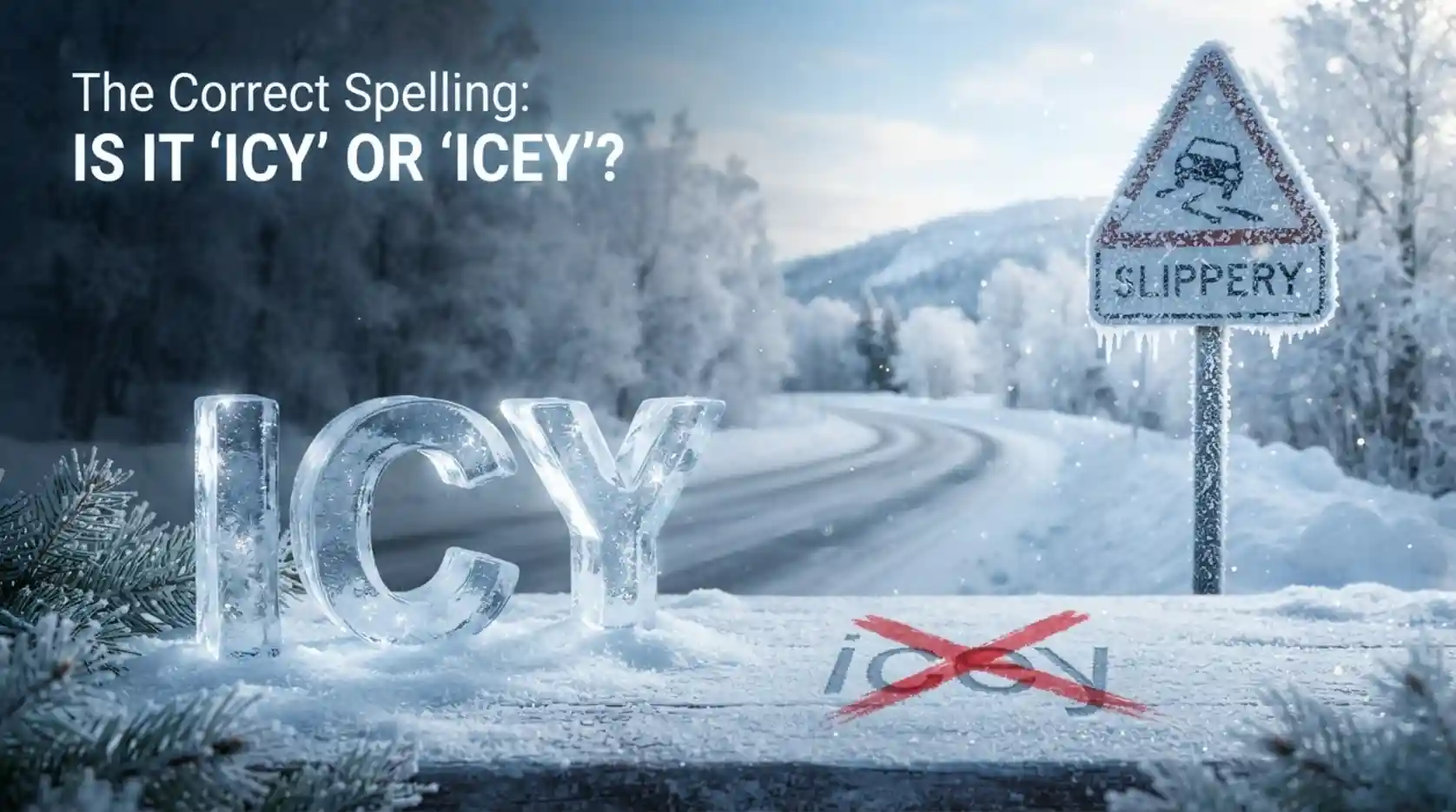
Icy is the correct spelling. Icey is a misspelling.
This is true in American English, British English, and every other major form of English. Dictionaries list only “icy.”
Here are some examples:
- The road was icy this morning.
- She gave me an icy stare.
- Be careful on the icy steps.
- The wind felt icy on my face.
The only time you will see “Icey” is in a name, such as a brand, a nickname, or a social media handle. In regular writing, use “icy.”
The Origin of Icey or Icy
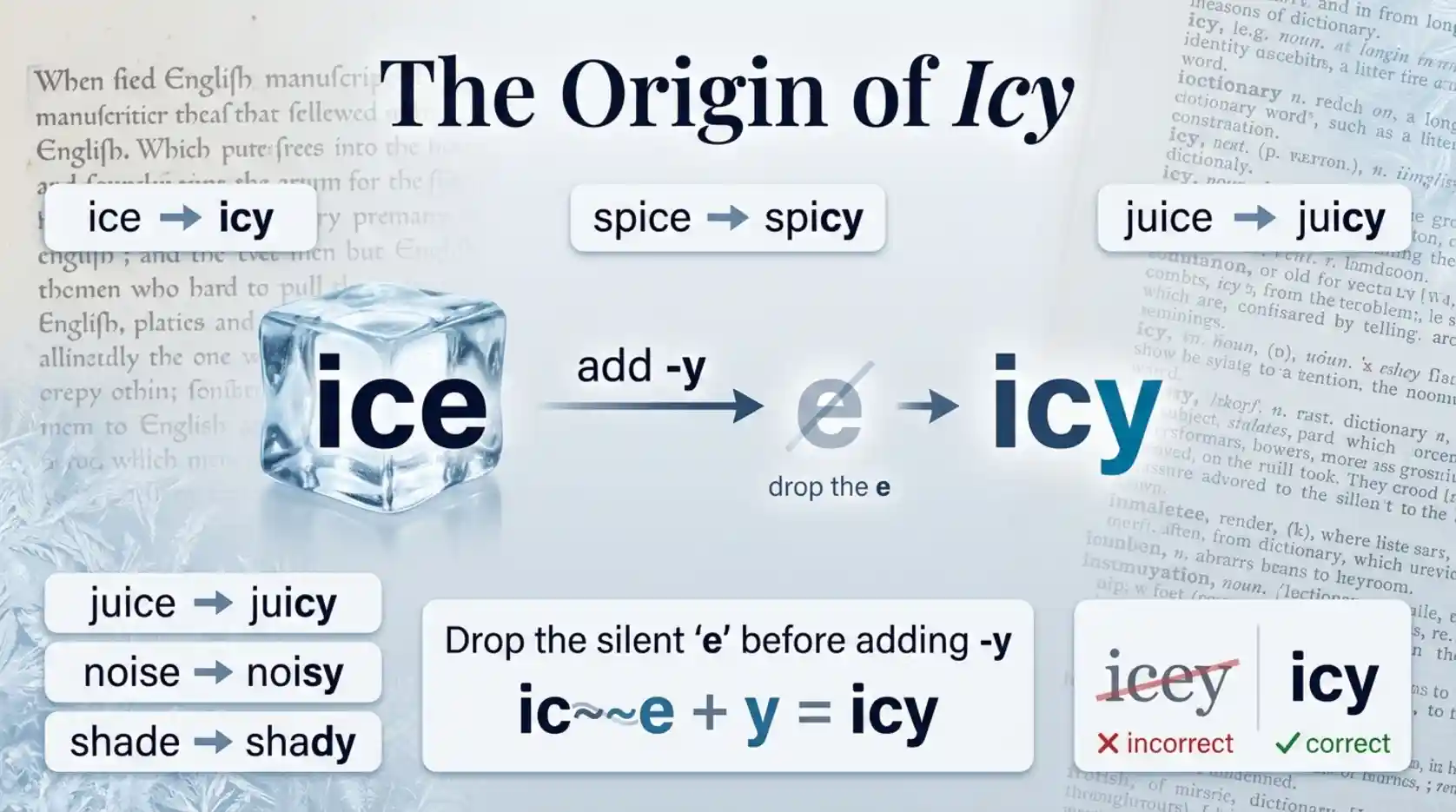
The word starts with ice. In Old English, ice was written īs. Speakers added a small ending, -y, to make an adjective. This ending means “full of” or “like.” So “icy” means “full of ice” or “like ice.”
Many English words follow this pattern:
- ice → icy
- spice → spicy
- juice → juicy
- noise → noisy
- shade → shady
The rule is easy. When a word ends in a silent e, drop the e before adding -y.
So why do people write “icey”? There are a few reasons:
- Habit. The word “ice” has an e, so people keep it.
- Look-alike words. Words like pricey, dicey, and cagey keep the e. This makes “icey” look normal.
- Sound. The word is said “eye-see.” Spelling by sound can lead to extra letters.
Some words keep the e by long-standing custom. “Icy” is not one of them.
Icey or Icy: British English vs American English Spelling
Good news: there is no difference. Both British and American English use “icy.”
Many other words do change between the two styles. Here is a side-by-side look:
| Word type | American English | British English | Same or different? |
| Cold, with ice | icy | icy | Same |
| Full of spice | spicy | spicy | Same |
| Full of juice | juicy | juicy | Same |
| Costly | pricey | pricey | Same |
| Hue | color | colour | Different |
| Preferred item | favorite | favourite | Different |
| To organize | organize | organise (also organize) | Different |
The changes you see between US and UK spelling mostly involve endings like -or/-our and -ize/-ise. They do not touch the -y ending in “icy.” That is why you can stop worrying about which country you are writing for.
Which Spelling Should You Use?
Use icy everywhere. Here is the advice by audience:
- US readers: Use icy. Icey will look like a typo.
- UK and Commonwealth readers (Canada, Australia, India, and others): Use icy. The spelling is the same.
- Global readers: Use icy. It is the standard form in dictionaries, style guides, and news outlets.
The only exception is a proper name. If a person, band, or brand spells its name “Icey,” copy that spelling exactly. That is a name, not the word.
Common Mistakes with Icey or Icy
Here are the errors people make most often, with fixes:
| Mistake | Correction | Tip |
| icey | icy | Drop the silent e from ice |
| iceyer, iceyest | icier, iciest | Change y to i before -er and -est |
| icyly | icily | Change y to i before -ly |
| iciness spelled “iceyness” | iciness | Same y-to-i rule |
| iccy | icy | Only one c |
| icy tea | iced tea | Use “iced” for a drink served with ice |
The last one is a favorite. Icy describes something covered in ice or very cold. Iced describes something that has ice added to it. You drink iced coffee. You slip on an icy sidewalk.
Icey or Icy in Everyday Examples
In an email:
“Please drive carefully. The roads near the office are icy.”
In the news:
“Icy conditions caused delays on highways across the region.”
On social media:
“Woke up to an icy world outside. Not going anywhere today.”
In formal writing:
“The report describes icy surface conditions that raised the risk of accidents.”
In a story:
“An icy silence filled the room.”
Notice that “icy” fits both plain facts and figures of speech. It can mean literally covered in ice, or it can mean cold in tone.
Icey or Icy – Google Trends & Usage Data
I can’t pull live Google Trends numbers here, so I won’t give you exact figures. But the general pattern is clear and easy to check yourself.
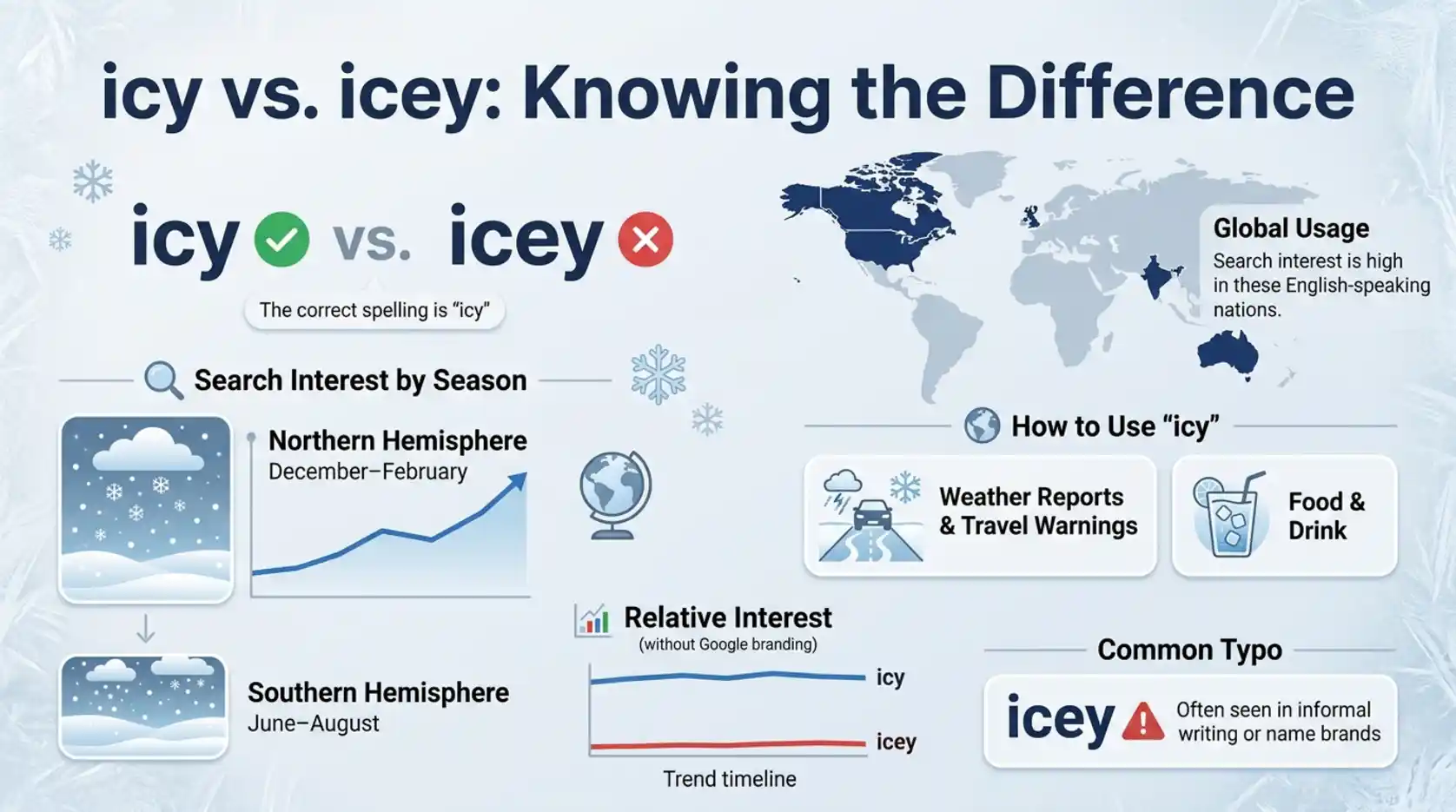
- Popularity by country: People search for this in English-speaking countries such as the US, the UK, Canada, Australia, and India. Most searchers want to confirm the spelling, not choose between two regional forms.
- Popularity by season: Interest tends to rise in winter. In the Northern Hemisphere, that means December to February. In the Southern Hemisphere, it is more likely June to August.
- Popularity by context: “Icy” appears in weather reports, travel warnings, food and drink writing, and everyday speech. “Icey” appears mostly as a typo, a name, or a stylized tag.
You can check current data at trends.google.com. Type “icy” and “icey” as two search terms and compare them. Keep in mind that Trends shows relative interest, not exact counts.
Here is a side-by-side look at the word forms:
| Form | Correct? | Meaning or use |
| icy | Yes | Covered in ice, very cold |
| icey | No | Common misspelling (or a name) |
| icier | Yes | More icy |
| iciest | Yes | Most icy |
| icily | Yes | In a cold, unfriendly way |
| iciness | Yes | The state of being icy |
| iceyer / iceyest | No | Wrong forms |
Icey or Icy: FAQs
1. Is it icey or icy?
It is icy. Icey is a misspelling.
2. Is “icey” ever correct?
Only as a name, such as a brand, nickname, or username. It is not a standard English word.
3. Why is “icy” spelled without an e?
The word comes from “ice.” When you add -y to a word that ends in a silent e, you usually drop the e. The same happens in spicy and juicy.
4. Is “pricey” spelled with an e? Why not “icy”?
Yes, “pricey” is common, and “pricy” is also seen. Some -y words keep the e by custom. “Icy” does not.
5. Do the British spell it differently from Americans?
No. Both use “icy.”
6. What is the comparative of icy?
Icier. The superlative is iciest.
7. What is the difference between icy and iced?
Icy means covered in ice or very cold, like an icy road. Iced means served with ice, like iced tea.
Conclusion
So, is it icey or icy? The answer is simple. Icy is the correct spelling. Icey is a common mistake, and you should avoid it in your writing.
Here are the key points to remember. Icy comes from the word ice. The silent e drops before the -y ending. This is the same rule you see in spicy, juicy, and noisy. Some words, like pricey and dicey, keep the e, but that does not change the rule for icy.
There is no British and American split here. Readers in the US, the UK, Canada, Australia, and India all expect icy. Use it in emails, reports, news stories, and social posts.
Remember the forms too. Use icier for more icy, iciest for most icy, and icily for the adverb. None of them have an extra e.
If you ever doubt yourself, say the word ice, remove the e, and add y. Then check the word once with your spell checker. Do this a few times and it will become habit. Now you can write about frosty roads, cold winds, and chilly stares with full confidence.