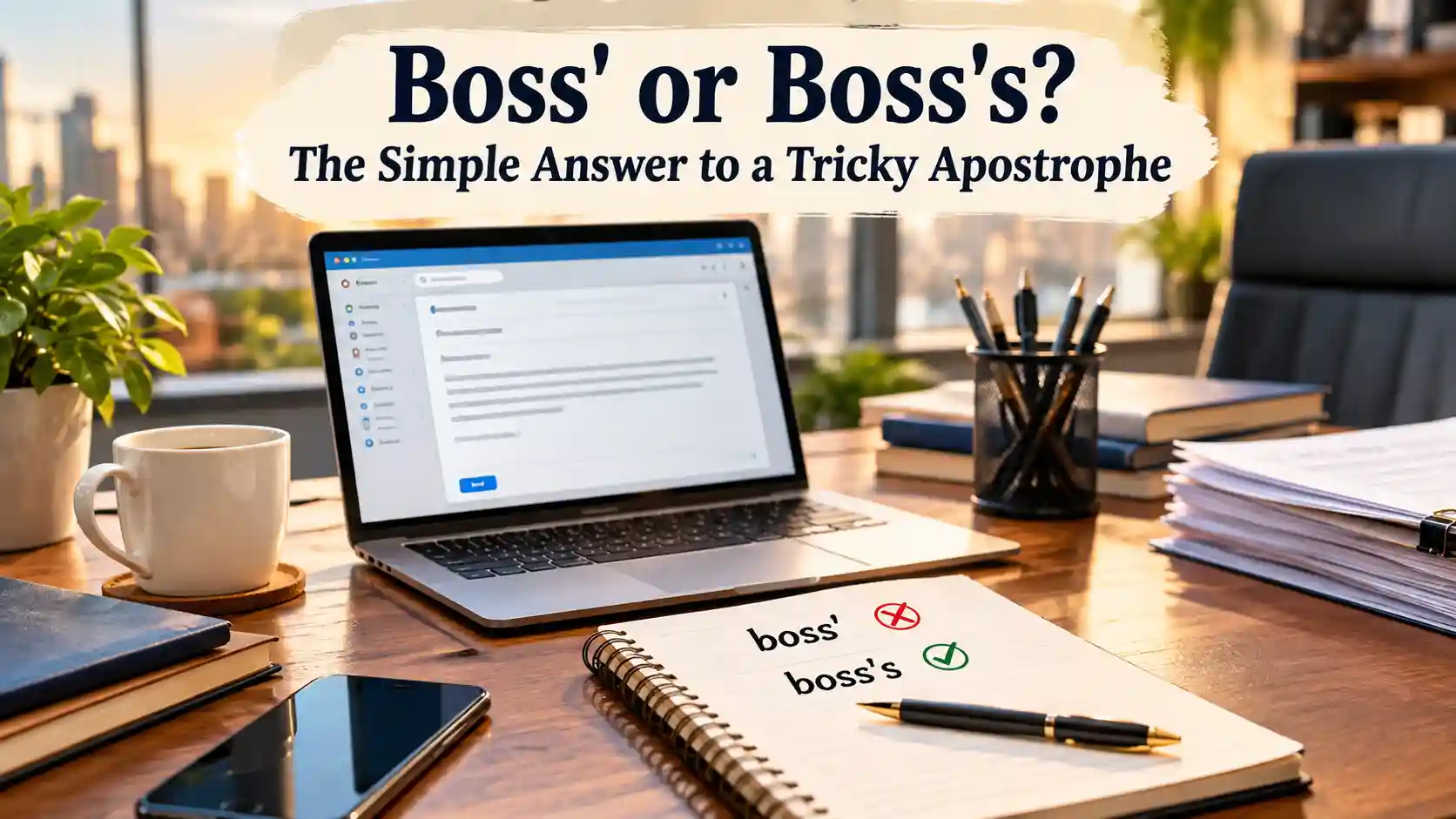
You are typing an email. You want to say the desk belongs to your boss. Then you freeze. Is it “boss’ desk” or “boss’s desk”?
You are not alone. Many people search for “boss’ or boss’s” every day. The word ends in s, so the apostrophe feels odd. Should you add another s? Should you skip it? Different teachers give different rules, and different websites do too. That creates doubt.
This guide clears it up. You get a quick answer first. Then you learn where the word came from and why the rules differ. You will see how US and UK writers handle it. You will also see common mistakes, real examples, and a clear way to pick one spelling and stick with it.
By the end, you will know exactly what to type. You will also know how to explain it if your boss asks.
Boss’ or Boss’s – Quick Answer
Use “boss’s” for one boss. It is the safest choice. Most major style guides prefer it.
Use “bosses'” for many bosses.
Examples:
- The boss’s office is on the third floor. (one boss)
- I read the boss’s email twice. (one boss)
- The bosses’ meeting starts at noon. (many bosses)
“Boss'” is not a mistake in every case. Some newspapers and writers use it. But “boss’s” is the choice you can defend anywhere.
The Origin of Boss’ and Boss’s
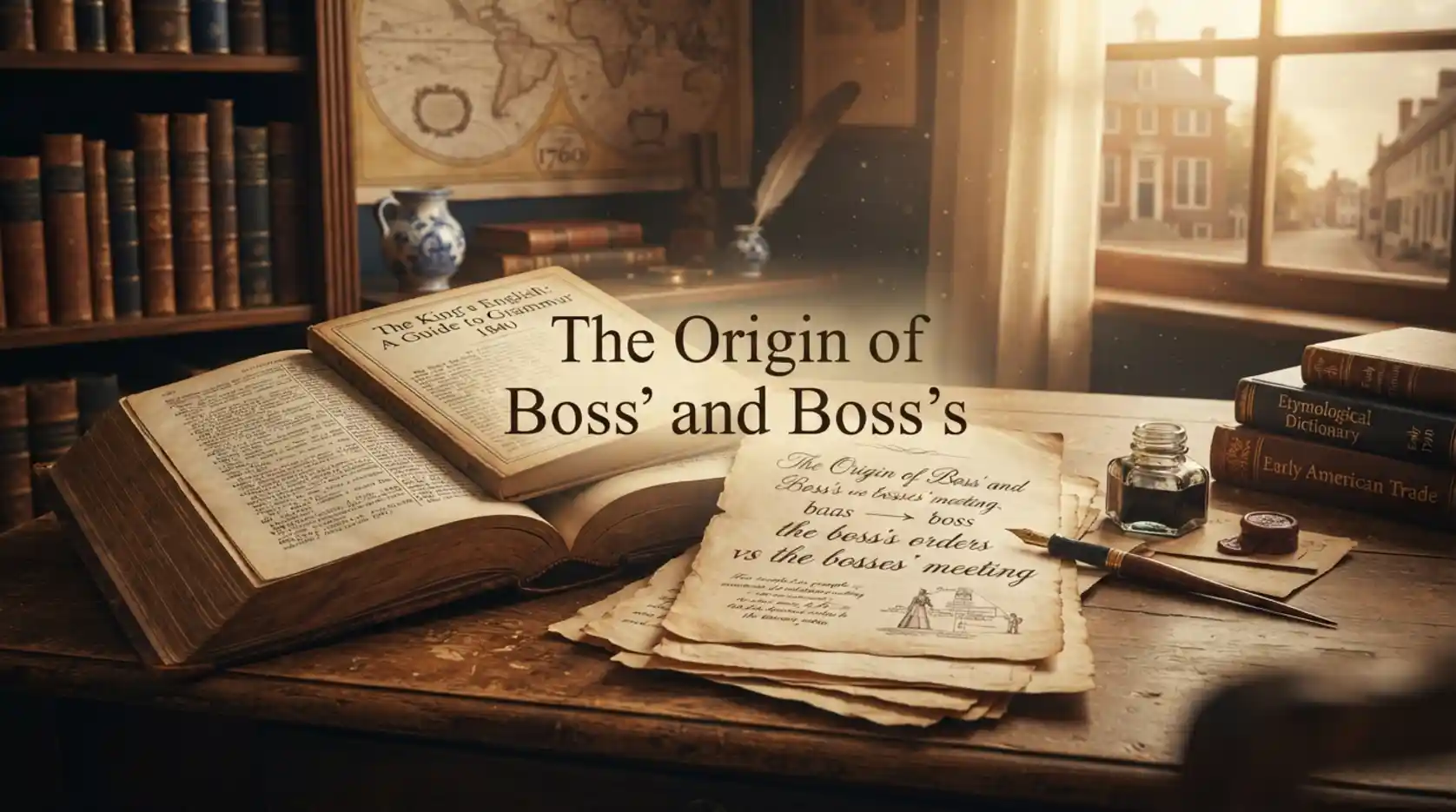
The word “boss” comes from the Dutch word baas. It means “master.” Dutch settlers in what is now New York used it in the mid-1600s. Americans liked it. It sounded less harsh than “master.” The word spread across the United States. Later it reached the UK and the rest of the world.
Now for the apostrophe. In old English, a word showed ownership with an -es ending. Think “the kinges horse.” Over time, writers dropped the e. They put an apostrophe where the e used to be. That is why we write “king’s horse” today.
So “boss’s” follows the old pattern. You add apostrophe plus s. You say it out loud as “boss-iz.”
Then why does “boss’” exist? Some writers thought that using two s sounds together looked awkward, so they preferred the shorter form. Some newspapers also used “boss’” to save space, while certain style guides created special rules for words ending in s. As these different preferences continued, both forms became common in writing. This is why you may see “boss’” and “boss’s” used in different places. The difference is mainly caused by changing style rules, not by careless writing.
British English vs American English Spelling
Many people think the US uses one form and the UK uses the other. That is not quite true. The choice depends more on the style guide than on the country.
Here is how it looks:
| Style Guide | Region | Singular Possessive | Notes |
| Chicago Manual of Style | US | boss’s | Add ‘s to singular nouns ending in s |
| AP Stylebook | US | boss’s | Common nouns take ‘s. Proper names ending in s take only an apostrophe |
| Strunk & White | US | boss’s | Classic rule: add ‘s |
| Oxford Style | UK | boss’s | Add ‘s in most cases |
| The Guardian | UK | boss’s | Add ‘s |
| Casual writing | Both | boss’ or boss’s | Both appear, but boss’s is more common |
The plural form is the same everywhere: bosses’.
Which Spelling Should You Use?
Pick the choice that fits your reader.
- US readers: Use “boss’s.” It matches Chicago, AP, and most schools.
- UK and Commonwealth readers: Use “boss’s.” Oxford and most UK papers prefer it.
- Global readers: Use “boss’s.” It is the clearest and least likely to be marked wrong.
- Your company has a style guide: Follow it. Rules at work beat rules online.
- You write for a newspaper or a school: Check their guide first, then stay consistent.
The most important tip: be consistent. Do not write “boss’s” in one line and “boss'” in the next.
Common Mistakes with Boss’ and Boss’s
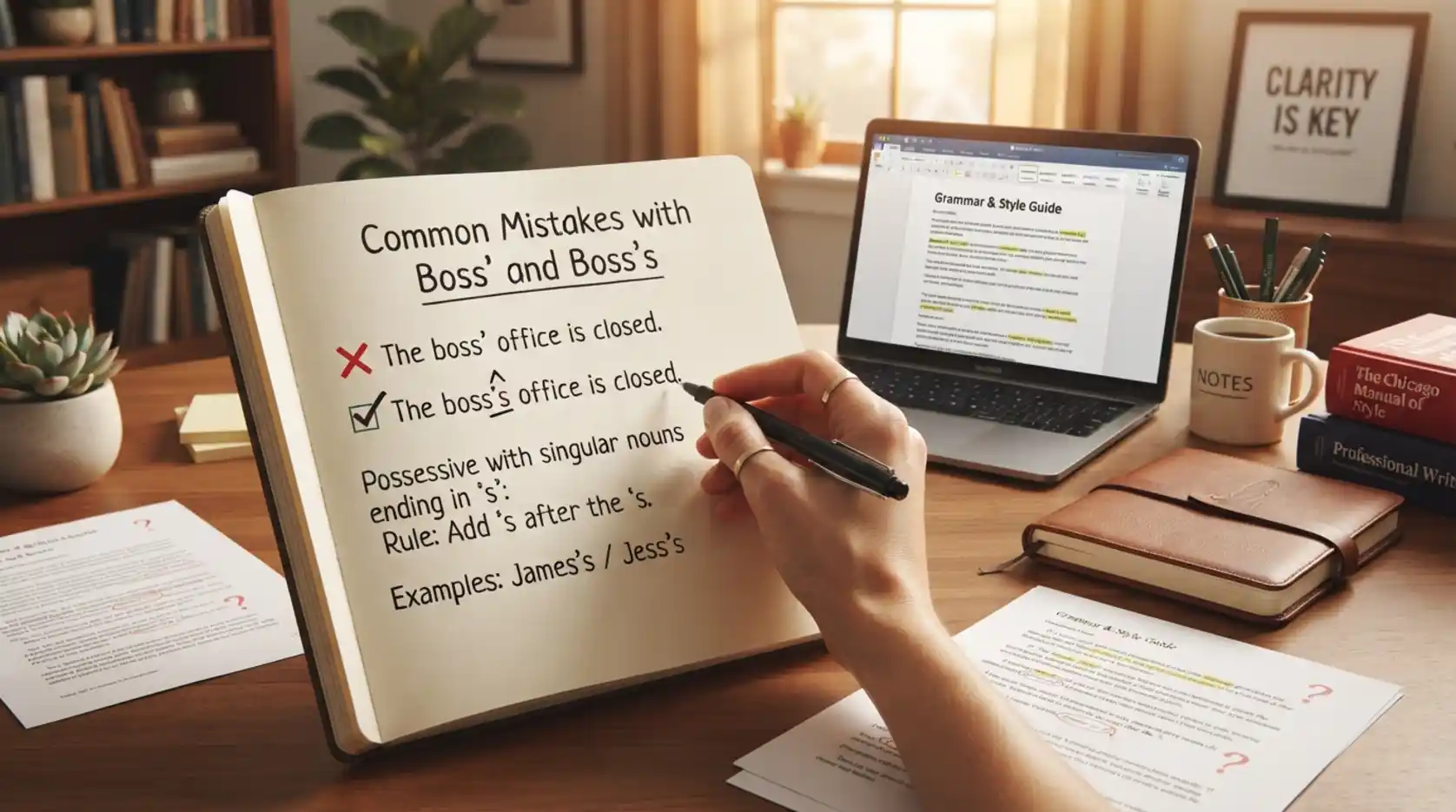
Mistake 1: Using “bosses” to Show Ownership
One common mistake is using “bosses” when you want to show that something belongs to one boss. For example, “The bosses office is big” is incorrect because the sentence needs an apostrophe. The correct form is “The boss’s office is big.”
Mistake 2: Mixing Up Singular and Plural
It is also easy to confuse “boss’s” with “bosses’.” Use “boss’s” when one boss owns something, such as “The boss’s meeting.” When several bosses are involved, use “bosses’”, as in “The bosses’ meeting.”
Mistake 3: Adding an Apostrophe to a Plain Plural
Another mistake is adding an apostrophe when you only want to show that there is more than one boss. The sentence “We have three boss’s” is incorrect because no possession is involved. The correct sentence is “We have three bosses.”
Mistake 4: Leaving Out the Apostrophe
An apostrophe is necessary when you want to show that something belongs to the boss. For example, “My bosses car is red” is incorrect. The correct version is “My boss’s car is red.” The apostrophe shows that the car belongs to one boss.
Mistake 5: Changing the Style in the Same Document
Writers may sometimes use both “boss’” and “boss’s” in the same piece of writing. This can make the writing look inconsistent. It is better to choose one style based on the relevant style guide and use it throughout the document.
Boss’ and Boss’s in Everyday Examples
In an email
- “Please send the report to my boss’s assistant.”
- “I will check my boss’s calendar and reply today.”
In the news
- “The boss’s decision surprised the team.”
- “The company’s bosses’ pay was made public.”
On social media
- “My boss’s Zoom background is a cat. I can’t focus.”
- “Reminder: your boss’s opinion is not your worth.”
In formal writing
- “The boss’s approval is required before the budget is released.”
- “The bosses’ responsibilities are listed in Section 4.”
Boss’ or Boss’s – Google Trends and Usage Data
Search interest in this question stays steady all year. It rises when people return to school or work, since that is when more people write emails and reports. Interest also tends to come from English-speaking countries such as the US, UK, Canada, Australia, and India.
You will see two patterns in real usage:
- In print and formal writing: “boss’s” is the more common form.
- In quick, casual writing: “boss'” appears more often, sometimes by mistake and sometimes by habit.
For live numbers, check Google Trends yourself. Search for “boss’s” and “boss'” side by side and filter by country and date. Trends change, and fresh data is better than any fixed figure.
Keyword Variations Side by Side
| Form | Meaning | Correct? | Example |
| boss’s | One boss owns something | ✅ Preferred | The boss’s pen |
| boss’ | One boss owns something | ⚠️ Accepted by some, less common | The boss’ pen |
| bosses’ | Many bosses own something | ✅ Correct | The bosses’ pens |
| bosses | More than one boss (no ownership) | ✅ Correct | Two bosses called |
| boss’s’ | Nothing | ❌ Wrong | — |
FAQs
1. Is it “boss’ or boss’s”?
“Boss’s” is the safest choice for one boss. “Boss'” is used by some writers, but fewer style guides back it.
2. Is “boss'” ever correct?
Sometimes. A few newspapers and writers use it. It is not a wild error. It is just less common than “boss’s.”
3. How do I write the possessive of more than one boss?
Use “bosses’.” Example: “The bosses’ cars are in the lot.”
4. Do Americans and British people spell it differently?
Not by rule. Both prefer “boss’s” in most guides. The real difference is between style guides, not countries.
5. How do I say “boss’s” out loud?
Say “boss-iz.” If you say the extra syllable, write the extra s.
6. Does the same rule work for other words ending in s?
Mostly, yes. “The class’s schedule” and “the bus’s route” follow the same pattern. Names can be different, so check your style guide.
7. What if my company uses “boss'”?
Follow your company style guide. Being consistent matters more than which form you pick.
8. Is “bosses” the same as “boss’s”?
No. “Bosses” means more than one boss. “Boss’s” shows that one boss owns something.
Conclusion
When deciding between boss’ and boss’s, the correct form depends on what you want to say. Use boss’s when you are talking about something that belongs to one boss. Use bosses’ when something belongs to two or more bosses. However, use bosses without an apostrophe when you simply mean more than one boss and are not showing ownership.
Here are the key takeaways:
- “Boss’s” is the safest form in both US and UK writing.
- The word comes from Dutch baas, and the possessive follows an old English pattern.
- The real split is between style guides, not countries.
- “Boss'” is not always wrong, but it is less common and harder to defend.
- Consistency matters. Pick one form and use it everywhere.
When in doubt, say the word out loud. If you hear the extra “iz” sound, add the extra s. If your school, job, or publisher has a style guide, follow it.
Now you can write about your boss’s desk, your boss’s email, or your boss’s big idea with full confidence. No more freezing. Just type it and hit send.