Your event is off. You open a blank email. Then you stop. Is it “canceled” or “cancelled”? One L or two? You type both and stare at the screen. They look wrong now.
You are not alone. Thousands of people search for this every month. It comes up in work emails, news stories, school notices, and app messages. The words look almost the same, and both show up in print. That makes it hard to know which one is right.
Here is the good news. Both are correct. They are two spellings of one word. One is mostly American. The other is mostly British. Neither is a mistake.
This guide ends the confusion. You will learn the quick answer, where the word came from, and why the spellings differ and you will see which one to use for your reader. You will also get examples, a comparison table, and answers to common questions. By the end, you will never second-guess it again.
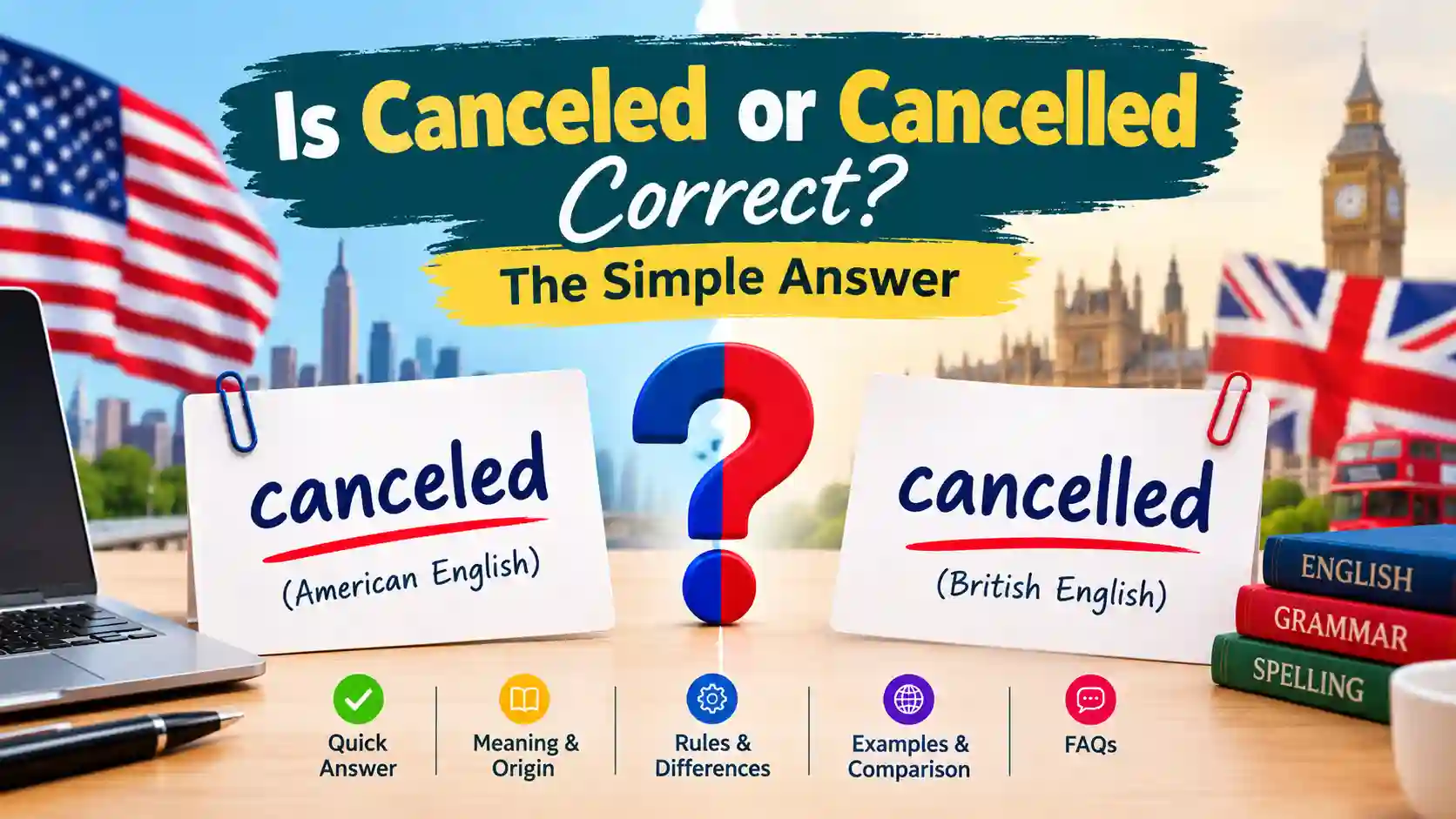
Is Canceled or Cancelled – Quick Answer
Both are correct.
- Canceled (one L) is American English.
- Cancelled (two Ls) is British English. Canada, Australia, and New Zealand also use it.
The meaning is the same. Both mean “called off” or “stopped.”
Examples:
- American: “The flight was canceled because of snow.”
- British: “The train was cancelled because of snow.”
Same word. Same meaning. Only the spelling changes.
Quick tip: The noun is always “cancellation” with two Ls. This is true in the US and the UK.
The Origin of Canceled or Cancelled
The word “cancel” is old. It comes from the Latin word cancellare. That word meant “to cross out.” Long ago, scribes crossed out a mistake with lines that formed a lattice. A lattice looks like a grid of crossed bars. The Latin word for lattice was cancelli.
The word moved into Old French as canceller. Then it came into English around the 1300s. At first, it meant to cross out writing. Later it grew to mean ending a plan, a trip, or a deal.
So why two spellings?
In the early 1800s, an American writer named Noah Webster made a dictionary. He wanted spelling to be simpler and more logical, he cut extra letters and he wrote “color” instead of “colour” “center” instead of “centre.” He also favored single L’s in words like “traveled.”
British writers kept the older forms. So the two countries drifted apart. Today, “canceled” is the common American spelling. “Cancelled” is the common British spelling.
British English vs American English Spelling
The difference comes down to one rule.
The British rule: When a verb ends in a single vowel plus L, double the L before adding -ed or -ing. This is true even when the last syllable is not stressed.
The American rule: Double the L only if the last syllable is stressed. Otherwise, keep it single.
In “cancel,” the stress is on the first syllable (CAN-cel). So Americans keep one L.
Spelling Comparison Table
| Word | American English | British English |
| cancel (past) | canceled | cancelled |
| cancel (ongoing) | canceling | cancelling |
| travel | traveled | travelled |
| travel (ongoing) | traveling | travelling |
| label | labeled | labelled |
| model | modeled | modelled |
| level | leveled | levelled |
| cancel (noun) | cancellation | cancellation |
Notice the pattern. These words all follow the same rule. If you know one, you know them all.
One more point. American writers sometimes use “cancelled” too. Dictionaries list it as a less common variant. So you will see it in US writing. But “canceled” is the standard choice.
Which Spelling Should You Use?
Pick the spelling that fits your reader.
Writing for a US audience? Use canceled. Most US style guides, including the AP Stylebook, prefer it.
Writing for a UK audience? Use cancelled. This is the standard in British newspapers, schools, and businesses.
Writing for Canada, Australia, or New Zealand? Use cancelled. Canada is mixed, but “cancelled” is still the most common choice there. Check your organization’s style guide if you have one.
Writing for a global audience? Choose one and stay with it. Many global brands use American English. If that is your case, use “canceled.” If your main readers are in the UK or Commonwealth, use “cancelled.”
The golden rule: Be consistent. Do not use both spellings in one document.
Common Mistakes with Canceled or Cancelled
Here are the errors people make most often.
1. Mixing spellings in one text.
- Wrong: “The show was canceled. The tour was cancelled too.”
- Right: “The show was canceled. The tour was canceled too.”
2. Using one L in “cancellation.”
- Wrong: “cancelation”
- Right: “cancellation”
Both countries use two Ls here. Some US writers spell it with one L, but it is rare and often flagged as an error.
3. Thinking one spelling is “wrong.”
Neither is. They are regional.
4. Dropping a letter in other forms.
- Wrong: “caneled” or “cancled”
- Right: “canceled” or “cancelled”
5. Mixing “cancel” with “cancer” or “council.”
These are different words. Check your spelling before you send.
6. Ignoring your spell checker’s language setting.
Set your tool to US or UK English. It will then flag the wrong form for you.
Canceled or Cancelled in Everyday Examples
See how it looks in real life.
Work email (US):
“Hi team, today’s meeting has been canceled. We will reschedule next week.”
Work email (UK):
“Hi all, today’s meeting has been cancelled. We will reschedule next week.”
News headline (US):
“Concert Canceled Due to Storm”
News headline (UK):
“Match Cancelled After Heavy Rain”
Social media:
“My flight got canceled again. 😩”
“Train cancelled. Again. Brilliant.”
Customer service:
“Your order has been canceled. A refund will arrive in 3–5 days.”
Formal writing:
“The committee cancelled the hearing pending further review.”
“Any cancellation must be made in writing.”
App notification:
“Your subscription was canceled.”
Canceled or Cancelled – Google Trends & Usage Data
Search interest tells a clear story. Here is the general pattern. For exact, current numbers, check Google Trends yourself.
By country:
- United States: People search for “canceled” more often. “Cancelled” still gets searches, often from people unsure of the rule.
- United Kingdom: “Cancelled” leads by a wide margin.
- Canada: Both appear. “Cancelled” is often more common.
- Australia and New Zealand: “Cancelled” is the clear favorite.
- India and other Commonwealth nations: “Cancelled” is the usual choice.
By context:
- Travel and events: Searches rise when weather, strikes, or delays hit. Flights and trains are the top topics.
- Entertainment: TV shows get “canceled” or “cancelled” all the time. Fans search for news about their favorites.
- Online culture: The phrase “cancel culture” boosted searches in recent years.
How to check it yourself:
Go to Google Trends. Type both words. Pick a country. Pick a date range. You will see which spelling wins in that place.
Keyword Variations Side by Side
| Form | Spelling (US) | Spelling (UK) | Notes |
| Base verb | cancel | cancel | Same everywhere |
| Past tense | canceled | cancelled | Main difference |
| Present participle | canceling | cancelling | Follows the same rule |
| Noun | cancellation | cancellation | Two Ls in both |
| Person who cancels | canceler | canceller | Rarely used |
| Common use | “Flight canceled” | “Train cancelled” | Regional habit |
FAQs
1. Is it canceled or cancelled?
Both are right. Use “canceled” for American English. Use “cancelled” for British English.
2. Which spelling is more common?
It depends on the country. “Canceled” leads in the US. “Cancelled” leads in the UK, Australia, and most Commonwealth nations.
3. Is “cancelled” wrong in American English?
No. It is a less common variant. You will see it in US writing, but “canceled” is the standard choice.
4. Why does “cancellation” have two Ls?
The noun follows a different pattern. Both US and UK dictionaries spell it with two Ls.
5. What about “canceling” and “cancelling”?
The same rule applies. Use “canceling” in the US. Use “cancelling” in the UK.
6. Do other words follow this rule?
Yes. “Traveled/travelled,” “labeled/labelled,” and “modeled/modelled” work the same way.
7. Which one should I use on my website?
Use the spelling that matches your main audience. Then be consistent on every page.
8. Does it change the meaning?
No. The meaning is identical.
Conclusion
Here is what you need to remember.
“Canceled” and “cancelled” are the same word. Both are correct. The only difference is the region. Americans use one L. The British, and most Commonwealth countries, use two.
The word comes from the Latin cancellare, which meant “to cross out.” Noah Webster simplified many American spellings in the 1800s. That is why the two forms split.
Your choice is simple. Writing for the US? Use canceled. Writing for the UK, Canada, Australia, or New Zealand? Use cancelled. Writing for the world? Pick one and stick with it.
Avoid the common slips. Do not mix spellings in one text. Do not drop a letter in “cancellation.” It always has two Ls. And set your spell checker to the right language.
Now you know the rule. You can write your next email, headline, or post with confidence. The next time a trip is called off, you will not stop and stare at the screen. You will just type the right word and hit send.