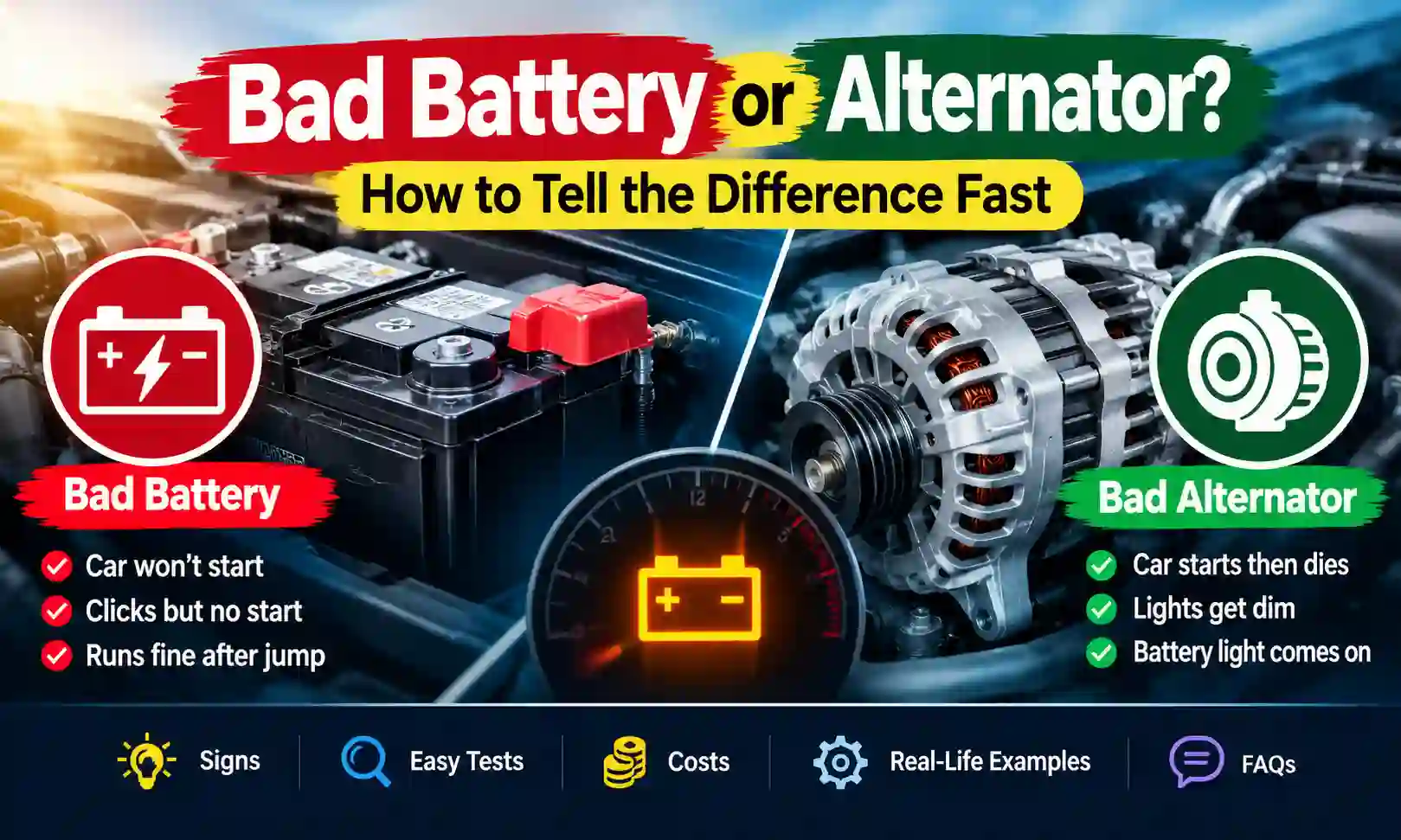
Your car won’t start. Or the lights flicker. Or a battery light glows on the dash. Now you wonder: is it the battery, or is it the alternator?
You are not alone. Thousands of drivers search “bad battery or alternator” every month. The two parts work as a team, so their problems look alike. Both can leave you stuck with a dead car.
This confusion costs real money. Buy a new battery when the alternator is bad, and the new battery dies too. Replace the alternator when the battery is weak, and you wasted a few hundred dollars.
This guide fixes that. You will get a quick answer first. Then you will learn the signs, the easy tests, and the common mistakes. You will also see costs, real-life examples, and answers to common questions.
Read on, and you can spot the real problem in minutes. No special skills are needed. A free test at a parts store or a cheap tool can help too.
Bad Battery or Alternator – Quick Answer
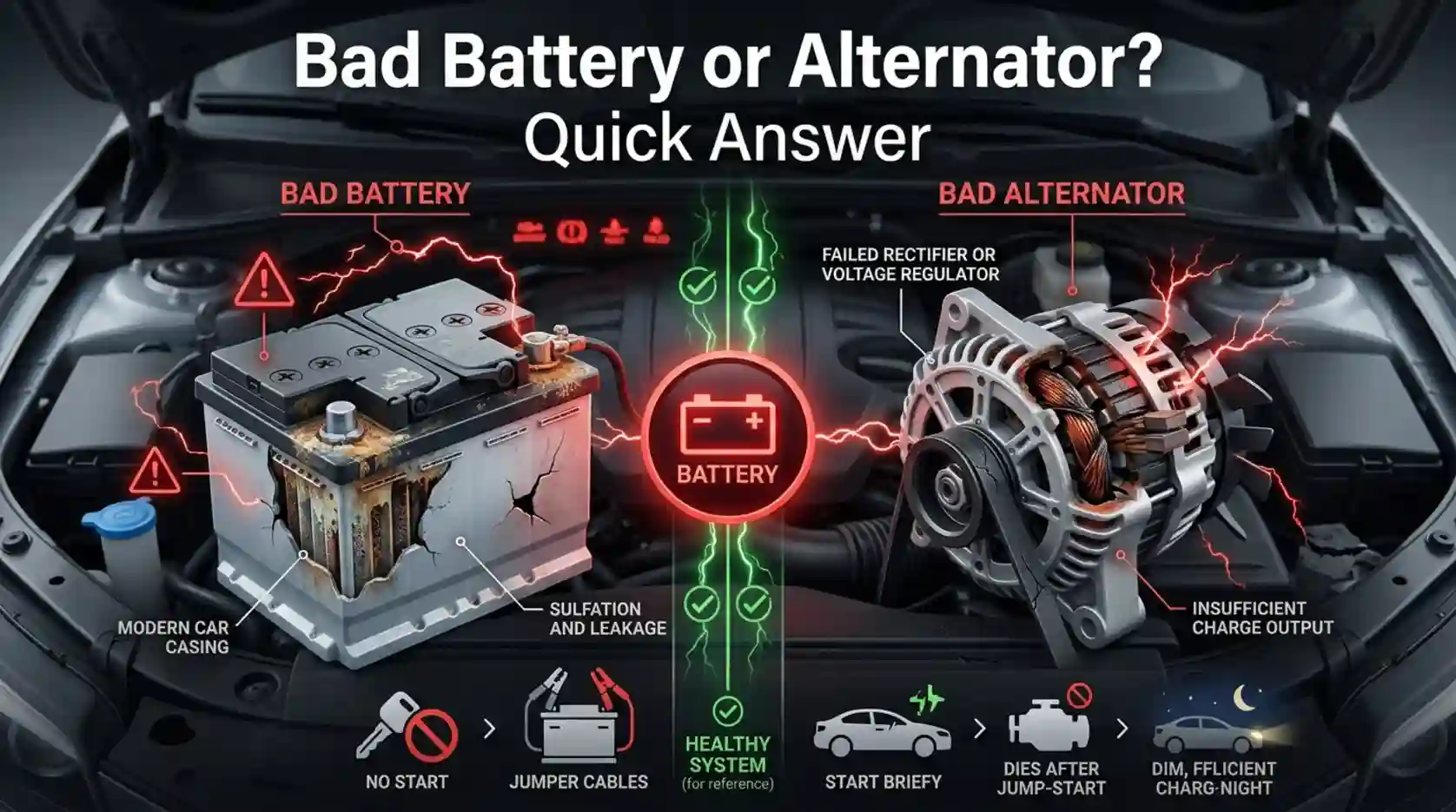
The battery starts the car. The alternator keeps it running.
- Bad battery: The car won’t start, or it clicks. But once jump-started, it runs fine for a while.
- Bad alternator: The car starts, then dies soon after. Lights get dim while you drive. The battery light comes on.
Examples:
- You turn the key. You hear a click. The lights are weak. This is likely the battery.
- You jump-start the car. It runs, then dies in ten minutes. This is likely the alternator.
- Your car starts fine in the morning. But the radio cuts out and the headlights fade while driving. This is likely the alternator.
Fast test: Start the car with a jump. Remove the jumper cables. If the engine dies at once, the alternator is likely bad.
The Origin of “Battery” and “Alternator”
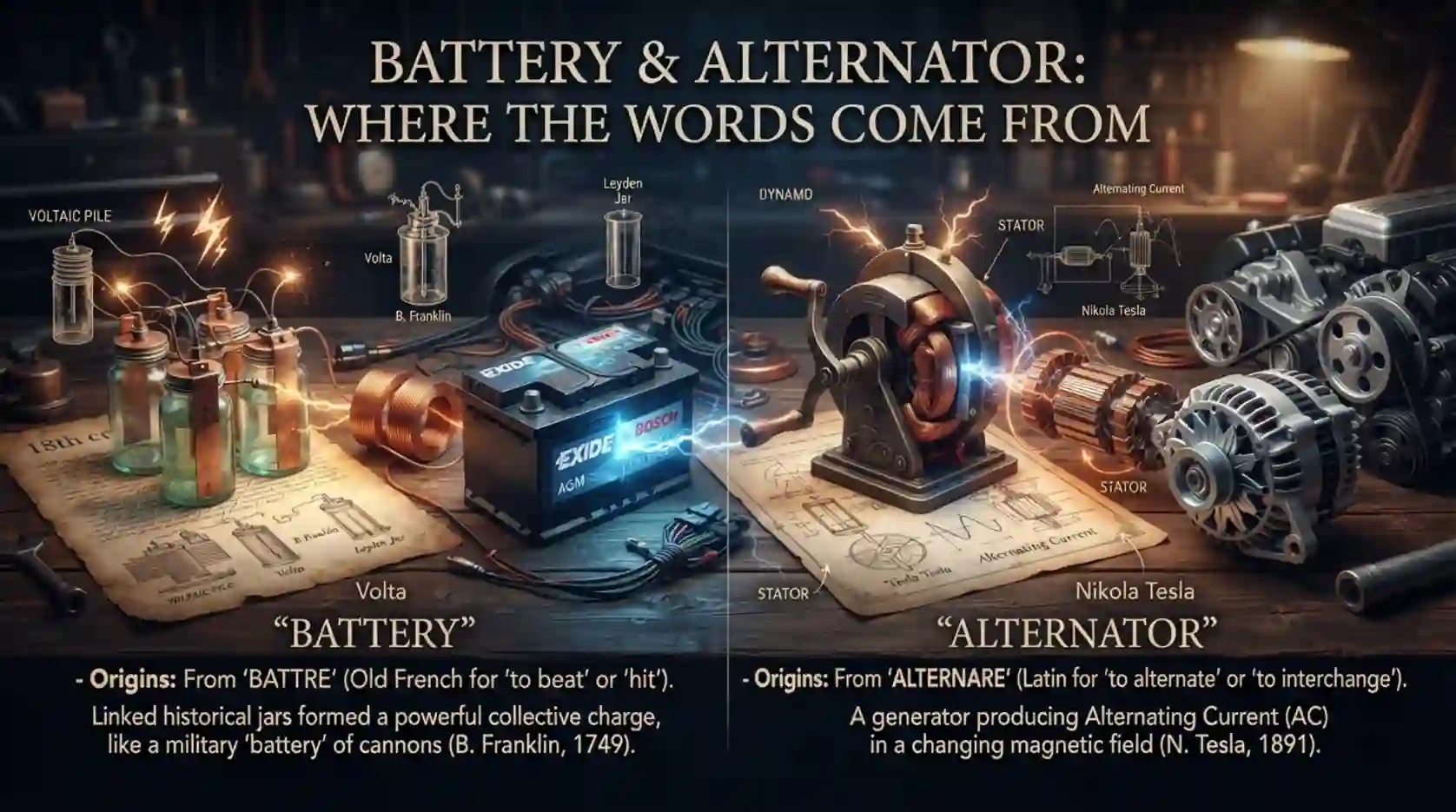
Words can help you remember what each part does.
Battery: The word comes from the French batterie, from the verb battre, “to beat.” It first described groups of guns that fired together. Benjamin Franklin used the word in the 1740s for a group of linked electric jars. The name stuck for any set of cells that store power.
Alternator: It comes from “alternate.” The part makes alternating current (AC). A car runs on direct current (DC), so the alternator turns AC into DC with parts called diodes.
Why this matters: The battery stores power. The alternator makes power. Keep that in mind and the symptoms make more sense.
There is no spelling fight here. Both words are spelled the same everywhere. The only differences are in nearby car words, covered next.
British English vs American English Terms
Both countries spell “battery” and “alternator” the same way. Many car words around them differ, though.
| Idea | American English | British English |
| Dead battery | Dead battery | Flat battery |
| Cables to jump a car | Jumper cables | Jump leads |
| Front cover over engine | Hood | Bonnet |
| Start a dead car | Jump-start | Jump-start / bump-start |
| Old power generator | Generator | Dynamo |
| Car repair shop | Auto shop / garage | Garage / workshop |
| Dashboard warning | Battery light | Battery warning light |
Tip: In the UK, “my battery is flat” means the same as “my battery is dead” in the US.
Which Term Should You Use?
Use the words your reader knows.
- US readers: “dead battery,” “jumper cables,” “hood.”
- UK and Commonwealth readers: “flat battery,” “jump leads,” “bonnet.”
- Global readers: Use “battery” and “alternator.” These work everywhere. Add the local word once in brackets, like “flat (dead) battery.”
For mechanics and formal writing, use “charging system.” It covers the battery, alternator, and wiring.
Common Mistakes with Bad Battery or Alternator
1. Replacing the battery first, every time.
A weak alternator kills new batteries. Test before you buy.
2. Thinking a jump-start fixes the problem.
A jump only gives you power for now. It does not repair anything.
3. Ignoring the battery light.
This light often means a charging problem. It does not always mean a bad battery. Check the alternator too.
4. Blaming the starter.
A slow crank is usually the battery. A single loud click can be the starter. Check the battery first.
5. Skipping the cables.
Loose or rusty terminals mimic a dead battery. Clean them and tighten them first. It is free.
6. Driving on a failing alternator.
The car runs on battery power alone. It will stop without warning. Get it checked soon.
7. Guessing without a meter.
A cheap multimeter gives a clear answer (see below).
Easy Multimeter Check
- Engine off: A healthy battery reads about 12.4–12.7 volts. Below 12.0 means it is weak.
- Engine running: A healthy alternator makes about 13.7–14.7 volts. If the number stays near 12 volts, the alternator is not charging.
Bad Battery or Alternator in Everyday Examples
In an email to a mechanic:
“My car clicks but won’t start. The lights are dim. Could it be a bad battery or alternator? Can you test both?”
In a news-style tip:
“Cold weather makes a weak battery fail. But if your car dies while driving, the alternator is more likely at fault.”
On social media:
“Car died again 😩 Is it a bad battery or alternator? Jump worked but it died in 5 mins. Help!”
(Helpful reply: “Sounds like the alternator.”)
In formal writing (repair report):
“The vehicle failed to start. Battery voltage was 11.8 V at rest and 12.0 V while running. The alternator was not charging and was replaced.”
Bad Battery or Alternator – Google Trends & Usage Data
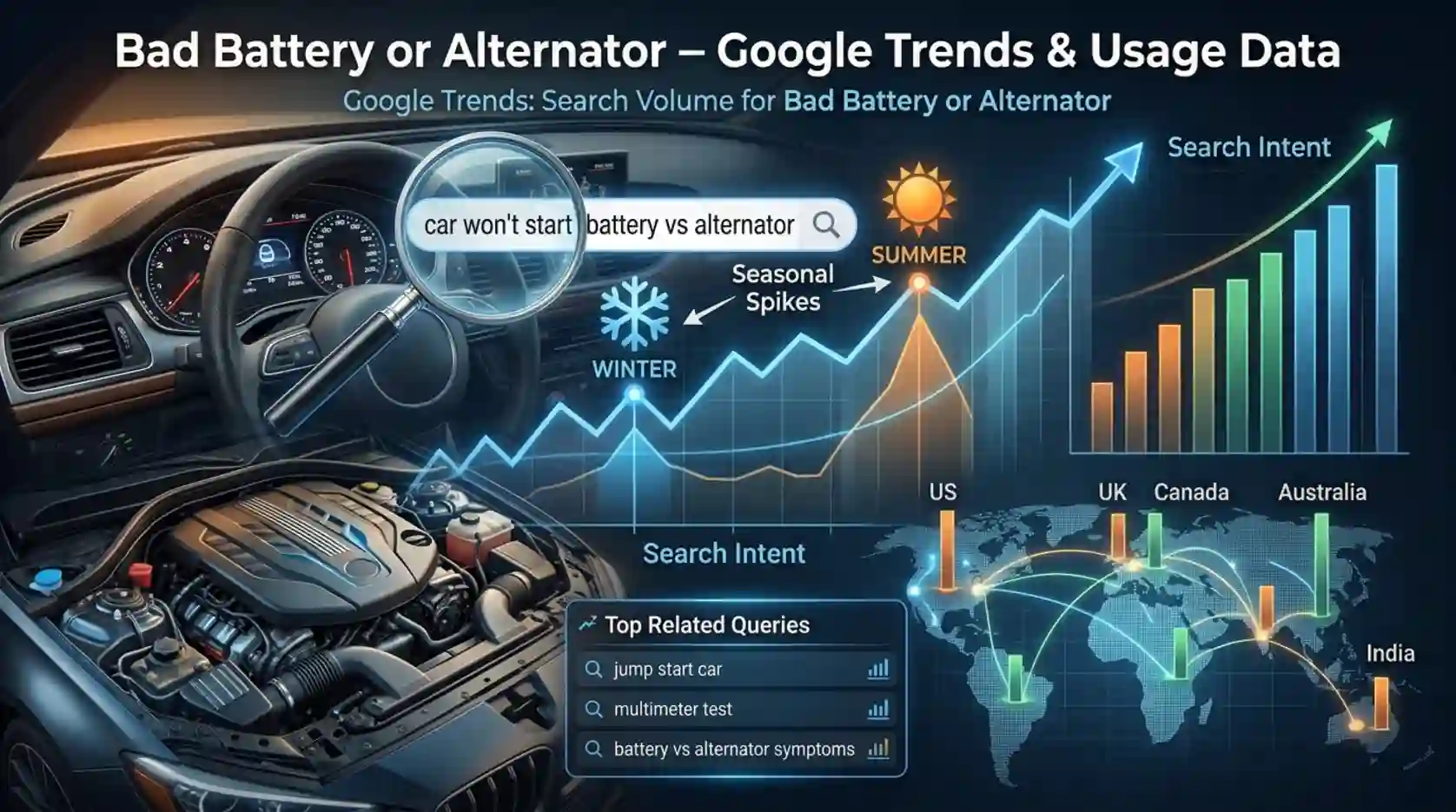
I can’t pull live Google Trends numbers here. Check trends.google.com for exact figures. Here is what usually shows up for this kind of search:
- Seasonal spikes: Searches rise in winter. Cold air weakens batteries. They also rise in summer, because heat wears batteries down.
- Countries: Interest is high in the US, Canada, UK, Australia, and India. These places have many car owners and big weather swings.
- Wording by region: US users search “dead battery.” UK users search “flat battery.”
- Intent: Most searches are urgent. People are often stuck and want a fast answer. This is why a short answer near the top works best.
- Related searches: “signs of a bad alternator,” “how to test a car battery,” “car won’t start clicking.”
Tip: Compare “bad battery” and “bad alternator” in Trends. Set the region and time range to see local patterns.
Comparison Table: Symptoms Side by Side
| Symptom | Bad Battery | Bad Alternator |
| Car won’t start | Very common | Sometimes (battery drained) |
| Clicking sound on start | Yes | Sometimes |
| Dies while driving | Rare | Common |
| Dies after a jump-start | Rarely, at first | Yes, often fast |
| Dim headlights | At start | While driving |
| Battery warning light | Sometimes | Often |
| Whining or grinding noise | No | Possible |
| Burning smell | Rare | Possible (belt or wires) |
| Swollen or leaking case | Possible | No |
| Voltage with engine running | Normal (~14 V) | Low (near 12 V) |
| Typical cost (approx.) | 100–300 | 400–1,000 |
Costs vary by car and location.
FAQs
1. How do I know if it’s a bad battery or alternator?
If the car won’t start but runs after a jump, suspect the battery. If it dies soon after a jump or while driving, suspect the alternator. A voltage test confirms it.
2. Can a bad alternator kill a new battery?
Yes. A weak alternator can’t recharge the battery. It will drain, and may be damaged for good.
3. Can I drive with a bad alternator?
Only for a short time. The car runs on battery power until it’s empty. Then it stops. Don’t drive far.
4. How long does a car battery last?
Most last about three to five years. Heat and short trips shorten that.
5. How long does an alternator last?
Often 7 to 10 years, or 100,000 miles or more. It varies a lot.
6. What does a dead battery sound like?
Often a fast clicking. Or a slow, weak crank. Sometimes there is no sound at all.
7. Does the battery light always mean a bad battery?
No. It means the charging system has a problem. The alternator, belt, or wiring may be the cause.
8. Can I test it myself?
Yes. Use a multimeter. Or visit a parts store. Many test batteries and alternators for free.
Conclusion
A bad battery and a bad alternator look alike, but they are not the same.
The battery starts the car. If your engine won’t turn over, or you hear clicks, check the battery first. Look at the cables for rust or looseness. Then test the voltage.
The alternator keeps the car running. If your car dies while driving, the lights dim, or the battery light glows, suspect the alternator. Test the voltage with the engine on. Anything near 12 volts means it is not charging.
Remember this simple rule: a jump that doesn’t last points to the alternator.
Don’t guess. A new battery won’t fix a bad alternator. And a new alternator won’t fix a dead battery. Test first. Spend second.
Use local words your readers know: “flat battery” in the UK, “dead battery” in the US. But the parts and the tests are the same everywhere.
If you feel unsure, ask a mechanic. A quick check is cheap. A tow truck is not. Fix the real problem once, and you will be back on the road with confidence.