
You are planning a trip. You type “seaside or weather” into Google. Maybe you want to know if you should visit the coast or check the forecast. Maybe you want to know which word fits your sentence. Or maybe you mixed up two words that sound alike.
You are not alone. People search this phrase for many reasons. Some think it is a spelling choice, like color and colour, some mix up weather with whether. Some just want to plan a holiday.
This guide clears it up fast. Here is the key fact: seaside and weather are two different words. They are not two spellings of one word. Both are spelled the same in the US and the UK. But people use them in different ways.
We will show you the meaning, the history, the common mistakes, and real examples. You will leave knowing which word to use, and when.
Short on time? Jump to the quick answer. Want the full story? Keep reading.
Seaside or Weather – Quick Answer
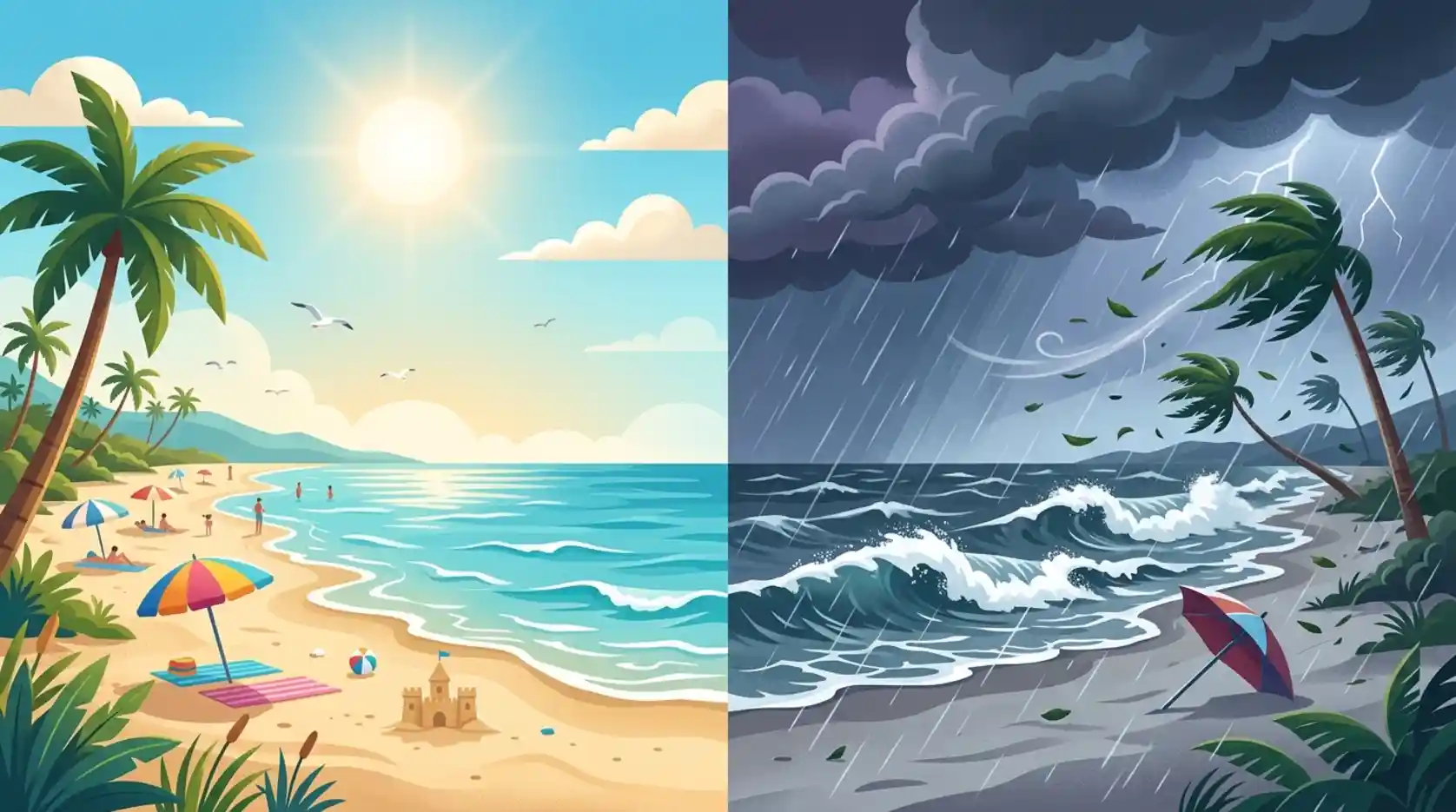
Seaside means the land next to the sea. Think beach, shore, or coast town.
Weather means the state of the air outside. Think rain, sun, wind, or snow.
They are not the same thing. You can use both in one sentence:
- “The seaside is lovely when the weather is warm.”
- “We checked the weather before our seaside trip.”
Not sure which one you need? Ask one question. Are you talking about a place? Use seaside. Are you talking about conditions in the sky? Use weather.
And if you mean “if,” as in “I don’t know if it will rain,” you want a third word: If.
The Origin of Seaside and Weather
Both words are old. Both come from Old English roots.
Seaside joins two plain words: sea and side. “Sea” comes from the Old English word sǣ. “Side” comes from sīde. Put together, they mean “the side of the sea.” The word grew common as coastal towns became holiday spots, especially in Britain.
Weather comes from the Old English word weder. It meant wind, air, or storm. Many old Germanic languages had a similar word. That is why you see it in German (Wetter) and Dutch (weer).
Why do people mix them up? Seaside has no sound-alike word. The trouble is with weather. It shares its sound with two other words:
| Word | Old English root | Meaning |
| weather | weder | Sky and air conditions |
| If | hwæther | “If” or “either way” |
| wether | wether | A male sheep (rare) |
All three sound the same today. They have three spellings and three meanings. That is where most spelling errors begin.
British English vs American English Spelling
Here is the good news. Seaside and weather are spelled the same in both. No “ou” versus “o.” No “-ise” versus “-ize.” One spelling each.
The real difference is not spelling. It is word choice.
- Britons say seaside a lot. It is a warm, familiar word. Think seaside towns, seaside holidays, and seaside piers.
- Americans say beach, shore, or coast more often. “Seaside” sounds a little old-fashioned or British to many Americans. They still understand it.
| Feature | British English | American English |
| Spelling of “seaside” | seaside | seaside |
| Spelling of “weather” | weather | weather |
| Common word for the place | seaside | beach, shore, coast |
| Common phrase | “a day at the seaside” | “a day at the beach” |
| Weather talk | Very common small talk | Common, often tied to region |
| Hyphen or space? | One word | One word |
Remember: don’t write “sea side” or “sea-side.” The standard form is one word.
Which Spelling Should You Use?
Since the spelling is the same, your real choice is word choice. Think about your reader.
Writing for a US audience:
- Use beach or shore for most travel writing.
- Use seaside when you want a classic, charming tone.
- Use weather as normal.
For a UK or Commonwealth audience:
- Seaside is the natural pick.
- You can also use coast or beach.
- Use weather as normal.
Writing for a global audience:
- Beach and coast are the safest words.
- Use seaside when you want a gentle, holiday feel.
- Keep sentences short and clear.
SEO tip: If your page targets a UK audience, use “seaside.” If it targets the US, use “beach” as the main word. Add “seaside” as a helper word.
Common Mistakes with Seaside and Weather
Here are the errors people make most often.
| Mistake | Fix |
| “I don’t know weather to go.” | “I don’t know If to go.” |
| “If is sunny today.” | “The weather is sunny today.” |
| “We stayed at the sea side.” | “We stayed at the seaside.” |
| “A sea-side hotel” | “A seaside hotel” |
| “The wether was awful.” | “The weather was awful.” |
| “Seaside” and “weather” as spelling twins | They are two different words. |
| Capitalizing “Seaside” mid-sentence | Use lowercase unless it starts a name. |
A simple trick: Weather has “eat” inside it. Think of food, a picnic, or the sky. “If” has “he” and “her” in it. Think of choices between two things.
Seaside and Weather in Everyday Examples
Email:
- “Hi Sam, the weather looks great for Saturday. Shall we meet at the seaside café?”
- “Please let me know If you can join us.”
News headline:
- “Seaside towns brace for stormy weather.”
- “Weather office warns of high winds along the coast.”
Social media:
- “Seaside sunsets never get old. 🌅”
- “Weather said rain. We went anyway.”
Formal writing:
- “The seaside economy depends heavily on seasonal weather.”
- “The committee will decide If to approve the plan.”
Travel blog:
- “The best seaside walks happen in spring, when the weather is mild.”
Seaside or Weather – Google Trends & Usage Data

I can’t see live Google Trends data from here, so I won’t make up numbers. Here is what is generally true, and how you can check it yourself.
What to expect:
- “Weather” is one of the most searched words online. People check it every day. Its searches rise during storms, heat waves, and holidays.
- “Seaside” is searched far less. It rises in summer and during school breaks.
- “If” vs “weather” is a classic grammar question. It spikes around exam seasons and school terms.
- Countries: “Seaside” tends to be used more in the UK, Ireland, and Commonwealth countries. “Beach” tends to lead in the US.
How to check real data:
- Go to Google Trends.
- Enter “seaside” and “weather” as two terms.
- Set the region (US, UK, or worldwide).
- Compare “seaside,” “beach,” and “coast” together.
Treat any numbers you read elsewhere with care. Always check the date and region.
Comparison Table: Keyword Variations Side by Side
| Term | Part of speech | Meaning | Correct? | Example |
| seaside | noun / adjective | Land by the sea | ✅ | “A seaside town” |
| sea side | two words | Not standard | ❌ | — |
| sea-side | hyphenated | Not standard | ❌ | — |
| beach | noun | Sandy or pebbly shore | ✅ | “A sunny beach” |
| coast | noun | Land along the sea | ✅ | “The Pacific coast” |
| weather | noun | Sky and air conditions | ✅ | “Nice weather today” |
| If | conjunction | “If” | ✅ | “If you go or stay” |
| wether | noun | A male sheep | ✅ (rare) | “A wether grazed.” |
Frequently Asked Questions
1. Are “seaside” and “weather” the same word?
No. Seaside is a place near the sea. Weather is the state of the air.
2. Is “seaside” British or American English?
It is used in both. It feels more natural in British English. Americans usually say “beach” or “shore.”
3. Is it “seaside” or “sea side”?
Write it as one word: seaside.
4. What is the difference between weather and If?
Weather is about rain, sun, and wind. If means “if.” They sound the same but mean different things.
5. Does “weather” have a different US and UK spelling?
No. It is spelled weather in both.
6. What is a “wether”?
A wether is a castrated male sheep. It is a rare word. Most people never need it.
7. Can I use “seaside” and “weather” in one sentence?
Yes. For example: “The weather was perfect at the seaside.”
8. Which word is better for SEO, “seaside” or “beach”?
It depends on your audience. Use “seaside” for UK readers. Use “beach” for US readers. Add the other as a helper word.
Conclusion
Let’s sum it up. “Seaside or weather” is not a spelling puzzle. These are two separate words. Seaside is a place by the sea. Weather is what the sky is doing.
Neither word changes spelling between US and UK English. The only real difference is how people choose their words. Britons love “seaside.” Americans lean toward “beach” and “shore.”
The most common mistake is mixing up weather and If. Remember this: weather is about the sky. If is about a choice.
Also remember to write seaside as one word. Don’t add a space or a hyphen.
If you write for the UK or Commonwealth, use “seaside” with confidence, if you write for the US, lead with “beach” and use “seaside” for charm. If you write for the whole world, keep it simple and clear.
Check your sentence before you hit send. Ask yourself: is it a place, a sky, or a choice? That one question will keep your writing sharp, correct, and easy to read.