It is October. Kids pick costumes. Parents buy candy. And someone types a question into Google: is it “trick or treating Halloween” or “trick-or-treating on Halloween”?
You are not alone. Millions of people search this phrase every fall. Some want to know what it means. Some want to know where it came from. Many just want to spell it right. Should there be hyphens? Is Halloween always capitalized? Do the US and UK write it the same way?
The phrase looks simple, but it mixes a verb, a noun, and a holiday name. That makes it tricky. Writers get it wrong in emails, school notes, and news stories.
This guide clears it up. You get a quick answer first. Then you learn the history, the spelling rules, and the common mistakes. You see real examples and comparison tables. And you get clear advice on which form to use for your audience.
Read on. By the end, you will write it with confidence this Halloween and every one after.
Trick or Treating Halloween – Quick Answer
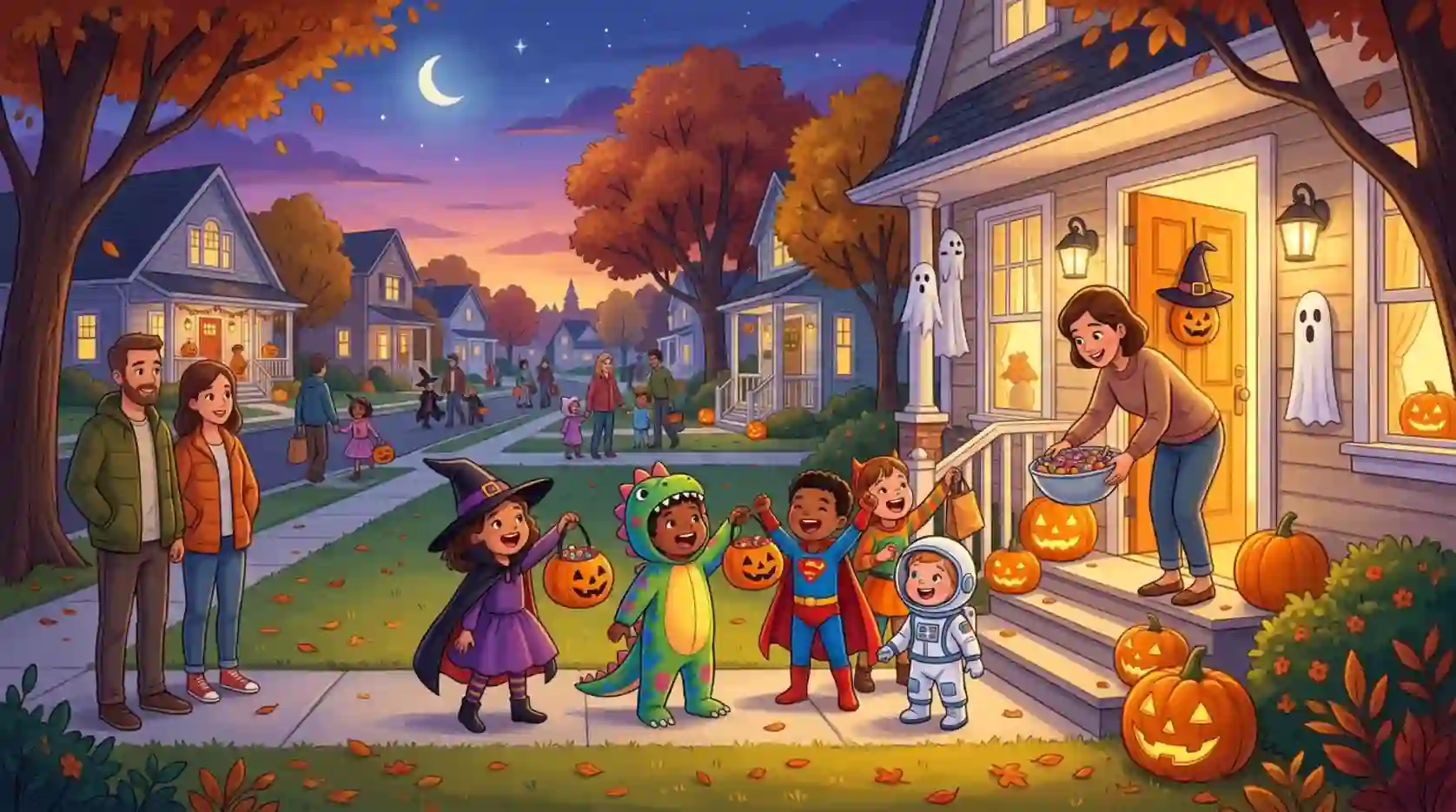
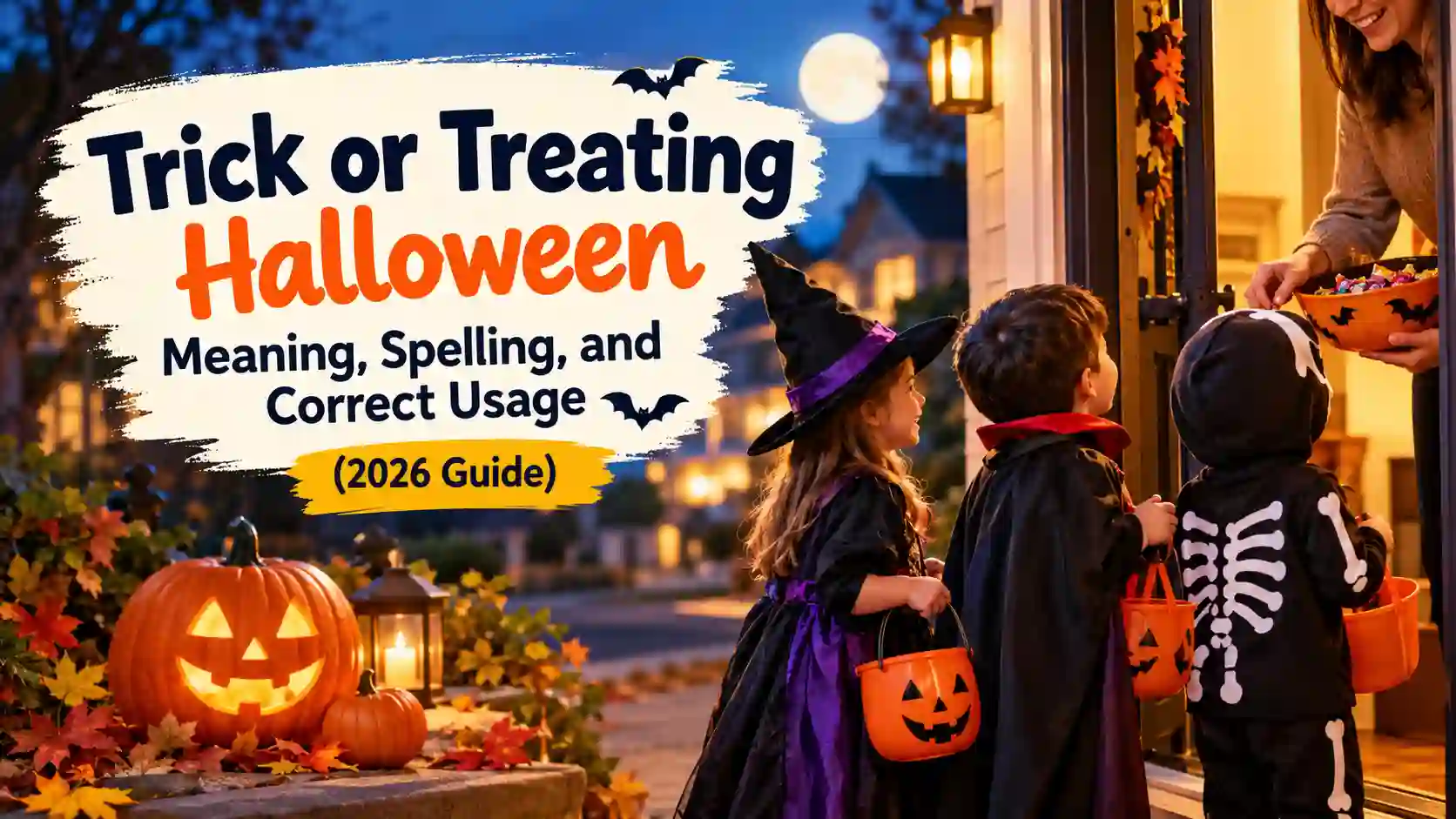
Trick-or-treating is the Halloween custom where children dress up, go door to door, and say “Trick or treat!” Neighbors give them candy.
The most widely accepted spelling is trick-or-treating (with hyphens), especially in American English. Many people in the UK and elsewhere write trick or treating (no hyphens). Both are understood everywhere.
Examples:
- “The kids went trick-or-treating on Halloween night.”
- “We are trick or treating at six.”
- “She is a trick-or-treater this year.”
- “Trick or treat!” (said at the door)
Always capitalize Halloween. It is the name of a holiday.
The Origin of Trick or Treating Halloween
Halloween comes from “All Hallows’ Eve.” That is the night before All Saints’ Day on November 1. The word “Hallow” is an old word for “saint.” Over time, “All Hallows’ Eve” shrank to “Hallowe’en,” and then to “Halloween.”
The custom of going door to door is older than the phrase. In Britain and Ireland, people went “souling.” They begged for small cakes and sang prayers for the dead. In Scotland and Ireland, children went “guising.” They wore costumes and performed songs or jokes for treats.
Immigrants brought these habits to North America. The phrase “trick or treat” appeared in print in the 1920s and 1930s. One of the earliest known uses was in Canada in 1927. By the 1950s, trick-or-treating was a normal part of American Halloween.
Why do spellings differ? The phrase is fairly new. It became a verb (“to trick-or-treat”) only after the custom spread. Dictionaries and style guides then made different choices about hyphens. Older British writing also used the apostrophe form “Hallowe’en.” That is rare today.
British English vs American English Spelling
The big difference is the hyphen. American sources lean toward hyphens. British sources often skip them. Neither is wrong.
| Feature | American English | British English |
| Activity | trick-or-treating | trick or treating (also trick-or-treating) |
| Verb | to trick-or-treat | to trick or treat |
| Person | trick-or-treater | trick or treater |
| Holiday | Halloween | Halloween (old style: Hallowe’en) |
| Shouted phrase | “Trick or treat!” | “Trick or treat!” |
| Common local term | trick-or-treating | trick or treating, guising (Scotland and Ireland) |
Key rule: The shouted phrase “Trick or treat!” never needs hyphens. Hyphens appear when the phrase works as a verb, noun, or adjective.
Which Spelling Should You Use?
Pick based on your reader.
- US audience: Use trick-or-treating. This matches major US dictionaries and news style.
- UK, Ireland, Australia, and Commonwealth audience: Either works. Trick or treating is common. Use trick-or-treating if your brand style guide says so.
- Global audience: Use trick-or-treating. It is the most widely seen form online.
- Formal writing: Follow your style guide. Check it for hyphen rules.
- SEO tip: People search both ways. Use your main form in the title. Mention the other form once in the text.
Whatever you choose, stay consistent in one piece of writing.
Common Mistakes with Trick or Treating Halloween
| Mistake | Correction |
| halloween | Halloween (capital H) |
| trick or treating, trick-or-treating, and trick or treat-ing in one article | Pick one form and keep it |
| trick-or-treat’ing | trick-or-treating |
| tricks or treats | trick or treat (the phrase does not change) |
| trick or treater’s | trick-or-treaters’ (plural possessive) |
| “I’m going to trick or treat Halloween.” | “I’m going trick-or-treating on Halloween.” |
| Hallowe’en in modern US text | Halloween |
| “Trick-or-treat!” at the door, in dialogue | “Trick or treat!” |
A quick fix: If the words act as one idea, join them with hyphens. If you are quoting the shout, leave them apart.
Trick or Treating Halloween in Everyday Examples
Email (to parents):
“Dear parents, our school will host a safe trick-or-treating event on Halloween. Kids should wear costumes.”
News headline:
“Cities Set Trick-or-Treating Hours for Halloween Night”
Social media:
“Just back from trick or treating! 🎃 Best candy haul ever. #Halloween”
Formal writing:
“Trick-or-treating is a popular Halloween tradition in North America.”
Neighborhood notice:
“Porch lights on means trick-or-treaters are welcome.”
Text message:
“Are we still going trick or treating at 6?”
Notice how the tone changes. Formal writing and news lean toward hyphens. Texts and social posts are more relaxed.
Trick or Treating Halloween – Google Trends & Usage Data

I cannot pull live Google Trends numbers here. You can check them free at trends.google.com. These are the patterns you will typically see:
- Seasonal spike: Search interest rises through October. It peaks in the final days before October 31. It falls sharply on November 1.
- By country: Interest is strongest in the United States and Canada, where the custom is biggest. The UK, Ireland, and Australia also show a clear yearly rise.
- By context: People search for hours, safety tips, costume ideas, and the meaning and spelling of the phrase.
- Spelling forms: “Trick or treat” is the broadest search. “Trick or treating” and “trick-or-treating” follow. Search tools often treat hyphens and spaces as the same.
What this means for you: Publish early in October. Update the page each year.
Keyword Variations Side by Side
| Variation | Type | Typical use |
| trick or treat | noun, verb, shout | “Trick or treat!” |
| trick-or-treat | verb, adjective | “a trick-or-treat bag” |
| trick or treating | activity | UK and casual writing |
| trick-or-treating | activity | US and formal writing |
| trick or treating Halloween | search phrase | Online queries |
| trick-or-treating on Halloween | full correct phrase | Articles and notices |
| trick-or-treater | person | “Three trick-or-treaters came by.” |
FAQs
1. What does trick or treating mean?
It is a Halloween custom. Children in costume visit homes and ask for candy. The phrase suggests that if they get no treat, they might play a trick.
2. Is it trick-or-treating or trick or treating?
Both are used. Trick-or-treating is more common in US writing. Trick or treating is common in the UK.
3. Is Halloween capitalized?
Yes. Always write Halloween with a capital H.
4. When is Halloween in 2026?
Halloween is on October 31. In 2026, that is a Saturday.
5. What is the plural of trick-or-treater?
It is trick-or-treaters. The possessive plural is trick-or-treaters’.
6. Is “trick or treat” a verb?
Yes. You can say, “The children trick-or-treat every year.” It is also a noun and a shout.
7. Do people outside the US go trick or treating?
Yes. Canada has a long tradition. It has grown in the UK, Ireland, and Australia. Scotland and Ireland also have the older custom of guising.
8. Where did the phrase come from?
It grew out of older door-to-door customs like souling and guising. The phrase itself appeared in print in North America in the 1920s and 1930s.
Conclusion
Trick or treating Halloween is a simple idea with a few spelling traps. Here are the key points.
Trick-or-treating is the safest, most widely accepted form. It is the standard in American English and the best choice for a global audience. Trick or treating is common in British English and is not wrong. The shouted phrase, “Trick or treat!”, never takes hyphens.
Always capitalize Halloween. Use trick-or-treaters for the plural. Avoid old forms like “Hallowe’en” unless you want a vintage feel.
The custom has deep roots. Souling and guising came first. The modern phrase grew in North America and spread worldwide.
Your best move: Pick one form for your reader. Use it every time. Check your style guide if you write for work.
Now you know what the phrase means, where it came from, and how to write it. Have a safe, fun, and well-spelled Halloween.