You are writing a sentence. You want to say that one person did something alone. Then you stop. Is it “theirself” or “themself”? Or should you write “themselves”?
You are not alone. Many people hit this wall. The singular “they” is now common in speech and writing, but the grammar rules have not caught up in everyone’s mind. That leaves a gap, and people search to fill it.
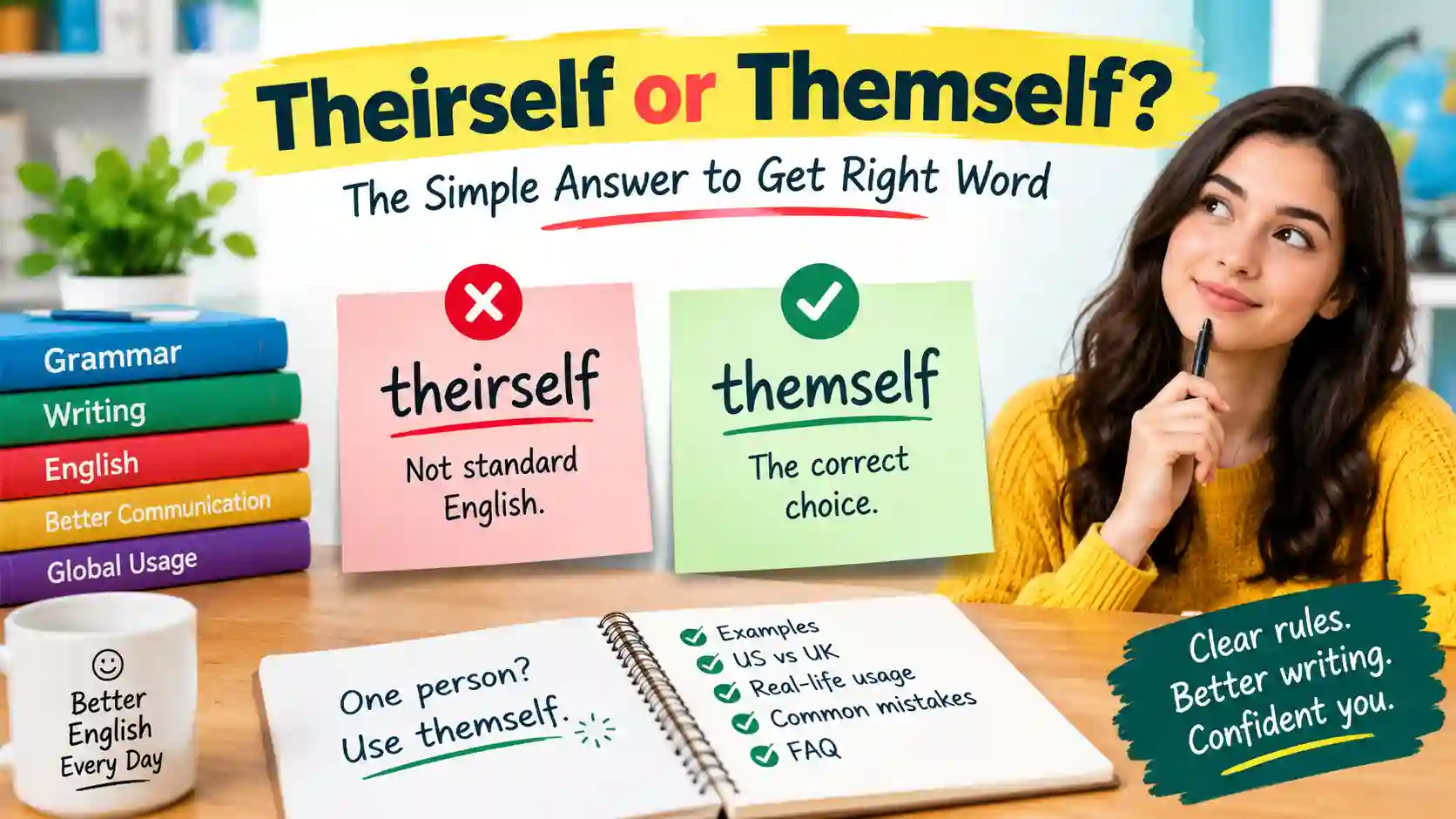
This article gives you the answer fast. The short version: “themself” is the correct choice. “Theirself” is not standard English.
You will also learn where each word came from and you will see how US and UK writers treat them. You will learn which one suits your reader and which mistakes to avoid. There are real examples for emails, news, social posts, and formal writing. There is also a comparison table and a full FAQ.
Read on, and you will never second-guess this word again.
Theirself or Themself – Quick Answer
Use “themself.” It is the standard reflexive form of singular “they.”
Do not use “theirself.” Most dictionaries and style guides do not accept it. It is mostly heard in casual or regional speech.
Here are examples:
- Correct: “Each person must introduce themself to the group.”
- Correct: “Someone locked themself out of the building.”
- Correct: “My friend taught themself to code.”
- Incorrect: “Each person must introduce theirself.”
One more option is safe in every case: “themselves.” Many style guides prefer it for formal writing, even with a single person. If you want zero risk, use it.
The Origin of Theirself or Themself
“Themself” is not new. It appeared in English as early as the 1300s. Writers used it for one person of unknown gender, much like we do today.
Then things changed. In the 1500s, grammar teachers decided that “self” should match a singular word. “Themselves” has a plural ending, so they pushed it out. For a long time, “themself” looked wrong to many editors.
In the last few decades, “themself” has come back. The reason is simple. People now use singular “they” for one person, including someone who uses “they” as a personal pronoun. A singular word wants a singular “self,” so “themself” fits.
“Theirself” has a different story. It comes from mixing “their” and “self,” the way “myself” and “yourself” are built. It appears in dialect and casual speech. But “their” is not the form that reflexive pronouns follow. Compare “himself” and “itself,” which use the object form (him, it), not the possessive. That is why “themself” fits the pattern and “theirself” does not.
Why do spelling differences exist? Because English has no single rule-maker. Speakers made up forms, and editors later chose which ones to keep.
British English vs American English Spelling
Here is a surprise. This is not a true US vs UK spelling split. Unlike “color” and “colour,” there is no “American” and “British” version of “themself.” The real difference is how much each side accepts it.
| Feature | American English | British English |
| “Themself” | Growing acceptance, especially in newer dictionaries | Accepted in some places, less common |
| “Themselves” (for one person) | Common in formal writing | Common in formal writing |
| “Theirself” | Nonstandard | Nonstandard |
| Style tone | Often more open to change | Often more careful |
| Safe choice | “Themselves” or “themself” | “Themselves” |
Spelling rules do not change the word itself. “Themself” is spelled the same on both sides of the Atlantic. What changes is the comfort level of editors, and style guides do not all agree.
Which Spelling Should You Use?
Pick the word based on your reader.
For a US audience: Use “themself” in modern, everyday writing. Use “themselves” if your publisher follows a strict style guide.
For a UK or Commonwealth audience: “Themselves” is the safer pick. “Themself” is understood, but some editors may flag it.
For a global audience: Choose “themselves,” or rewrite the sentence. For example, “Each person must introduce themselves” works everywhere.
In Formal and Everyday Writing: Check the style guide first. If there is none, “themselves” is the lowest-risk choice.
In all cases: Avoid “theirself.”
A good rule: when in doubt, write around it. “Everyone should check the form before signing” has no reflexive pronoun at all.
Common Mistakes with Theirself or Themself
Using “Theirself” Instead of “Themself”
- Wrong: “A person should protect theirself.”
- Right: “A person should protect themself.” (or “themselves”)
When “Themself” Refers to Multiple People
- Wrong: “The students pushed themself too hard.”
- Right: “The students pushed themselves too hard.”
Plural means “themselves.” Always.
Why “Theirselves” Is Incorrect
- Wrong: “They did it by theirselves.”
- Right: “They did it by themselves.”
Mixing Singular and Plural Reflexive Forms
- Wrong: “Each student should ask themself if they are ready, then prepare themselves.”
- Right: “Each student should ask themself if they are ready, then prepare.”
Using a Reflexive Pronoun When It Is Not Needed
- Wrong: “Please send the form to John or themself.”
- Right: “Please send the form to John or them.”
A reflexive pronoun is only for when the person does something to themself.
Theirself or Themself in Everyday Examples
Email:
“If a client cannot log in, ask them to reset the password themself. If they get stuck, we will help.”
News writing:
“The suspect turned themself in to police on Tuesday.” (Many outlets would write “turned themselves in.”)
Social media:
“My coworker just taught themself guitar in a month. I’m so impressed!”
Formal writing:
“A candidate who wishes to withdraw must notify the office themselves.”
Casual speech (not recommended in writing):
“He said somebody hurt theirself.” This is how you may hear it, but do not copy it into text.
Notice the pattern. “Themself” works well in friendly, modern writing. “Themselves” works everywhere. “Theirself” works nowhere in print.
Theirself or Themself – Google Trends & Usage Data
I did not pull live Google Trends numbers for this article, so the points below describe general patterns. Check Google Trends yourself for exact, up-to-date figures.
- Search interest: People tend to search “theirself or themself” when they are unsure about the grammar. Searches often rise during school and work seasons, when people write essays and reports.
- By country: Interest tends to be strongest in English-speaking countries such as the US, UK, Canada, Australia, and India. Many learners of English also search this phrase.
- By context: Questions about “themself” often connect to singular “they” and inclusive language. Questions about “theirself” usually come from people who heard it in speech and wonder if it is real.
- In published writing: “Themselves” is still the most common form for one person. “Themself” is smaller but growing. “Theirself” is very rare in edited text.
Comparison Table: Keyword Variations Side by Side
| Form | Standard? | Used for | Example | Verdict |
| Themself | Yes, increasingly | One person (singular they) | “Someone hurt themself.” | Good |
| Themselves | Yes | Many people, or one person in formal use | “They hurt themselves.” | Safest |
| Theirself | No | Casual or dialect speech | “He hurt theirself.” | Avoid |
| Theirselves | No | Dialect speech | “They did it theirselves.” | Avoid |
| Himself / Herself | Yes | One person, known gender | “She hurt herself.” | Good |
FAQs
1. Is “theirself” a real word?
It shows up in speech and some dictionaries label it nonstandard. Do not use it in school, work, or published writing.
2. Is “themself” correct?
Yes. It is the singular reflexive form of “they,” and major dictionaries now list it.
3. Should I use “themself” or “themselves” for one person?
Both can be right. “Themself” is clearer for a single person. “Themselves” is safer in formal writing.
4. Is “themself” accepted in British English?
It is understood and used, but less common. UK editors often prefer “themselves.”
5. Can “themself” be used for a person who uses they/them pronouns?
Yes. Many people who use “they/them” also use “themself,” and it is a respectful choice.
6. Why do some editors dislike “themself”?
Older rules said a plural-looking pronoun should match “they.” Some style guides still follow that rule.
7. How can I avoid the problem?
Rewrite the sentence. Instead of “Each person should look after themself,” try “Each person should take care.”
Conclusion
Here is what to remember. “Themself” is the correct form when you mean one person and use singular “they.” It has a long history in English and has returned to modern use. “Theirself” is not standard, and you should skip it. The same goes for “theirselves.”
If you want the safest choice, use “themselves.” It works for one person or many, and almost every style guide accepts it. If you want to be clear and modern, use “themself” for a single person.
Think about your reader. For US audiences, “themself” is fine in everyday writing and for UK, Commonwealth, or global readers, “themselves” is often better. For formal papers, check the style guide.
Finally, remember the easy trick: rewrite the sentence so you do not need the word at all. Short, clear sentences are always a win.
Now you know the answer. Write with confidence.