You are typing a sentence. You stop. Is it “this” or “these”? Even native speakers pause here.
People search for “this or these” because they want a fast, safe answer. They do not want a long grammar lesson. Some think it is a spelling problem. Others wonder if British and American English use the words differently. Many get stuck on tricky words like “data,” “news,” and “series,” which look plural but do not always act that way.
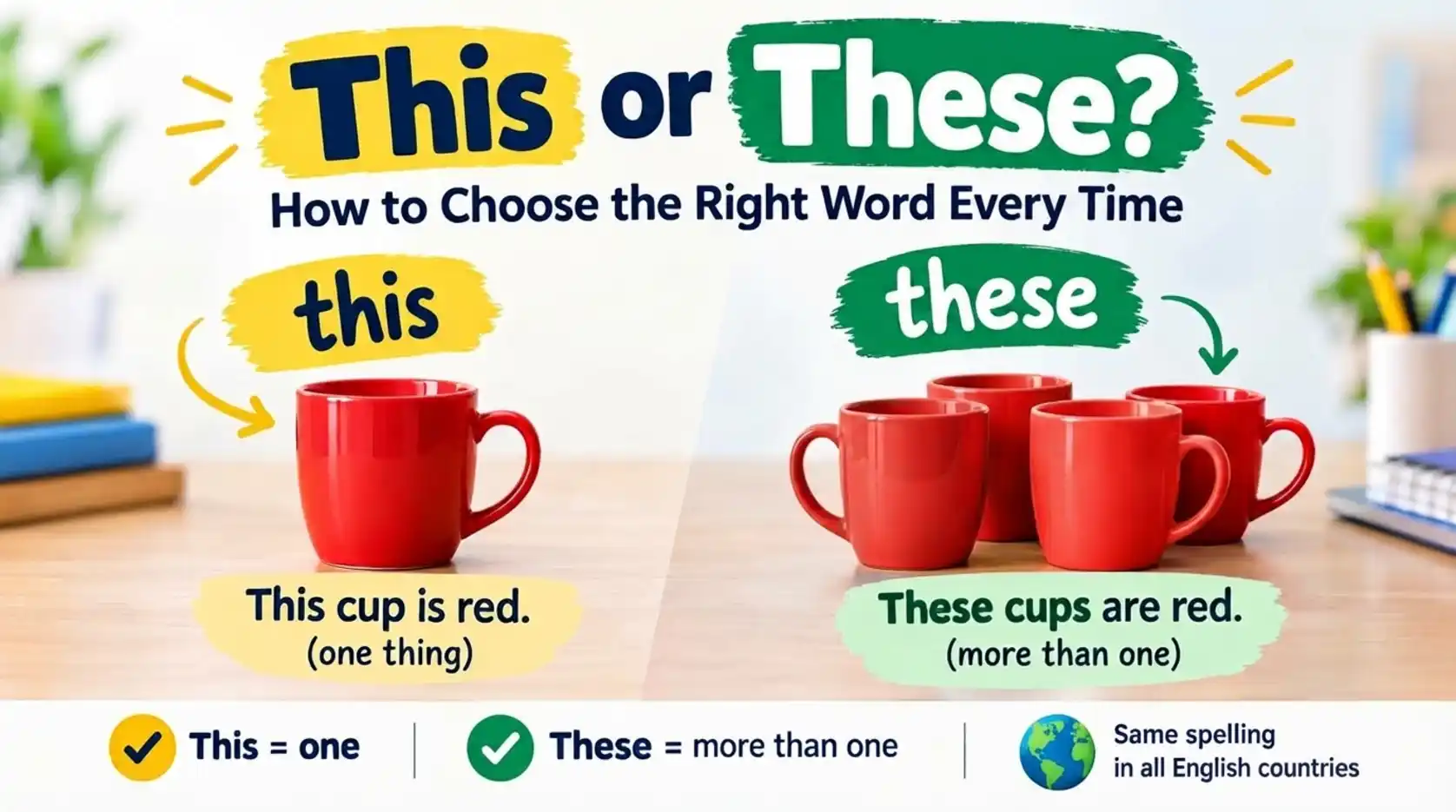
Here is the good news. The rule is simple. “This” points to one thing. “These” points to more than one. Both words are spelled the same in every English-speaking country. There is no British or American version.
This guide clears up the confusion. You will get a quick answer, the history of each word, and a spelling comparison. You will also see common mistakes, real examples, and answers to common questions. By the end, you will choose the right word without a second thought.
This or These – Quick Answer
Use “this” for one person, place, thing, or idea. Use “these” for two or more.
- This book is good. (one book)
- These books are good. (many books)
- This apple is red. (one apple)
- These apples are red. (many apples)
Both words point to something close to you. Their partners, “that” and “those,” point to something far away.
| Near | Far | |
| One | this | that |
| More than one | these | those |
Quick test: Look at the noun after the word. Is it one? Use “this.” Is it more than one? Use “these.” The verb must match: “This is” and “These are.”
The Origin of “This” and “These”
Both words are very old. They come from Old English, the language spoken over 1,000 years ago.
“This” comes from the Old English word þis. That letter, þ, is called “thorn.” It made the “th” sound. Over time, people dropped the old letter and wrote “th.”
“These” comes from the Old English plural þās. That same word also gave us “those.” For a long time, “these” and “those” were close cousins. Later, English speakers gave them separate jobs. “These” became the word for things near you. “Those” became the word for things far away.
Why do spelling differences exist? For these two words, they do not. English spelling changed a lot in the Middle Ages, but “this” and “these” settled into one form. Today, the UK, the US, Canada, Australia, and India all spell them the same way.
British English vs American English Spelling
The spelling is identical. There is no “thys” or “theese” in any standard English. People often expect a difference because other words do change, like “colour” and “color.”
| Word | British English | American English |
| this | this | this |
| these | these | these |
| that | that | that |
| those | those | those |
Here are words that do differ between the two, for comparison:
| British | American |
| colour | color |
| organise | organize |
| centre | center |
| whilst | while |
The rule for “this” and “these” is the same everywhere. The only small difference is style. Some writers in the UK use “whilst” or “amongst.” Neither affects “this” or “these.”
Which Spelling Should You Use?
Use the standard spelling. It never changes.
- US readers: Use “this” and “these” as shown.
- UK and Commonwealth readers: Use the same words. Nothing changes.
- Global readers: Use the same words. They are safe in every country.
What does change by audience is the style around the words. In science writing, “these data” is common. In daily speech, many people say “this data.” Both are accepted. Pick one and stay consistent.
Common Mistakes with “This or These”
1. Mixing singular and plural
- Wrong: These book is new.
- Right: This book is new. / These books are new.
2. Using “these” with “news”
“News” is singular, even though it ends in “s.”
- Wrong: These news are sad.
- Right: This news is sad.
3. Using “this” with “kinds” or “types”
- Wrong: This kinds of cars are fast.
- Right: This kind of car is fast. / These kinds of cars are fast.
4. Using “this” with plural time words
- Wrong: I have waited this three days.
- Right: I have waited these three days.
5. Getting stuck on “data,” “media,” and “series”
- “This data is useful” is fine in most writing.
- “These data are useful” is fine in science and formal papers.
- “Series” is the same in singular and plural. Say “this series” or “these series.”
6. Wrong verb after the word
- Wrong: These is my keys.
- Right: These are my keys.
“This or These” in Everyday Examples
- “Please review this file before Monday.”
- “I have attached these documents for your records.”
News
- “These measures will start next week.”
- “This decision affects millions of people.”
Social media
- “This is my favorite song right now.”
- “These shoes are everything.”
Formal writing
- “This study tests a new method.”
- “These results show a clear pattern.”
Everyday talk
- “Can you pass me this pen?”
- “Look at these photos from our trip!”
“This or These” – Google Trends & Usage Data
I cannot pull live Google Trends numbers here, so I will not make any up. You can check the real data at trends.google.com by searching “this or these.” Here is what you can expect to see and why.
- Steady interest: Grammar questions like this stay popular all year. They do not spike with news events.
- Learner-heavy regions: Searches usually come from countries with many English learners and students, such as India, Pakistan, the Philippines, Nigeria, and Bangladesh. The US and UK also show steady searches.
- Peaks during school terms: Interest tends to rise when exams and homework are active.
- Context: People search this phrase for homework, for work emails, and for essays. Most want a quick rule, not a long lesson.
Tip: In Google Trends, compare “this or these” with “that or those.” Then filter by country and by “past 5 years” for a clear picture.
Comparison Table: Keyword Variations Side by Side
| Word | Number | Distance | Example |
| this | Singular | Near | This chair is mine. |
| these | Plural | Near | These chairs are mine. |
| that | Singular | Far | That chair is his. |
| those | Plural | Far | Those chairs are his. |
| Tricky Noun | Use | Example |
| news | this | This news is good. |
| series | this / these | These series are popular. |
| data | this / these | This data is clear. |
| people | these | These people are kind. |
| information | this | This information helps. |
| glasses (eyewear) | these | These glasses are new. |
FAQs
1. What is the difference between “this” and “these”?
“This” is for one thing. “These” is for more than one. Both point to things that are close.
2. Is “these” the plural of “this”?
Yes. “These” is the plural form of “this.”
3. Is there a British and American spelling of “these”?
No. Both spell it “these.” There is no difference.
4. Can I say “this data” or must I say “these data”?
Both are correct. “This data” is common in daily and business writing. “These data” is common in science and formal papers.
5. Why is “this news” correct, not “these news”?
“News” is a singular noun. It ends in “s,” but it means one thing. So it takes “this.”
6. Do I say “this kind of things” or “these kinds of things”?
Say “this kind of thing” or “these kinds of things.” Keep the word and the noun matched.
7. What is the difference between “these” and “those”?
“These” points to things near you. “Those” points to things far away.
8. Which one do I use with “people”?
Use “these.” “People” is plural. Say “these people.”
Conclusion
Choosing between “this” and “these” is easy once you know the rule. Use “this” for one thing. Use “these” for more than one. Look at the noun, then match the verb. “This is” and “These are.”
You also learned that there is no spelling split. British, American, and global English all use the same two words. Both come from Old English, and they have been stable for hundreds of years.
The tricky cases are few. “News” and “information” take “this.” “People” and “glasses” take “these.” “Data” and “series” can go either way, so pick one style and keep it. Avoid the common slips, like “these book” or “this kinds.”
Here is the best advice. When you are unsure, find the noun. Count it. One means “this.” More than one means “these.” That small habit will keep your emails, essays, and posts clean and professional. Save this guide, and use it whenever you pause at the keyboard.